What Is Network Architecture?
- What is network architecture?
- What are the benefits of a strong network architecture?
- What are the types of network architecture?
- How does computer network architecture work?
- How does cloud network architecture work?
- What are network architecture best practices?
- How can AWS support your network architecture requirements?
What is network architecture?
Network architecture is the strategic design of how network devices, services, and software are organized and interconnected. The goal of network architecture is to achieve effective network performance, security, scalability, and reliability. Network architecture defines both the physical and logical structures of a network. Well-designed network architecture balances capabilities such as low latency, high throughput, fault tolerance, and efficient resource utilization, while adhering to security policies.
What are the benefits of a strong network architecture?
A well-designed network architecture can help make sure that your network operates efficiently, with benefits in performance, security, and operational visibility.
Predictable performance
The practice of network architecture design helps provide more consistent network performance, so users can access networks reliably. Performance gains come from applying consistent design patterns and quality-of-service policies.
Fault tolerance
When designing a network architecture, avoid creating single points of failure. Network devices should perform reliably during unexpected outages or high traffic states. To prevent single points of failure, network engineers can install dual power supplies for critical infrastructure, create multiple uplinks for critical connections, or institute failover mechanisms in the case that important hardware shuts down.
Segmentation for security
Security is often embedded into the structure of a well-architected network infrastructure, including within virtual private networks. Network engineers can segment network traffic to prevent lateral movement of network events from one system to another. For example, a customer-facing sales team might have access to one segment, and an internal accounting team operates on another segment. If an external security threat affects an external-facing system, it won’t be able to reach more interior systems; the rest of the network remains guarded.
Resource optimization
Well-architected computer networks are efficient in their use of all resources. These resources can include bandwidth, computing capacity, device utilization, and cloud resources for networking. Engineers use a combination of techniques to optimize resource levels. Common strategies for resource optimization include intelligent routing, load balancing, and network automation.
Operational visibility
Ideally, your network architecture should include comprehensive monitoring and logging capabilities. Logs and monitoring tools are some of your primary means to observe operations and identify potential network events that can affect user devices and network traffic flows in general. Visualization tools offer an overview of your network, including events and alerts.
What are the types of network architecture?
Two primary classifications help to clarify a network architecture’s structure and scope.
Communication model types
The network’s communication model defines how network devices and services interact.
Client-server architecture
In this model, clients request information and servers process and deliver the response. For example, requesting a web page. This design is common for many traditional and current network operations.
Peer-to-Peer network (P2P) architecture
Within the peer-to-peer network model, all devices, or “peers,” have equal capabilities and responsibilities; there’s no central server. Instead, each device can act as both client and server, to share resources and connect users directly with others. P2P is often used for file sharing and distributed computing applications.
Hybrid architecture
The hybrid network model combines elements of both peer-to-peer and client-server networks. It allows organizations to use centralized services where needed, and enabling direct communication between devices when appropriate.
Cloud-based architecture
This model is a different network architecture that uses cloud platforms to build scalable, globally available, and resilient networked business systems. Engineers typically design this type of network architecture using infrastructure as code (IaC), where they program network tools as software running on cloud network infrastructure, rather than using physical devices on a network. This approach can help shorten deployment times for large-scale network architectures.
Area types
The network area type describes the network's geographic scope.
Local Area Network (LAN)
A LAN connects devices within a single facility, like one office or home. Because of their size, LANs can typically provide low latency for traffic within their networks, which is ideal for internal communication, file sharing, and local application access.
Wide Area Network (WAN)
A WAN connects multiple networks, such as LANs, across a large geographic area, including between cities or countries. Organizations often use WANs to link branch offices, data centers, and cloud environments.
The Internet
The global network of interconnected LAN, WAN, and other networks uses standardized protocols, such as TCP/IP, to enable efficient communication between supported devices. The Internet architecture supports a vast range of services, from email and web browsing to cloud computing and real-time collaboration.
How does computer network architecture work?
Network architecture refers to how a network should be structured and how its key components interact to operate at peak efficiency. Network architects follow overarching design principles to deploy many software and hardware components and network protocols to achieve that goal.
Physical layer components of network architecture
All networks are built from a foundational physical layer. Engineers use cabling, commonly fiber optic or copper, to connect network switches, which direct traffic within a LAN. Routers connect the local network to other networks. Wireless access points (WAPs) enable wireless connections to end-user devices and other components. This layer also encompasses the power and cooling systems required to operate this hardware in data centers safely.
Logical routing and segmentation
The Open Systems Interconnection (OSI) model provides a framework for network functions in seven layers of abstraction. The first is the physical layer. The next two layers govern how traffic moves.
- Layer 2 (Data Link): Switches direct local communication according to the unique MAC address assigned to each device.
- Layer 3 (Network): Routers make intelligent forwarding decisions using IP addresses, the equivalent of a mailing address that is recognized within and across networks. Routers can help assign internal IP addresses, client devices can self-assign with DHCP, and in some instances, engineers or end users can manually configure IP addresses on devices.
Segmentation is the process of subdividing enterprise networks into different zones based on certain criteria. Common segmentation criteria can include work function, data sensitivity, or user roles.
Load distribution and failover
A load balancer distributes incoming traffic across multiple network resources to help prevent any one resource from being overloaded with traffic. You can implement load balancers as hardware or software.
Failover mechanisms are processes for automatically redirecting traffic from primary to secondary systems when a failure occurs. Your network monitoring services can detect an event and invoke actions on routers, load balancers, and other resources to initiate the failover.
Security enforcement points
You can embed security at multiple levels throughout network architecture. Key security reenforcement points include:
- Network perimeter: Here, firewalls and intrusion prevention systems filter traffic entering and leaving the network
- Internal segments: Microsegmentation isolates workloads on virtual private networks, so an event in one segment can't impact those in another, and helps prevent lateral movement from one resource to another
- Cloud-native controls: IaC firewalls in the cloud can function at the cloud’s edge or internally to filter traffic, whereas security groups and access control lists (ACLs) further enforce security
How does cloud network architecture work?
Cloud network architecture is designed to deliver the same core networking functions as traditional on-premises networks. The difference in cloud networking is that all network functions are virtualized, and it is typically designed for full scalability. Cloud services must typically offer greater flexibility, automation, and global reach to accommodate the scale of modern cloud workloads.
Software-defined networking (SDN)
Software-defined networking is the technology that enables clouds to operate at scale. In traditional data center networks or LANs, each device, primarily routers and switches, handles both routing decisions (the control plane) and the actual data packet forwarding (the data plane).
SDNs separate these two functions using software routers and switches in the cloud instead of physical hardware. By separating the two functions, SDNs allow you to centralize your entire network management, which would otherwise be handled across the entire distributed control plane.
Virtual private clouds (VPCs)
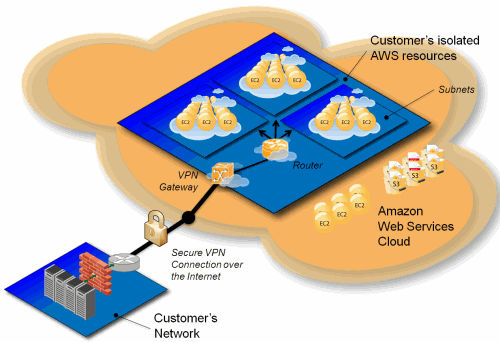
Virtual private clouds are a fundamental component of cloud network architectures. A VPC is a logically isolated section of a cloud, like AWS, where you can launch resources isolated and secured from other cloud traffic. For example, you can replicate a complex on-premises network topology in your VPC using software-defined networking to gain better scaling capabilities and more options for automating network resource automation.
What are network architecture best practices?
Designing a resilient, secure, and scalable network requires careful planning and adherence to established best practices.
Design for redundancy
Your network architecture should include redundant connections to help make sure it continues operating reliably during network events. For example, you can create multiple Availability Zones (AZs) in AWS, which are separate, isolated data centers within the AWS cloud. These AZs can take over for each other should an issue arise in one zone, helping to ensure reliable remote access.
Separate control planes from data planes
Software-defined networking implicitly helps you separate control planes from data planes. Decoupling the control and data planes can make it easier to manage cloud operations and hybrid operations when you need to scale them up. By separating traffic, control traffic doesn’t compete with user traffic, and configuration changes don’t disrupt active sessions.
Implement a zero-trust security model
Apply zero-trust principles across both on-premises and cloud environments to reduce the risk of unauthorized network events. Zero trust contrasts with traditional perimeter-based security. Zero trust is a security model that assumes no user or device is trusted by default, regardless of their stated credentials and where they are on your internal network. Every access request is reauthenticated and reauthorized at every network asset checkpoint and resource.
Monitor and log traffic
Use tools like Amazon CloudWatch to aggregate logs into a central system for analysis, alerting, and any necessary compliance reporting.
Version and test configuration changes before deployment
In cloud networking, you can use Infrastructure as Code (IaC) tools to define, version, and test changes in isolated environments before applying them to production. IaC allows rapid testing of new configurations without waiting for hardware changes.
Document dependency chains and critical paths
Understand how applications and services depend on underlying network components. Map critical paths so that you can prioritize protection and respond faster during network events.
Plan for more bandwidth than you think you need
Bandwidth demands can grow faster after network deployments due to new applications, remote work, or the deployment of data-intensive workloads. Overprovision strategically and use scalable services such as AWS Direct Connect, which can help you more reliably handle traffic spikes without service degradation.
How can AWS support your network architecture requirements?
AWS offers a range of services to connect your local networks to the AWS cloud, or to build your own, private, fully virtualized networks in the AWS cloud. Explore our range of networking services:
- Amazon CloudWatch is an intelligent observability service that provides actionable insights across applications and infrastructure. CloudWatch helps you gain complete visibility into performance, availability, and security so you can resolve issues faster and improve system reliability.
- AWS Direct Connect allows you to create a dedicated network connection to AWS. With AWS Direct Connect, while in transit, your network traffic remains on the AWS global network and never touches the public internet.
- AWS Transit Gateway is where you connect Amazon VPCs, AWS accounts, and on-premises networks to a single gateway. AWS Transit Gateway acts as a cloud router to scale your networks.
- Amazon Virtual Private Cloud (VPC) allows you to define and launch AWS resources in a fully logically isolated virtual network on AWS.
- Elastic Load Balancing (ELB) helps you to distribute network traffic to improve application scalability. Elastic Load Balancing automatically distributes incoming application traffic across multiple targets and virtual appliances in one or more Availability Zones (AZs).
Get started with network architecture on AWS by creating a free account today.
Browse all cloud computing concepts
Browse all cloud computing concepts content here:
Did you find what you were looking for today?
Let us know so we can improve the quality of the content on our pages