AWS Partner Network (APN) Blog
Mastering automated agent performance evaluations in Amazon Connect Customer
By: Vaividh Yasa, Lead Cloud AI Architect – TEKsystems Global Services
By: Nestor Gandara, Principal Partner SA Leader – AWS
 |
| TGS |
 |
Quality assurance leaders face a difficult choice: How do you guarantee every call meets standards when your team can realistically review only a fraction of them? This gap between visibility and coverage costs organizations millions in missed coaching opportunities and inconsistent customer experiences. Performance evaluations measure how well agents handle interactions from greeting customers professionally and verifying identity to demonstrating empathy and resolving issues on the first call. An agent’s ability to execute these behaviors consistently directly determines whether a customer walks away satisfied or frustrated.Historically, quality assurance has been a manual, labor-intensive effort. A supervisor listens to a recorded call, reviews a checklist of expected behaviors, and scores the agent on each criterion. The challenge is scale: a typical contact center handles thousands of calls per day, but a supervisor can realistically review only a handful. This means most interactions go unevaluated, creating blind spots in performance data and limiting the organization’s ability to coach agents effectively.
Amazon Connect Customer addresses this gap with automated evaluation forms. Amazon Connect Customer offers three distinct automation methods that can score evaluation questions without human intervention: generative AI, which reads the conversation transcript and interprets whether the agent met the criteria; conversational analytics categories, which use rules-based phrase detection to identify specific keywords or phrases; and contact metrics, which pull quantitative data like hold count or call duration directly from the telephony system.
The promise is compelling. You can evaluate every interaction, eliminate subjective inconsistency, and give leaders complete visibility into agent performance. But that promise depends entirely on how well the evaluation form is designed, and this is where most organizations struggle.
The challenge when automation can’t be trusted
A large media and entertainment enterprise came to TEKsystems Global Services (TGS) after investing significant effort in building automated evaluations using the generative AI capabilities in Amazon Connect Customer. They’d followed the approach most organizations take: translate the quality assurance checklist into questions, enable generative AI automation on each one, and iterate until the numbers improve. Despite multiple iterations, their system wasn’t producing results they could trust.
On several critical evaluation questions, automated accuracy (the rate at which the system’s automated answers matched expert human evaluator judgments) was stuck at 66.67 percent. One in three automated answers was wrong. Worse, the system was hallucinating. Generative AI was crediting agents with demonstrating empathy when no empathetic language existed in the conversation and marking behaviors as completed when the transcript contained no supporting evidence. The evaluation forms were also being applied manually to individual contacts, limiting coverage and consuming supervisor time.The system was producing numbers but not producing truth. The team had exhausted the approaches they knew. They brought in TGS as specialists to diagnose the issues and engineer a path forward.
A strategic framework for matching the right method to each question
The assessment revealed that the root cause wasn’t a service limitation. The problem lay in the design. The customer had applied generative AI to every evaluation question regardless of whether the question was subjective or objective, contextual or keyword based. This one-size-fits-all approach meant that straightforward, deterministic checks were being processed through generative AI when more straightforward methods would’ve provided consistent, hallucination-free results.TGS developed a strategic decision methodology that became the foundation of the entire engagement. The most consequential decision in building an automated evaluation form is which automation method you assign to each question:
- Generative AI for questions such as evaluating empathy, professionalism, or whether an agent guided the conversation effectively, which require natural language understanding, contextual interpretation, and the ability to recognize intent across many phrasing variations.
- Amazon Connect Customer conversational analytics categories for objective, keyword-based behaviors where the agent either said a specific type of phrase or didn’t, such as hold procedures, specific greetings, or identity verification statements. These deliver deterministic accuracy with zero hallucination risk.
- Contact metrics for quantitative measurements pulled directly from the telephony system, such as hold count, call duration, or transfer events where no transcript analysis is needed.
The following graphic illustrates these three methods.
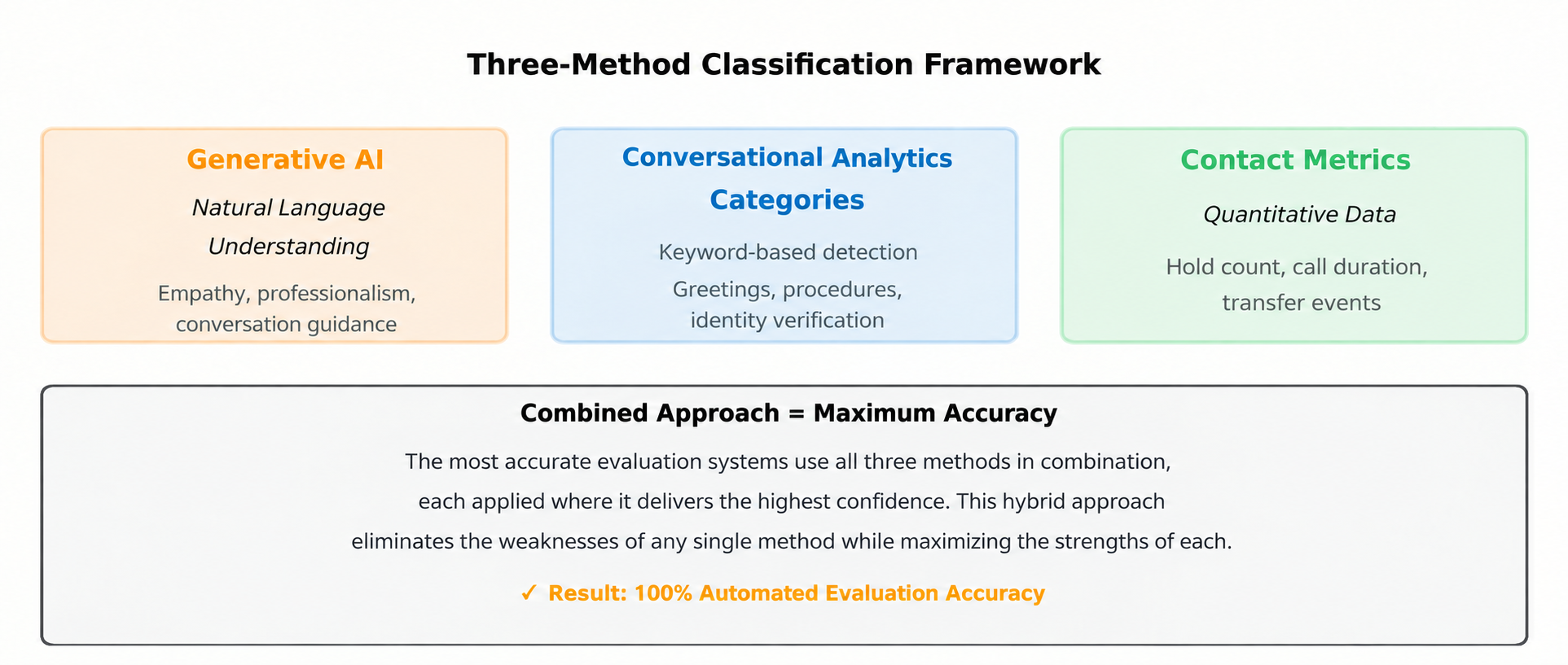 Figure 1: Three-method classification framework for automated evaluation accuracy
The most accurate evaluation systems use all three methods in combination, each applied where it delivers the highest confidence. This hybrid approach eliminates the weaknesses of any single method while maximizing the strengths of each.
Design principles that drove the transformation
Four additional design principles proved essential to achieving 100 percent automated accuracy:
- Decompose compound questions into atomic units – The customer’s original form bundled multiple behaviors into single questions. A combined question asking whether the agent introduced themselves, identified their team, and helped had only 66.67 percent accuracy. Redesigned as three independent questions, accuracy improved immediately and supervisors could now pinpoint exactly which behavior needed coaching.
- Engineer instructions for an AI audience – Instructions written for human evaluators leave too much room for generative AI to interpret and fabricate. Effective instructions include explicit decision logic, qualifying and disqualifying examples, anti-hallucination directives, and clear edge case handling.
- Invest in transcription accuracy first – Two of the lowest-performing questions shared a common root cause; generative AI was searching for terms incorrectly transcribed. TGS configured the custom vocabulary feature in Amazon Connect Customer with domain-specific terms, pronunciation hints, and common spoken variations. This single step produced a 15–30 percentage point accuracy improvement on affected questions before changing a single instruction.
- Automate evaluation application, not only scoring – TGS configured Amazon Connect Customer rules to automatically apply evaluations to all qualifying interactions, eliminating selection bias, guaranteeing complete coverage, and freeing supervisors to focus on coaching.
Business outcomes
The transformation produced measurable results across key dimensions in quality assurance:
- Automated evaluation accuracy went from 66.67 percent on the lowest-performing questions to 100 percent across all evaluation criteria. Every automated answer now matched what a trained human reviewer would conclude from the same call. Hallucinations were completely eliminated.
- Coverage moved from manual application on a small subset of interactions to fully automated evaluation of every qualifying contact, giving leaders statistically meaningful data instead of anecdotal impressions.
- Coaching specificity improved dramatically. Atomic questions identified which behaviors needed attention per agent, unlocking targeted development plans instead of generic training.
- Agent engagement increased as self-service dashboards gave agents ownership of their own performance data, shifting the dynamic from evaluation as surveillance to evaluation as development.
- Operational efficiency improved as automated evaluations freed supervisor time for high-value coaching activities instead of manual call reviews.
Principles for automated evaluation success
For organizations considering or currently implementing Amazon Connect Customer automated evaluations, here are proven principles for success:
- Match the automation method to the question type – The most accurate systems combine generative AI, conversational analytics categories, and contact metrics applied where it delivers the highest confidence.
- Invest in the transcript first – Custom vocabulary is the foundation all automation methods depend on.
- Decompose complex questions – One behavior per question produces higher accuracy, better diagnostics, and more actionable coaching.
- Automate evaluation application – Rules-based automation guarantees every interaction is assessed, eliminating selection bias.
- Build observability infrastructure from the start – Enable continuous measurement, calibration, and refinement as your evaluation system matures.
Conclusion
The difference between a contact center that uses automated evaluation technology and one that achieves automated evaluation excellence is a strategic approach. In this case, the customer had the right technology and the right intent, but they needed specialized expertise to unlock the full potential of their system. This included a classification framework that matches each question to the right automation method, instruction engineering that eliminates hallucinations, and operational automation that guarantees complete coverage.Automation can’t replace thoughtful design but incorporating it into a well-planned system multiplies the effectiveness of the solution. For organizations ready to transform their contact center quality assurance, the path from unreliable automation to trusted, production-ready evaluation begins with understanding that the most consequential decisions are made before the first instruction is written.
As contact centers mature in their use of automated evaluations, the next frontier will be multimodal evaluations that combine voice, tone, and behavioral signals with real-time coaching integration that surfaces insights to supervisors within moments of agent interactions. For quality assurance leaders, this means shifting from retrospective coaching to real-time guidance that catches quality issues before they cascade across customer interactions.
Ready to transform your contact center evaluations? Visit the AWS Partner Network Blog to learn more about how Amazon Connect Customer enhances customer conversations. Learn more about how TGS helps enterprises deploy on Amazon Connect Customer.
 .
TEKsystems Global Services – AWS Partner spotlight
TEKsystems Global Services (TGS) is an AWS Premier Tier Services Partner specializing in cloud transformation, AI-powered automation, and contact center modernization. With deep expertise across Amazon Connect Customer, Amazon Bedrock, and AWS artificial intelligence and machine learning (AI/ML) services, TGS helps enterprises design and implement solutions that deliver measurable business outcomes.
Contact TEKsystems Global Services | Partner Overview | AWS Marketplace