AWS Partner Network (APN) Blog
Precision Retrieval for Regulated Industries with Vespa.ai on AWS
By: Parascovia Digori, Partner Solutions Architect – AWS
by: Daniel Koch, Solutions Architect – AWS
by: Harini Gopalakrishnan, General Manager, Health and Life Sciences – Vespa.ai
by: Zohar Nissare-Houssen, Presales Lead – Vespa.ai


When a life sciences team asks an artificial intelligence (AI) assistant for “recruiting Phase II trials for this biomarker near our sites,” a near-miss answer does more than slow enrollment. It can mislead clinicians and erode trust in the whole generative AI program. When a portfolio manager asks an AI research assistant to synthesize risk across billions of filings and news items, the answer has to be fast, ranked, and traceable to its source.
Life sciences and financial services are both regulated industries, where an answer has to be accurate and auditable. Across both, the pattern is the same. Enterprise AI succeeds or fails on whether the right context reaches the model.
That is the problem Vespa.ai is built to solve. Vespa.ai is an AI search platform that combines keyword, vector, and structured retrieval with machine-learned ranking in a single engine, for applications such as Retrieval Augmented Generation (RAG). On AWS, Vespa Cloud, the managed Vespa.ai service available in AWS Marketplace, sits between the data and the models. Amazon Simple Storage Service (Amazon S3) holds the source data, and custom models on Amazon SageMaker AI generate domain-specific embeddings. Vespa Cloud then retrieves and ranks the context, and a foundation model available through Amazon Bedrock uses that context to generate the answer. This post looks at two examples that show why retrieval quality decides the outcome: BioCanvas, a life sciences solution from Reveal HealthTech, and Bigdata.com, a production research platform from RavenPack.
The challenge: moving RAG from prototype to production
Teams can stand up a first RAG prototype quickly, but the difficulty starts when that prototype moves to production. At that point, the assistant has to combine unstructured text with structured attributes and respect domain rules such as synonyms and exclusion criteria. It also has to return ranked, attributable results fast enough to keep up with an agent or analyst workflow.
This gets harder as organizations add copilots and multi-step agents, because each reasoning step can trigger another search and weak context compounds across the workflow. Vector similarity alone cannot enforce the exactness that regulated domains require, and adding more retrieval steps drives up latency and cost.
Life sciences: Reveal HealthTech BioCanvas on AWS
According to a 2020 systematic review in the Journal of Medical Internet Research, around 80% of clinical trials miss their initial enrollment target and timeline, and those delays can mean as much as US$8 million per day in lost revenue for a drug developer. Behind those delays are questions that vector similarity alone cannot answer cleanly:
- Which trials match this molecular marker and are recruiting near this geography?
- Which compounds are similar by structure, function, and literature co-occurrence?
- How should evidence be ordered when phase, recency, cohort fit, and site proximity all matter?
With Vespa.ai, teams can combine keyword matching, structured filters, and vector search in a single query. This means an exact term such as HER2 (human epidermal growth factor receptor 2) does not get lost among semantic neighbors, and trial phase or status can be enforced at retrieval time. For multimodal programs, Vespa.ai works across text, metadata, and higher-dimensional representations such as tensors and multiple vectors. That matters when clinical notes, images, and molecular context need to be searched together rather than through five separate pipelines.
Vespa.ai explains this retrieval design in depth in Search me if You Can and in its Why Life Sciences AI Is a Search Problem series. This post focuses on how Reveal HealthTech built BioCanvas to apply that design on AWS.
Reveal HealthTech’s BioCanvas is a multimodal data intelligence layer. It brings structured records, clinical text, and images such as computed tomography (CT) and magnetic resonance (MR) scans into one searchable view. Figure 1 shows the data sources on the left, from electronic health record (EHR) data and imaging to claims and billing. On the right are the use cases they serve, from clinical trial control and cohort identification to commercial competitive intelligence.
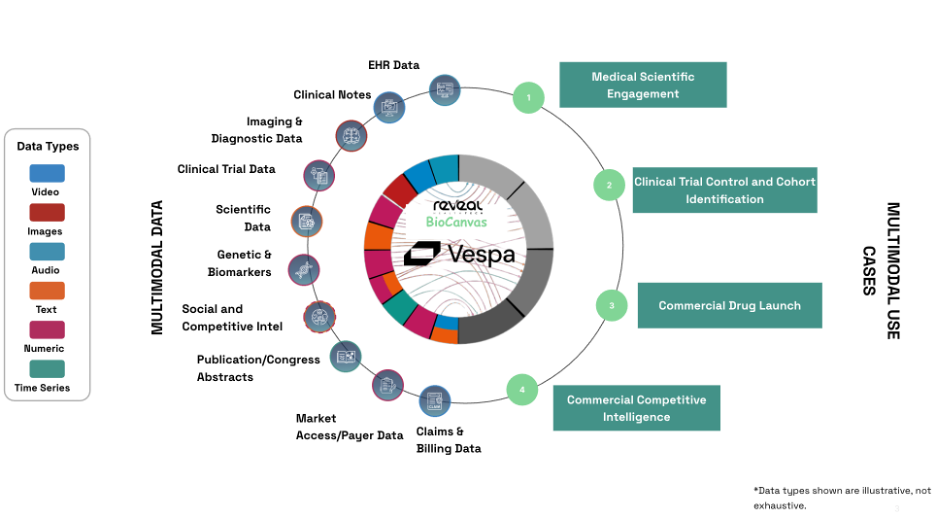
Figure 1. Reveal HealthTech BioCanvas, built on Vespa.ai, unifying multimodal healthcare and life sciences data to serve four enterprise use cases.
BioCanvas runs on AWS services, with Amazon S3 storing the raw and processed multimodal data, Amazon Managed Workflows for Apache Airflow (Amazon MWAA) orchestrating ingestion and embedding pipelines, and Amazon SageMaker AI training and hosting the domain models. Vespa Cloud acts as the retrieval and ranking layer: it retrieves broadly, re-ranks a smaller candidate set with deeper models and business rules, and returns results in a single query. This multi-phase pattern helps teams raise precision while keeping expensive scoring focused on the candidates that matter. It moves clinical RAG from semantically similar to operationally relevant results. Reveal HealthTech designed BioCanvas to shorten patient pre-screening by surfacing eligibility signals that sit in unstructured clinical data.
Fintech: conversational research at billion-document scale
Financial research follows a parallel pattern, with professionals looking for an engine that works across a real-time corpus of filings, news, research, and proprietary signals and returns answers they can verify and trace to source.
RavenPack’s Bigdata.com does this over more than one billion financial documents spanning 20-plus years of market history. To support that scale, RavenPack chose Vespa.ai for vector search and retrieval.
“Our RAG architecture combines vector search with RavenPack’s extensive financial knowledge graph for real-time insights and deep research. After working with Vespa.ai open source for a few years, we transitioned to Vespa Cloud to support our enterprise workflows. This simplifies our infrastructure as we scale and gives us access to expert guidance from Vespa engineers on billion-scale vector deployment.”
– Armando Gonzalez, CEO and Co-founder, RavenPack / Bigdata.com
On Bigdata.com, hybrid retrieval and machine-learned ranking run in one query path, so the model receives only the excerpts it needs. This can reduce the context consumed per query by up to 100×.
A shared retrieval pattern on AWS
The pattern behind both examples comes down to five steps:
- Start from the decision workflow, such as trial matching, evidence assembly, or market research.
- Retrieve with hybrid signals so semantics and exactness coexist.
- Rank with domain and business logic, not one global similarity score.
- Serve in real time so agents and applications see fresh data.
- Scale on AWS as data and traffic grow, without rewriting the retrieval stack.
For regulated teams, where the retrieval layer runs matters as much as how well it ranks. Vespa.ai gives AWS customers two deployment options. The first is Vespa Cloud, a fully managed service that runs in AWS Regions. Applications in the customer’s virtual private clouds (VPCs), such as assistants built with Amazon Bedrock, can reach it through AWS PrivateLink, so retrieval traffic can stay off the public internet. For stricter data requirements, the second option, Vespa Cloud Enclave, runs the same managed service inside the customer’s own AWS account, so indexed clinical or financial data stays next to the source data in Amazon S3. Vespa Cloud is available in AWS Marketplace, so teams can buy it through their existing AWS billing.
Figure 2 shows this retrieval pattern on AWS. In the embedding flow, unstructured data lands in Amazon S3 and is embedded by custom models on Amazon SageMaker AI. In the retrieval flow, an application built with Amazon Bedrock sends the query to Vespa Cloud, which runs hybrid search and ranking and returns the top results the model uses to answer.
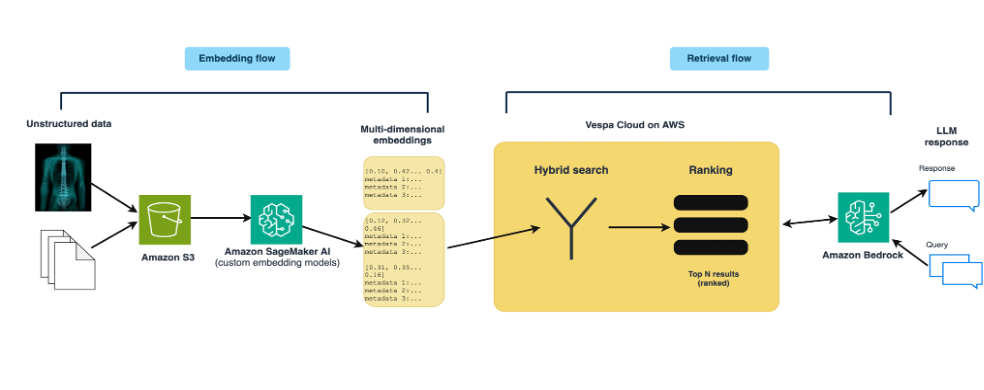
Figure 2. RAG on AWS with Vespa Cloud, Amazon S3, Amazon SageMaker AI, and Amazon Bedrock.
Conclusion
For AWS customers building generative AI in regulated industries, BioCanvas and Bigdata.com both show that answer quality depends on how well the retrieval layer finds, filters, and ranks context, and on where that layer runs. Teams can use Vespa.ai on AWS for multimodal clinical search or for research across billions of financial documents, and take it from pilot to production without rebuilding their retrieval stack.
To get started, explore Vespa Cloud on AWS Marketplace and the Vespa.ai documentation, or discuss your use case with your AWS account team. For related AWS guidance, see lessons learned from real-world RAG builds.

Vespa.ai – AWS Partner Spotlight
Vespa.ai is an AWS Advanced Partner that holds the AWS Generative AI Competency. Its AI search platform unifies vector search, hybrid retrieval, and machine-learned ranking in a single serving engine for real-time search, RAG, recommendation, and personalization. Vespa Cloud is available as a managed service on AWS through AWS Marketplace.