AWS Architecture Blog
How Clario technology detects PHI/PII in DICOM images using Amazon Bedrock
Clario, part of Thermo Fisher Scientific, uses Amazon Bedrock to automate PHI (Protected Health Information) and PII (Personally Identifiable Information) detection across thousands of DICOM (Digital Imaging and Communications in Medicine) image slices in clinical trials. Each image slice may carry PII or PHI hidden in metadata tags, in custom vendor fields, or burned directly into the pixels. Across imaging sites, central labs, sponsors, and CROs (Contract Research Organizations), every one of those slices must be cleared of PII and PHI before the image moves downstream.
DICOM is the universal standard for storing, transmitting, and managing medical imaging data across healthcare systems. In clinical trials, DICOM images play a critical role by providing objective, quantifiable evidence of a patient’s medical condition throughout the study lifecycle. From baseline imaging to follow-up scans, modalities such as MRI, CT, PET, and X-ray generate DICOM files. Radiologists, clinicians, and sponsors use these files to assess treatment efficacy, monitor disease progression, and support regulatory submissions. These images serve as a core component of the clinical evidence package, making their accurate management and standardized handling essential to trial integrity.
In this post, we share how the Clario team designed an automated PHI and PII detection solution on AWS for DICOM imaging data, the key design decisions behind the architecture, and the lessons the team learned along the way.
About Clario, part of Thermo Fisher Scientific
Clario science and endpoint solutions support the clinical trials industry through the systematic collection, management, and analysis of specific, predefined outcomes (endpoints) to evaluate a treatment’s safety and effectiveness. For more than 50 years, Clario endpoint solutions have been deployed more than 30,000 times, and since 2015, they have supported more than 700 FDA and EMA new drug approvals.
Business challenge
Clearing PII and PHI from every image slice in the clinical trial is only part of the problem. The imaging workflow around this clearing process must be just as rigorous. A well-structured imaging workflow supports every DICOM file captured across globally distributed trial sites. Files are ingested automatically, consistently standardized, and rigorously validated at every step of the journey. Enforcing standardized image acquisition protocols across sites and geographies alleviates inconsistencies. These inconsistencies could otherwise impact data quality or delay regulatory submissions. A centralized imaging infrastructure that maintains complete metadata traceability, including acquisition parameters, imaging equipment details, and timestamps, supports a fully auditable workflow aligned with GCP (Good Clinical Practice) requirements. This empowers sponsors and CROs to move faster with greater confidence and significantly reduces the risk of data queries or compliance gaps.
An equally important aspect of managing DICOM imaging data in clinical trials is embedding intelligent, automated PHI and PII protection directly into the data management process. DICOM files carry more than images. They include metadata and tags, which can contain sensitive information such as patient names, dates of birth, medical record numbers, and facility identifiers. This sensitive information must be carefully managed before sponsors, CROs, or third-party stakeholders receive the data. Proactively verifying that PII and PHI are accurately identified and de-identified at the source is a critical best practice that safeguards patient privacy in compliance with HIPAA, GDPR, and ICH E6 guidelines. Automated de-identification tools that adhere to DICOM Supplement 142 and NEMA (National Electrical Manufacturers Association) standards reinforce data security and regulatory trust. They also preserve the full clinical and scientific value of imaging data, so trial teams can support confident, high-quality regulatory submissions.
To address these challenges, the Clario team built a comprehensive PHI/PII detection solution on AWS using Amazon Bedrock (Anthropic’s Claude Sonnet 4.5 on Amazon Bedrock) that combines automation, accuracy, and security throughout the clinical trial imaging workflow.
Why Amazon Bedrock and Amazon Textract
When evaluating options for building the solution, the Clario team chose to standardize on Amazon Bedrock and Amazon Textract for several key reasons:
- Scalability without re-architecting: Amazon Bedrock and Amazon Textract provide scalability, reliability, and strong performance. The solution architecture can scale from a handful of documents to millions without re-architecting the solution or managing additional infrastructure. AWS manages the underlying capacity, so you can focus on building features instead of tuning servers or models.
- Security and compliance: Keeping customer data secure is non-negotiable. By using Amazon Bedrock and Amazon Textract within Clario managed AWS accounts, processing remains inside a hardened AWS environment, taking advantage of AWS Identity and Access Management (IAM), Amazon Virtual Private Cloud controls, and encryption at rest and in transit. The Clario team can align closely with its organization’s security, compliance, and data residency requirements.
- Managed foundation models: With Amazon Bedrock, the Clario team can access a range of high-quality foundation models as a fully managed service, without having to manage model training, hosting, or updates. This shortens the time to market, and you can iterate quickly as new models and capabilities become available in Amazon Bedrock.
- Purpose-built OCR and document processing: Amazon Textract provides purpose‑built optical character recognition (OCR) and intelligent document processing, which significantly improves accuracy over traditional OCR engines. Its ability to automatically detect and extract text, tables, and key‑value pairs from complex documents and images reduces the amount of custom parsing logic that must be maintained.
- End-to-end observability: Running on AWS provides end-to-end observability across the logs, metrics, and traces through services like Amazon CloudWatch and AWS CloudTrail. The Clario team can enforce governance policies, audit permissions, and track model and document processing usage centrally.
- Extensible AI foundation: Because the solution builds on Amazon Bedrock and Amazon Textract, the Clario team can adopt new models and document processing features as they become available, without re-architecting.
Solution overview
The solution is built entirely on AWS, designed to bring greater efficiency, accuracy, and security to the detection of PHI and PII embedded within DICOM files. Accessible through Amazon API Gateway with TLS encryption in transit, IAM-backed authorization, and rate limiting, the detection workflow is readily consumable by multiple downstream systems with minimal integration effort.
Clinical trial sites store their DICOM images in Amazon Simple Storage Service (Amazon S3). The detection workflow retrieves each file from that bucket and processes it through the detection pipeline, so every ingestion step is logged and auditable for clinical trial security and compliance reviews. The workflow scans both standard and custom private DICOM metadata tags for PHI and PII. This covers the vendor-specific and non-standard tags where sensitive information often hides. Supporting both DICOM (.dcm) and PDF file formats, the solution is well-positioned to address PHI detection needs across the most used file types in clinical trial workflows.
The Clario AI team made a few deliberate design decisions early on. They ran the backend on Amazon Elastic Kubernetes Service (Amazon EKS) because a single DICOM series can span thousands of slices, and the detection workload is long-running and memory-intensive. They chose Amazon Relational Database Service (Amazon RDS) for PostgreSQL to persist processing metadata because the audit trail needs relational queries and strong consistency for compliance reporting. And they put the service behind Amazon API Gateway so that authentication, API-key management, and rate limiting are handled at the edge, keeping the backend focused on detection.
The following diagram and steps show how a DICOM document moves from upload through detection to structured output:
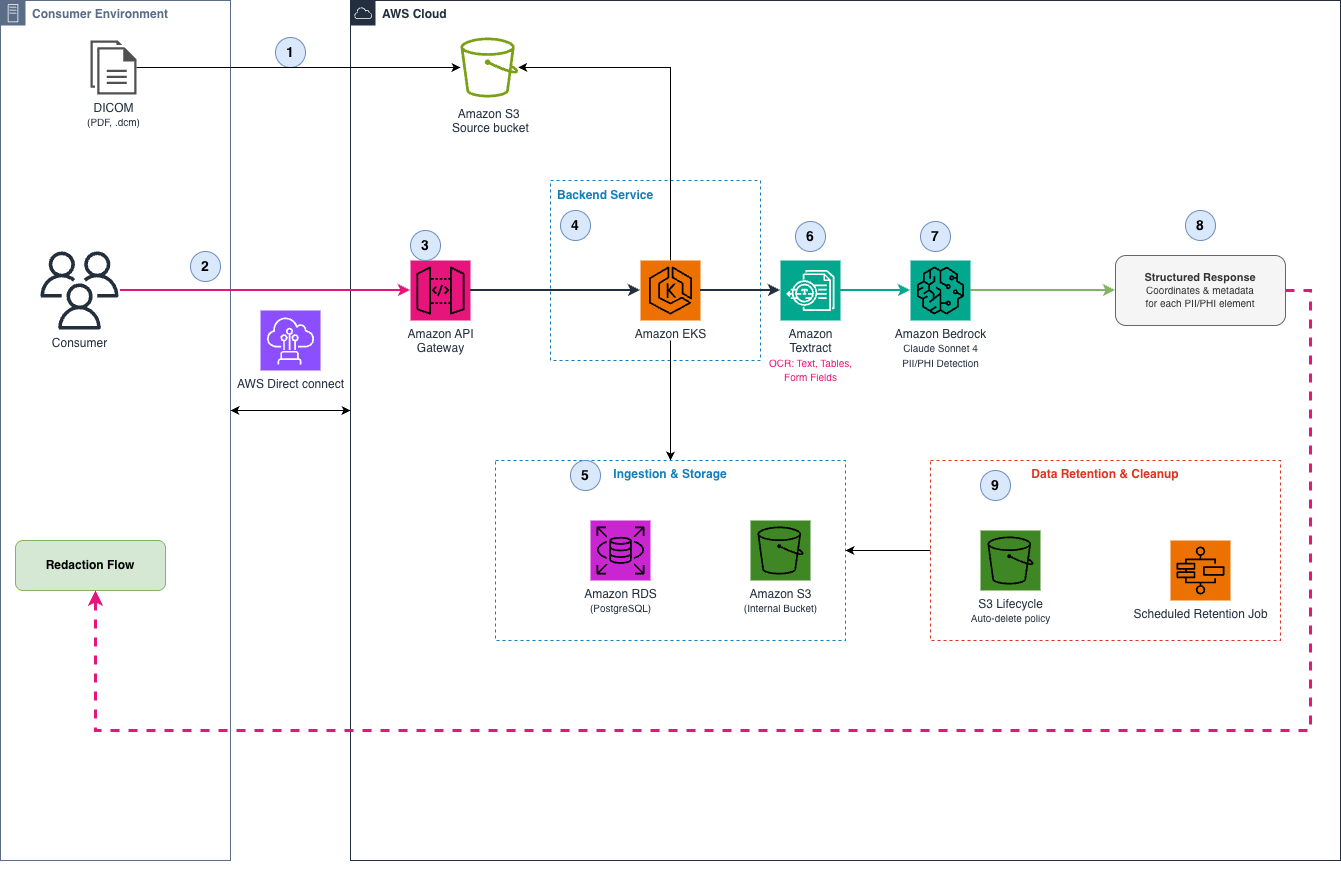
Figure 1: Solution architecture for DICOM image ingestion, detection pipeline, and data retention workflow
The following steps describe the data flow through the solution, as shown in the architecture diagram:
- A consumer, such as an upstream imaging application, first uploads the DICOM image document to an Amazon S3 bucket location that is accessible to the solution.
- The consumer then calls the Clario Internal API running on Amazon API Gateway, providing their consumer-specific API key and the location of the document. This call initiates the DICOM image analysis workflow.
- Amazon API Gateway fronts the API and receives the incoming request. API Gateway validates the API key and, on success, forwards the request to the detection backend endpoint running on Amazon EKS to initiate processing.
- The solution performs initial checks on the file location (for example, URL format, access, and basic metadata) and then begins the PII/PHI identification process. The pipeline retrieves the file from the source S3 bucket and ingests it into the detection workflow.
- The file is stored in an internal Amazon S3 bucket and relevant metadata persisted in a PostgreSQL database on Amazon RDS to support downstream processing and auditability.
- The workflow invokes Amazon Textract to perform OCR and intelligent document parsing. Textract extracts text, tables, and form fields from the uploaded document, returning a structured representation of the content.
- The OCR output is then passed to a large language model (Anthropic’s Claude Sonnet 4.5 on Amazon Bedrock) that is configured to analyze the extracted text and identify potential PII/PHI elements. The model evaluates the content and associates each detected sensitive element with its position in the document.
- Once analysis is complete, the detection workflow returns a structured response to the consumer, containing the coordinates and related metadata for each piece of sensitive data identified in the document. The consumer can take follow‑up actions, such as redaction or masking.
- To minimize data exposure and support compliance requirements, the ingested files and associated records are retained only for a limited window. The document stored in Amazon S3 is automatically deleted based on an Amazon S3 lifecycle retention policy, and corresponding records in Amazon RDS are removed via a scheduled cleanup job.
Deep image analysis and detection workflow
Beyond metadata, the solution uses Anthropic’s Claude Sonnet 4.5 on Amazon Bedrock to perform a deep scan of the actual image pixel content, detecting PHI or PII that may be physically burned into the image itself. This includes patient names, dates of birth, and patient IDs across every individual slice within a DICOM series that can span thousands of images.
When PHI or PII is identified, the solution precisely captures the spatial coordinates and type of sensitive information detected, passing these bounding box details downstream to integrated systems responsible for the actual pixel-level redaction. Separating detection from masking was a deliberate design decision. It preserves flexibility, supports full auditability, and a human-in-the-loop can review the flagged findings before redaction is applied.
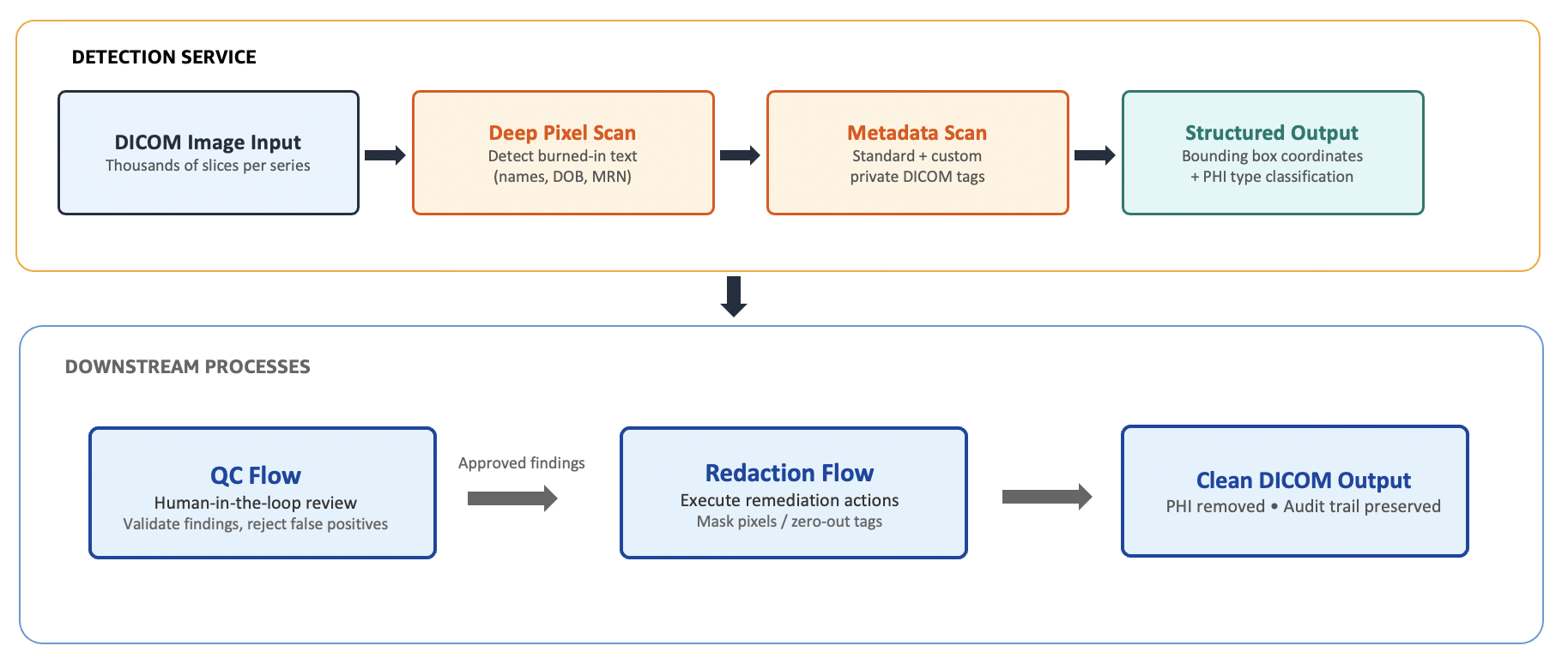
Figure 2: Deep image analysis and detection workflow showing the separation between AI-powered detection and human-supervised redaction
The detection solution returns structured coordinates for the identified PHI and PII, spanning burnt-in pixel text, standard DICOM header fields, and non-standard custom tags. The solution then hands these results off to two downstream processes. In the quality control (QC) flow, qualified reviewers validate the flagged findings and confirm which items require remediation. In the redaction flow, the system executes the appropriate action for each type of PHI identified: masking or overwriting burnt-in text within the image pixel data, or stripping and zeroing out sensitive DICOM metadata tags.
This separation of detection and redaction is intentional. The AI-powered detection solution focuses on comprehensive, high-recall identification across thousands of image slices and metadata fields. The redaction flow retains human oversight over the irreversible act of modifying clinical data, confirming that no PHI is left exposed and no clinically relevant information is removed.
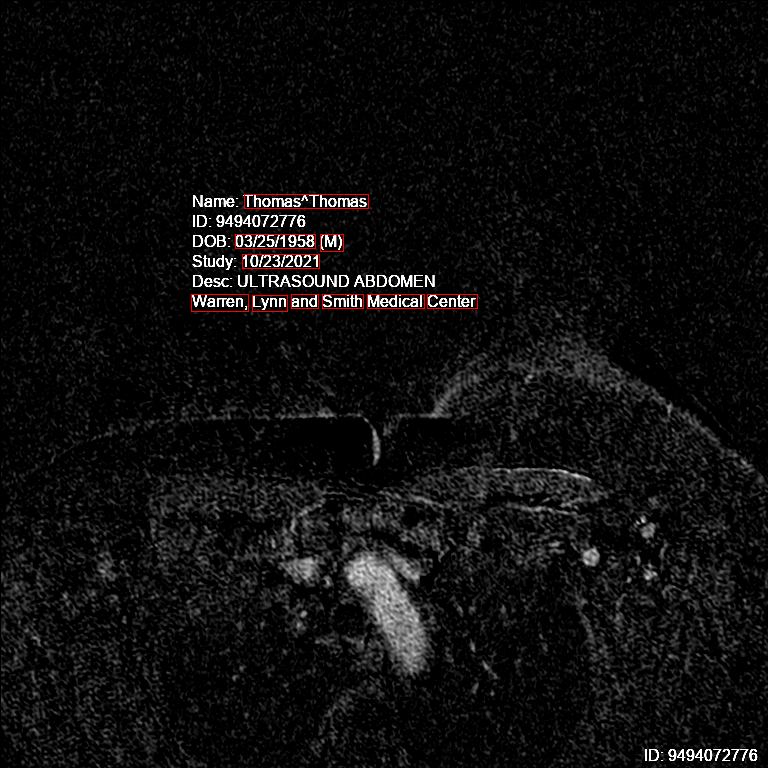
Figure 3: Sample DICOM image with detection
With the detection pipeline in place, the next step was to measure how accurately it identifies PHI and PII across real-world clinical documents.
Evaluation methodology
The team validated the solution in three stages: building a representative test dataset, creating ground truth annotations, and running an automated evaluation pipeline.
Building a representative test dataset
The Clario generative AI team partnered with internal stakeholders to assemble a diverse dataset, including:
- DICOM images with burned‑in annotations, overlays, and metadata.
- PDF documents such as reports and clinical summaries.
The dataset intentionally included documents that do and do not contain sensitive PII/PHI, allowing the team to measure both the model’s ability to detect sensitive information and its ability to avoid false alarms.
Creating ground truth annotations
For each document in the dataset, ground truth labels were generated that capture:
- The exact text corresponding to each PII/PHI element.
- The bounding box coordinates for each element on the page where available.
These annotations form the “gold standard” that the Clario team can use to compare the output from the production pipeline.
Automated evaluation pipeline
The Clario team implemented a set of evaluation scripts that:
- Run the full solution on each test DICOM or PDF, using the same workflow that powers the production system.
- Collect the model predictions, including the detected PII/PHI text, associated labels (for example, name, date of birth, medical record number), and coordinates where available.
- Compare predictions against ground truth using the following matching strategy:
- For PDFs and DICOM images where coordinates are available, a match is performed by spatial proximity, treating a predicted bounding box as a correct match if it falls within a configurable tolerance (by default, 3 pixels for each element of the bounding box).
- For DICOM metadata where coordinates are not available, a match is performed by a structured path.
Furthermore, the solution includes automated accuracy and performance (run time) checks, to improve system reliability across deployments. After validating the solution’s accuracy, the team assessed how it improves detection coverage across Clario clinical trial imaging workflows.
Results and benefits
The automated evaluation pipeline measured the solution’s detection performance against the manually annotated ground truth dataset across all three detection surfaces:
| Detection surface | Detection F1 | Label accuracy |
| PDF text | 0.9775 | 98.12% |
| DICOM burned-in image text | 0.9750 | 96.15% |
| DICOM metadata tags | 0.9951 | 99.60% |
Detection F1 measures how accurately the solution identifies PHI/PII instances. Label accuracy measures how correctly it classifies the type of identified PHI/PII (for example, person_name, date_of_birth, or gender).
These results demonstrate consistently high detection performance across all three data surfaces, with metadata tag detection achieving near-perfect accuracy. The solution meets the Clario generative AI team’s production-readiness bar for deployment in clinical trial workflows where compliance accuracy is non-negotiable.
Complete detection coverage
Manual QC reviewers bring deep domain expertise to PHI identification. But modern clinical trials generate an enormous volume of data: thousands of image slices per series, each with dozens of metadata tags, including non-standard vendor-specific fields. This volume makes exhaustive manual review impractical at scale. The automated solution extends that human expertise across the full dataset.
In internal testing conducted by the Clario team, the solution scanned 100% of image slices, standard DICOM header fields, and custom private tags in the test dataset. This comprehensive coverage complements the existing QC process by surfacing PHI occurrences that might otherwise require additional review passes, particularly in non-standard private tags and burned-in pixel text where sensitive data is less predictable.
Risk and compliance impact
By automating PII and PHI detection across metadata tags and image slices, the solution can strengthen an organization’s compliance posture against HIPAA, GDPR, and ICH E6 requirements.
Beyond the measurable results, the project surfaced several insights that can guide other organizations building similar solutions.
The AWS collaboration
The AWS Solutions Architecture team partnered with the Clario AI team throughout the design and optimization of the detection solution. Key areas of collaboration included:
- Scaling and throughput optimization: Provided prescriptive guidance on Amazon EKS pod scaling strategy to handle DICOM series with thousands of slices per request without timeout or memory pressure and tuned concurrent invocations to Amazon Bedrock to maximize throughput within account-level quotas.
- Cost-efficient inference architecture: Recommended batching strategies for Amazon Textract API calls and optimized prompt token usage for Claude Sonnet on Amazon Bedrock to reduce per-document inference cost at scale.
- Data retention and security controls: Recommended auto-deletion workflow using Amazon S3 Lifecycle policies and Amazon RDS scheduled jobs to meet HIPAA and GDPR data minimization requirements.
Lessons learned and best practices
Throughout the development and deployment of this solution, several valuable insights emerged that can benefit other organizations implementing similar AI-powered PHI detection systems for clinical trial imaging data.
Evaluate models against production-representative data
The Clario AI team adopted a rigorous model evaluation process early in development. Many open-source frameworks and off-the-shelf detection models demonstrated acceptable performance on curated test samples but experienced significant accuracy degradation when exposed to the full variability of production data. This variability includes diverse imaging modalities, vendor-specific private tags, and inconsistent burned-in text formatting across globally distributed trial sites. This reinforced the importance of evaluating any AI model at realistic, production-level data volumes before adoption. The solution that proved most effective was a carefully tuned pipeline where Amazon Textract handles text extraction and Claude Sonnet on Amazon Bedrock performs PHI/PII classification, with prompt engineering optimized for the specific patterns found in clinical trial DICOM data.
Ground truth data is non-negotiable
Building a reliable, automated evaluation pipeline required the manual creation of a ground truth dataset. The team acknowledges this process is time-consuming but necessary. This highlighted a best practice that is frequently underestimated: investing in high-quality, manually validated ground truth data is a prerequisite for developing and maintaining a trustworthy automated detection system. Attempting to shortcut this step risks deploying a solution whose real-world accuracy remains unknown, an unacceptable risk in the context of clinical trial compliance.
Separating detection from masking improves flexibility and auditability
The Clario team deliberately separated the PHI/PII detection function from the actual pixel-level redaction. Rather than performing masking directly, the solution identifies the precise coordinates and type of PHI/PII detected, passing this structured output downstream to integrated systems responsible for redaction. This separation proved to be a sound best practice. It preserves workflow flexibility, a human expert can review the findings before anyone makes irreversible changes to the image data, and keeps human accountability and auditability clear at every step.
Human-in-the-loop review remains an essential safeguard
Automation accelerates the detection and flagging process, but a key lesson learned is that human oversight should remain an integral part of the workflow. Incorporating a human review step for flagged findings before masking makes sure that edge cases and model uncertainties are appropriately handled. In the context of clinical trial data, where accuracy and regulatory accountability are paramount, this human-in-the-loop approach provides an essential layer of quality assurance that purely automated systems alone cannot fully replace.
Conclusion
The Clario automated PHI/PII detection solution demonstrates how AWS services can transform clinical trial imaging workflows by combining speed, accuracy, and compliance. By replacing manual spot-checks with automated scanning of every slice and metadata tag, the solution delivers complete PHI/PII detection coverage, reducing the risk of missed detections while strengthening compliance with HIPAA, GDPR, and ICH E6 requirements.
The key architectural decisions, comprehensive coverage of custom private tags, separation of detection from redaction, and human-in-the-loop validation provide a blueprint for other organizations managing sensitive imaging data in regulated environments. These lessons learned highlight that successful automation in clinical trials requires not just advanced technology, but thoughtful design that balances efficiency with the rigorous quality standards that patient safety and regulatory compliance demand.
Next steps
Organizations looking to implement similar PHI/PII detection capabilities for clinical trial imaging can start by:
- Evaluate current manual review processes: Map where reviewers spend the most time and where missed PHI poses the greatest compliance risk.
- Assess custom private DICOM tags: Catalog vendor-specific and site-specific tags across your imaging network to define the full detection scope.
- Build ground truth datasets: Annotate a representative sample with precise PHI labels to benchmark automated detection accuracy.
- Design human-in-the-loop workflows: Define review checkpoints where qualified personnel validate flagged findings before redaction.