AWS Architecture Blog
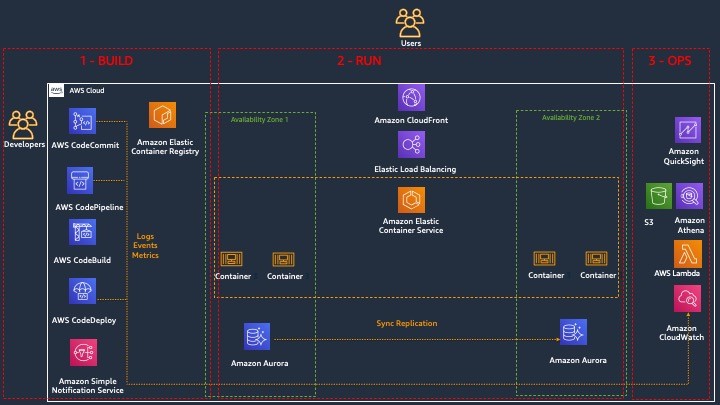
Why Deployment Requirements are Important When Making Architectural Choices
Introduction Too often, architects fall into the trap of thinking the architecture of an application is restricted to just the runtime part of the architecture. By doing this we focus on only a single customer (such as the application’s users and how they interact with the system) and we forget about other important customers like […]

Field Notes: Monitoring the Java Virtual Machine Garbage Collection on AWS Lambda
September 8, 2021: Amazon Elasticsearch Service has been renamed to Amazon OpenSearch Service. See details. When you want to optimize your Java application on AWS Lambda for performance and cost the general steps are: Build, measure, then optimize! To accomplish this, you need a solid monitoring mechanism. Amazon CloudWatch and AWS X-Ray are well suited […]

Architecture Patterns for Red Hat OpenShift on AWS
Editor’s note: Although this blog post and its accompanying code make use of the word “Master,” Red Hat is making open source code more inclusive by eradicating “problematic language.” Read more about this. Introduction Red Hat OpenShift is an application platform that provides customers with turnkey application platform that is much more than a simple […]

Field Notes: Serverless Container-based APIs with Amazon ECS and Amazon API Gateway
A growing number of organizations choose to build their APIs with Docker containers. For hosting and exposing these container-based APIs, they need a solution which supports HTTP requests routing, autoscaling, and high availability. In some cases, user authorization is also needed. For this purpose, many organizations are orchestrating their containerized services with Amazon Elastic Container […]

AWS Architecture Monthly Magazine: Robotics
September’s issue of AWS Architecture Monthly issue is all about robotics. Discover why iRobot, the creator of your favorite (though maybe not your pet’s favorite) little robot vacuum, decided to move its mission-critical platform to the serverless architecture of AWS. Learn how and why you sometimes need to test in a virtual environment instead of […]

Field Notes: Requirements for Successfully Installing CloudEndure Migration and CloudEndure Disaster Recovery
Customers have been using CloudEndure Migration and CloudEndure Disaster Recovery to meet business needs for many years. In 2019, CloudEndure was acquired by AWS, and provided the licensing for CloudEndure to all of their users free of charge for migration. During this time, AWS has identified the requirements for replication to complete successfully after initial […]

AWS Architecture Center: Your One-Stop Destination for Guidance & Resources
Discovering relevant architecture-related content has been simplified and made easier with the newly updated and expanded AWS Architecture Center. Now you can browse, search, and even request reference architectures, architecture patterns, best practices, and prescriptive guidance all in one location. The revamped Architecture Center is the only place where you can browse recommended guidance by […]

Field Notes: Deploying UiPath RPA Software on AWS
September 8, 2021: Amazon Elasticsearch Service has been renamed to Amazon OpenSearch Service. See details. Running UiPath RPA software on AWS leverages the elasticity of the AWS Cloud, to set up, operate, and scale robotic process automation. It provides cost-efficient and resizable capacity, and scales the robots to meet your business workload. This reduces the […]

Field Notes: Building a Shared Account Structure Using AWS Organizations
For customers considering the AWS Solution Provider Program, there are challenges to mitigate when building a shared account model with SI partners. AWS Organizations make it possible to build the right account structure to support a resale arrangement. In this engagement model, the end customer gets an AWS invoice from an AWS authorized partner instead […]

Dream11: Scaling a Fantasy Sports Platform with 5M Daily Active Users
Founded in 2008, Dream11 is India’s leading sports-tech startup with a growing base of more than 45 million users playing multiple sports such as fantasy cricket, football, kabaddi, and basketball. Dream11 uses Amazon Aurora with Amazon ElastiCache to serve 1 million concurrent users within 50ms response time, serving at an average 3 million requests per […]