AWS Architecture Blog
Serverless vehicle tracking at scale: Bosch L.OS on AWS
When Bosch Mobility Platform Solutions set out to unify vehicle tracking across India’s fragmented spot logistics market, they faced a daunting reality: dozens of telematics providers, incompatible data formats, and thousands of concurrent tracking requests — all needing real-time resolution. The result was L.OS, a serverless platform on AWS that standardizes this chaos into a single visibility layer.
In this post, we’ll show you how Bosch Mobility Platform Solutions (MPS) uses AWS services to solve these challenges through their L.OS solution. You’ll learn how Bosch built a scalable, serverless architecture that standardizes and integrates multiple tracking data sources, so you can achieve real-time visibility and data-driven decision-making across complex logistics networks.
Key challenges in logistics visibility
If you manage a modern supply chain, you face several critical challenges:
- Data fragmentation and integration complexity.
- Multiple tracking systems with incompatible data formats.
- Different communication protocols across providers.
- Lack of standardization in data exchange.
- Complex and costly point-to-point integrations.
- Operational inefficiencies.
- Manual coordination between stakeholders.
- Time-consuming reconciliation of conflicting information.
- Difficulty in providing accurate ETAs.
- Limited real-time visibility into shipment status.
- Scale and performance issues.
- High volume of concurrent tracking requests.
- Variable data quality from different sources.
- Performance bottlenecks during peak operations.
- Cost implications of real-time tracking.
- Regional complexities.
- Fragmented spot logistics networks.
- Multiple intermediaries in the supply chain.
- Varying levels of technological adoption.
- Regional compliance requirements (such as AIS140 and FASTag in India).
Introducing L.OS on AWS: A unified visibility solution
To address these challenges, Bosch’s Logistics Operating System (L.OS) on AWS provides a horizontal integration layer that connects previously siloed logistics solutions. The solution features a service catalog where solution providers and consumers can collaborate to solve complex use cases, fostering innovation in the logistics sector. Let’s explore how L.OS enhances vehicle visibility through its core workflows: discovery, tracking, and termination.
Discovery
When a client needs to track a vehicle, the service app makes a discovery call to the L.OS gateway. This call includes essential details such as the vehicle number plate or vehicle identification number (VIN). Upon receiving the request, the L.OS solution performs necessary authentication and authorization. L.OS then broadcasts the request and waits for acknowledgment from one or more connected participants. The responses contain information such as the mode, frequency, and reliability of tracking, which can be used for shortlisting and decision-making.
The following diagram illustrates the discovery workflow, showing how a client’s tracking request flows through L.OS to connected participants and back.
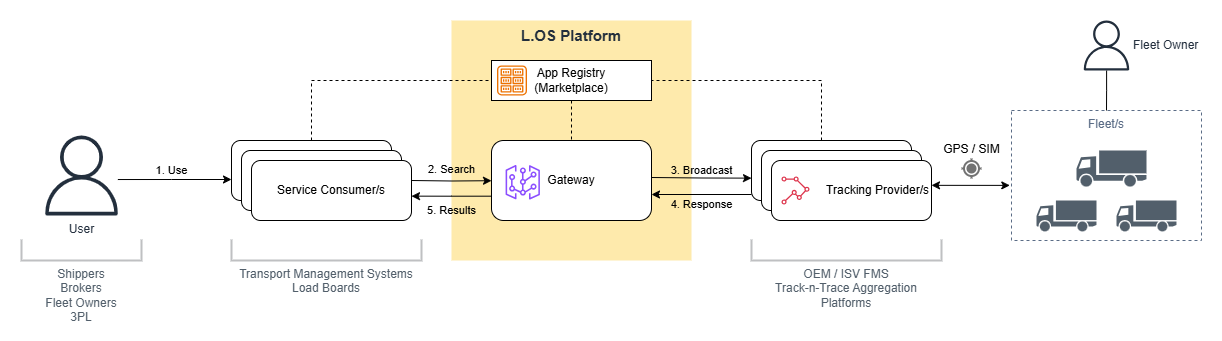
Figure 1 – The discovery flow: the service app sends a discovery call to the L.OS gateway with vehicle identifiers. L.OS broadcasts the request to connected participants, collects acknowledgments containing tracking mode, frequency, and reliability details, and returns them to the consumer for shortlisting.
Tracking
Once the consumer has selected a vehicle and a service provider (if there are multiple options), a request is sent to the L.OS to initiate tracking. This request is relayed to the specific service provider. The tracking mode determines who must grant consent. For SIM tracking, a consent request goes to the driver. For GPS tracking, it goes to the fleet owner. The solution waits for the tracking provider to create the trip. Upon receiving confirmation, L.OS registers the tracking request and provides a unique tracking ID to indicate that tracking has been initiated. From here, the consumer is asynchronously notified of the vehicle’s location at the specified frequency, or the maximum frequency supported by the service provider, whichever is faster. Consumers can also request the live location of the vehicle at any time between the regular reporting intervals.
The following diagram shows the tracking workflow, from initiation through consent, trip creation, and ongoing location updates.
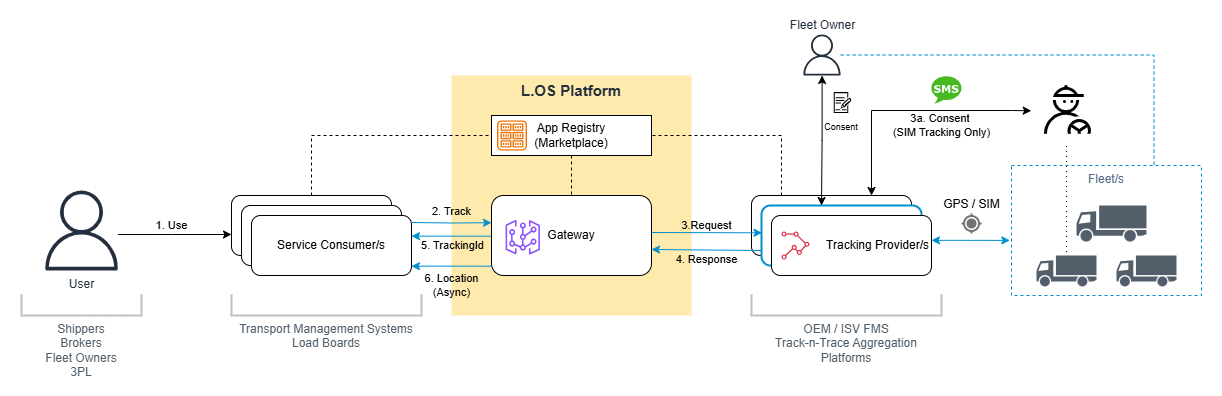
Figure 2 – The tracking flow: the consumer sends a tracking request to L.OS, which relays it to the selected service provider. A consent request is issued (to the driver for SIM tracking, or the fleet owner for GPS tracking). Once the provider confirms trip creation, L.OS returns a unique tracking ID and begins delivering asynchronous location updates at the agreed frequency.
Termination
The tracking is automatically terminated when the vehicle enters the destination geo-fence. Alternatively, tracking can be terminated manually by sending an explicit request to L.OS, which is then relayed to the service provider.
Architecture overview
The L.OS solution built on AWS uses various services to create a scalable, secure, and maintainable system. The architecture implements serverless components (AWS Lambda adapters) where appropriate while using containers (Amazon Elastic Container Service (Amazon ECS) with AWS Fargate) for the core connector service. Let’s explore how these AWS managed services work together to create a flexible and scalable integration solution. The following diagram shows the end-to-end architecture, illustrating how requests flow from client applications through the API layer, into the core connector service, and out to individual tracking providers.
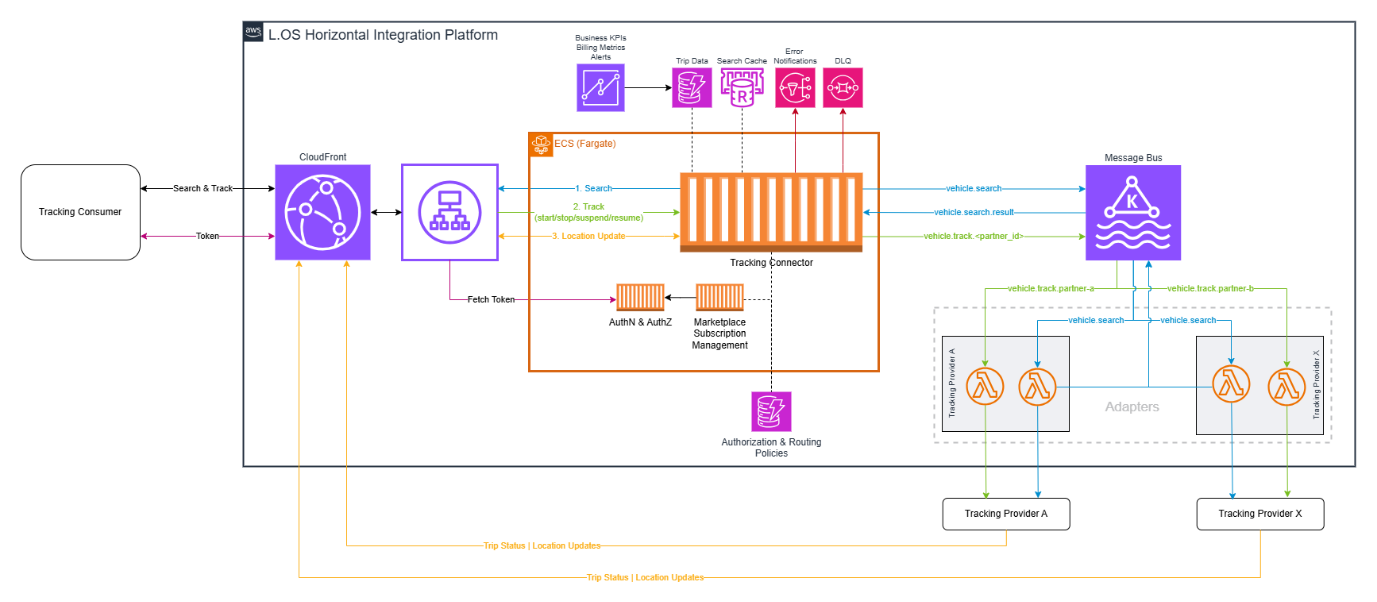
Figure 3 – L.OS architecture on AWS: Client applications connect through Amazon API Gateway to the Tracking Connector running on Amazon ECS Fargate, which handles protocol standardization, routing, and session management. Provider-specific Lambda adapters translate between the standardized connector API and each tracking provider’s API. Amazon MSK serves as the event bus for asynchronous location updates. Amazon ElastiCache provides low-latency caching for frequently accessed data, Amazon DynamoDB stores business rules and security policies, and the Marketplace Subscription Management service (also on Fargate) handles authentication, customer relationships, and provider configurations. Amazon QuickSight delivers real-time monitoring and usage analytics.
Key components
The architecture comprises five core components that work together to deliver reliable, real-time vehicle tracking at scale. Each component handles a distinct responsibility — from protocol translation to event streaming — allowing the system to scale and evolve independently.
Centralized orchestration with Amazon ECS Fargate
The Tracking Connector, running on Amazon ECS Fargate, serves as the central orchestration layer. It handles critical functions including:
- Protocol standardization across multiple providers.
- Intelligent request routing.
- Response aggregation.
- Session management.
- Comprehensive error handling.
- Performance optimization using Amazon ElastiCache.
Serverless provider integration
We use AWS Lambda to implement Tracking Adapters that handle provider-specific transformations. These adapters efficiently translate between our standardized connector API and various provider APIs, allowing for easy onboarding of new providers.
Event-driven communication
Amazon MSK (Managed Streaming for Apache Kafka) powers our message bus, enabling:
- Standardized topic patterns.
- Support for multiple domain connectors.
- Real-time data streaming for tracking, parking, vehicle health, charging, and fleet management.
Subscription and access management
The Marketplace Subscription Management service, deployed on Amazon ECS Fargate, manages:
- Customer relationships.
- Service consumer configurations.
- Provider integrations.
- Authentication and authorization token claims.
Policy and security enforcement
We use Amazon DynamoDB to store and manage:
- Business rules.
- Security policies.
- Authorization configurations.
- Routing rules.
Monitoring and analytics
Amazon QuickSight provides:
- Real-time system performance metrics.
- Usage analytics.
- Health monitoring.
- Anomaly detection.
Benefits
By implementing this serverless architecture on AWS, Bosch L.OS achieved significant improvements in vehicle tracking capabilities:
Operational efficiency
The combination of standardized Lambda adapters and the centralized Tracking Connector on ECS Fargate eliminates the manual coordination that previously slowed provider onboarding. Where ISVs once spent 2–4 weeks on bespoke integration work for each new customer request, the standardized connector API and adapter pattern reduces this to within 3 days. Real-time data validation at the connector layer — before events reach downstream consumers — also improves data accuracy by catching format inconsistencies at ingestion rather than during reconciliation.
Scalability and performance
Because the core connector runs on Fargate with auto-scaling task definitions, and each provider adapter is an independent Lambda function, the system scales horizontally without manual intervention. Bosch’s deployment currently handles 35,000 trips per day — each generating multiple location events — with sub-second response times for 99.9% of tracking queries. As new ISVs are onboarded, additional Lambda adapters are deployed independently, so scaling the provider network does not add load to existing integrations.
Cost optimization
Integrations in fragmented logistics markets often stall because multiple vendors must coordinate through manual processes — handoffs, SIM card provisioning, consent management, and troubleshooting. By automating these workflows within the L.OS connector layer and MSK event bus, Bosch estimates integration costs are reduced by 15–20%. The architecture also removes per-vendor overhead (SIM management, consent flows, provider-specific troubleshooting) that was previously passed on to small transporters. This potentially lowers their total tracking costs by 25–30%.
Enhanced customer experience
The unified API Gateway endpoint and MSK-powered event streaming mean consumers receive location updates from any connected provider through a single interface — regardless of the underlying tracking technology. What previously required hours of manual coordination across providers now surfaces as a consolidated event within approximately 1 minute, according to Bosch. Improved ETA accuracy is a direct result: with standardized, high-frequency location data flowing through ElastiCache, downstream planning systems can compute more reliable arrival predictions.
Compliance and security
DynamoDB-backed policy enforcement ensures that business rules, authorization configurations, and regional compliance requirements (such as India’s AIS140 and FASTag mandates) are evaluated consistently on every request. The built-in security features of AWS — IAM roles, virtual private cloud (VPC) isolation, and encryption at rest and in transit — provide the baseline. Automated audit trails captured through the event bus give organizations a verifiable record of all tracking operations.
L.OS growth
L.OS is currently operational in India with 10 integrated ISVs. The serverless adapter pattern makes geographic expansion straightforward: new region-specific adapters can be deployed as independent Lambda functions without modifying the core connector. Bosch plans to use this approach to expand into Europe for trailer monitoring use cases.
Conclusion
In this post, we showed how Bosch built L.OS, a serverless vehicle tracking platform on AWS that unifies fragmented logistics visibility into a single integration layer. By using AWS services such as Amazon ECS with Fargate for centralized orchestration and AWS Lambda for provider-specific adapters, the architecture standardizes multiple tracking providers into a unified API.
This standardization eliminates the need for maintaining multiple point-to-point integrations, freeing you to focus on core operations instead of managing repetitive integration tasks. Through strategic collaboration with key stakeholders in the visibility solutions space, L.OS is helping businesses achieve measurable outcomes: enhanced customer experience, increased operational agility, reduced operational expenses, and improved profit margins.
What started as a vehicle tracking solution is now evolving into a broader mobility services portfolio, powered by the scalable infrastructure that AWS provides. This evolution positions L.OS to address not only today’s tracking needs, but a broader range of logistics use cases as they emerge.
If you have questions or feedback about this post, leave a comment in the comments section.
- To learn more about the AWS services used in this solution, explore these resources:
- Explore the sample code for this solution on GitHub — includes Infrastructure as Code templates, Lambda function source code, and step-by-step deployment instructions.
- Building real-time fleet tracking applications on AWS
- Best practices for container-based applications using Amazon ECS
- Implementing event streaming with Amazon MSK
For more information about the Bosch L.OS solution and its capabilities, visit Bosch L.OS website.
Contact your AWS account team to learn how we can help you build similar solutions for your logistics operations.