AWS Big Data Blog
Fresher insights, faster decisions: talabat’s near-real-time analytics across AWS and Google Cloud
talabat is the leading everyday app in the Middle East and North Africa (MENA) region, offering customers a convenient and personalized way to order food, groceries, and other everyday essentials from a wide selection of restaurants and retailers. Founded in Kuwait in 2004, talabat has expanded its operations to the United Arab Emirates, Oman, Qatar, Bahrain, Jordan, Iraq, and Egypt, serving over seven million monthly active customers as of December 2025. talabat is headquartered in Dubai, United Arab Emirates, and in December 2024 successfully completed its initial public offering on the Dubai Financial Market (DFM). As a subsidiary of Delivery Hero SE, talabat uses global expertise to continuously enhance its service, expand its landscape, and drive innovation. With a strong network of partners and riders, talabat connects customers to what they need, when they need it – powering everyday convenience across the region.
In this post, we show how talabat built a hybrid, multi-cloud lakehouse that keeps a single Apache Iceberg copy of streaming data on AWS while enabling governed, near-real-time analytics from Google Cloud Platform (GCP).
Data at talabat
Data is the nervous system of talabat’s business. From the moment a customer hits “order” to the second their doorbell rings, talabat’s systems make split-second, data-driven decisions, instantaneously optimizing pricing, dispatch, routing, and order security. Over the years, talabat’s application grew into a landscape spanning two public clouds. Our transactional and operational backbone matured on AWS, where the engineering teams build and operate services. In parallel, a large population of analysts, data scientists, and analytics-engineering pipelines standardized on the Google Cloud Platform warehouse, Google BigQuery.
Both investments are deep, and both deliver value. So the strategic question wasn’t “which cloud do we consolidate on,” but rather “how do we make our data flow cleanly across the boundary between them.” That framing shaped everything that follows. The challenge isn’t only cross-cloud but cross-Region as well, with AWS services hosted in the EU region and the data in the GCP US region.
The following diagram shows how talabat’s data flows between the operational plane on AWS and the analytics plane on GCP.
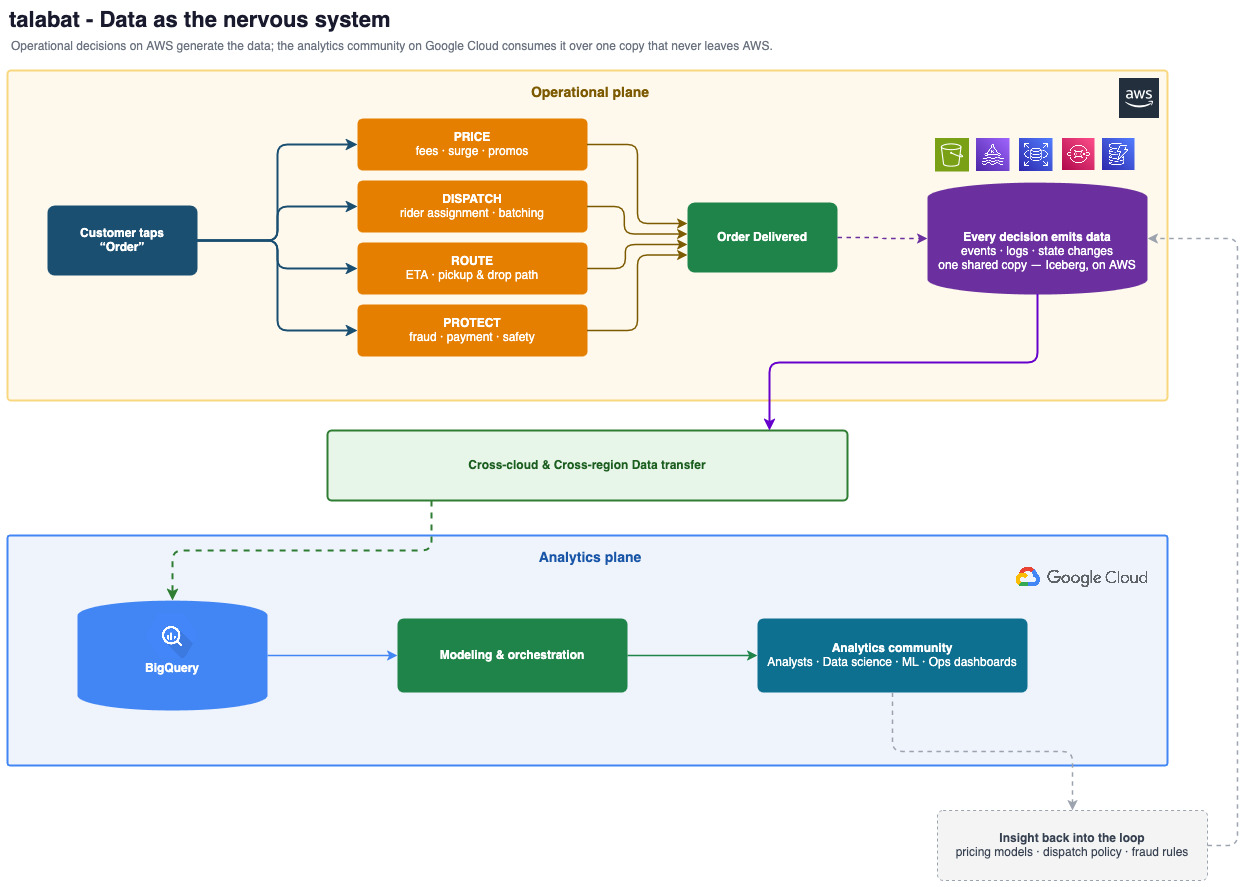
Figure 1: Data flow between the operational plane on AWS and the analytics plane on Google Cloud
Historically, the data engineering team orchestrated the data movement between the two clouds, mandating a physical movement from AWS to GCP, EU to US. Moving this using conventional extract, transform, and load (ETL) tools and frameworks delayed and duplicated the data through multiple hops: Amazon Relational Database Service (Amazon RDS) to Amazon Simple Storage Service (Amazon S3) EU AWS Region, Amazon S3 EU to Amazon S3 US Region, and finally Amazon S3 US to BigQuery US.
Each hop was a copy, and every copy compounded risk: multiple failure points, compounding latency, redundant compute and storage, type fidelity, and most importantly, cross-Region and cross-cloud egress cost.
In short, the old design paid in dollars, latency, and reliability to solve a problem it had created for itself: it moved data so that BigQuery could read it. A classic data warehouse bottleneck. Could we use an open data lake instead? Yes. But the analytics usage is heavy on BigQuery, which limits access through an open source data lake layer. So the redesign started from the opposite premise: keep one copy on AWS and let BigQuery read it in place. That is what the rest of this post describes: a lakehouse for talabat.
Challenges
Operational systems emit a continuous stream of business events like order lifecycle changes, vendor, menu, logistics and rider signals, and payments information published to Apache Kafka on Amazon Managed Streaming for Apache Kafka (Amazon MSK). These events are encoded as Protocol Buffers and governed by backward-compatible schemas registered in Confluent Schema Registry, so producers and consumers can evolve safely over time.
The requirement on the analytics side is straightforward to state and hard to meet: make these events queryable, correctly typed, within minutes of being produced, and make them queryable from the tools each team already uses.
It’s tempting to view a two-cloud footprint as technical debt. For a real-time business like talabat, it’s simply the terrain, and each side plays to a genuine strength:
- The event backbone lives on AWS. Our transactional and streaming systems publish to Amazon MSK. The lowest-latency, lowest-risk place to consume and process those events is next to them, in the same AWS Region.
- The analytics estate lives on Google Cloud. Thousands of downstream models and dashboards, and the people who build them, assume BigQuery as the query surface.
Consolidating either side would mean a multi-year migration and a significant regression in capability for one group of users, all to remove a seam between ingestion and analytics. Data engineers decided to engineer the seam instead. The design goal became a single sentence: keep one physical copy of the data on AWS, and read it natively from both clouds. A hybrid data lakehouse makes the “which cloud” question an access-path detail rather than an architectural fork.
What we tried first: Cross-cloud writes on the hot path
Our first attempt inverted the flow we eventually shipped. Raw (also called Bronze) layer data was written from AWS directly into BigQuery-managed Iceberg tables on Google Cloud Storage. On paper, this placed the data closest to the largest consumer base. In practice, writing across clouds on an always-on streaming path introduced a class of problems we did not want to live with:
- A cross-cloud dependency on the ingestion path. Every micro-batch was coupled to the availability and latency of a remote cloud’s write API.
- Streaming write-API failures surfaced as ingestion incidents. The remote write became the fragile link, turning read-side concerns into write-side outages, the worst place to absorb them.
- Preview-gated capabilities constrained the physical layout. Certain partitioning behaviors and features were not generally available, limiting how we could organize the data for cost and performance.
The lesson was clear: Shift left. The write path should be short, local, and straightforward. The cross-cloud concern belongs on the read path, where it can be made read-only, cached, and retried without affecting the ingestion. That reframing led directly to the architecture we run today.
Choosing how BigQuery would read AWS resident data
With the flow inverted (raw data on AWS, read from Google Cloud), we evaluated three ways for BigQuery to read tables that physically live on AWS. We assessed each against four criteria:
- No data movement.
- An open table format.
- A governable trust model.
- Minimal operational surface.
| Approach | Assessment |
| Cross-cloud write to Google Cloud Storage | Continue writing bronze into BigQuery-managed Iceberg on Google Cloud Storage. We rejected this for the preceding reasons: it puts a cross-cloud dependency and cross-Region latency on the ingestion hot path. |
| BigQuery Omni | Query AWS resident data through the managed cross-cloud compute of BigQuery Omni. This introduced more managed surface and more constraints than we needed for a read-only bronze layer, and we wanted to own the catalog and trust model directly. |
| Lakehouse federated Apache Iceberg REST catalog (authenticated by IAM) | Let BigQuery read data in Amazon S3 Tables, a capability of Amazon S3 that provides managed Apache Iceberg tables, through a federated catalog that synchronizes AWS Glue Data Catalog metadata, with access authenticated by cross-cloud IAM trust. This met all four criteria, and we chose it. |
The deciding properties were that the raw data doesn’t leave AWS, the format is open Apache Iceberg (so Amazon Athena, Spark, and Iceberg-compatible engines read the same tables), and the cross-cloud relationship is expressed as identity and trust rather than as a recurring copy job.
Why Amazon S3 Tables
With the architecture settled on a single Iceberg copy living on AWS, we needed a storage layer purpose-built for Iceberg at scale. Amazon S3 Tables met the requirements without adding operational surface. Table maintenance (compaction, snapshot expiration, and unreferenced file removal) runs automatically as a service-managed policy, avoiding the need for external orchestration jobs that would otherwise grow linearly with table count. Equally important, every table is an Amazon Resource Name (ARN)-addressable resource. That means IAM policies can grant or deny access for individual tables, the same least-privilege model we apply to any other AWS resource, and AWS CloudTrail records every access decision. For a cross-cloud design where the trust boundary is expressed entirely through IAM, having tables that are first-class IAM resources isn’t a convenience but a prerequisite. S3 Tables gave us managed Iceberg housekeeping and fine-grained, auditable access control in a single construct, so the engineering team could focus on the streaming logic rather than the storage plumbing beneath it.
Solution overview
The system has two halves that meet at an open table format:
- A short, local write path on AWS.
- A read-only cross-cloud handshake that lets BigQuery consume the data.
The single source of truth is Apache Iceberg data in Amazon S3 Tables. Every consumer reads that one physical copy.
The following diagram shows the end-to-end architecture, from event ingestion through storage to consumption paths.
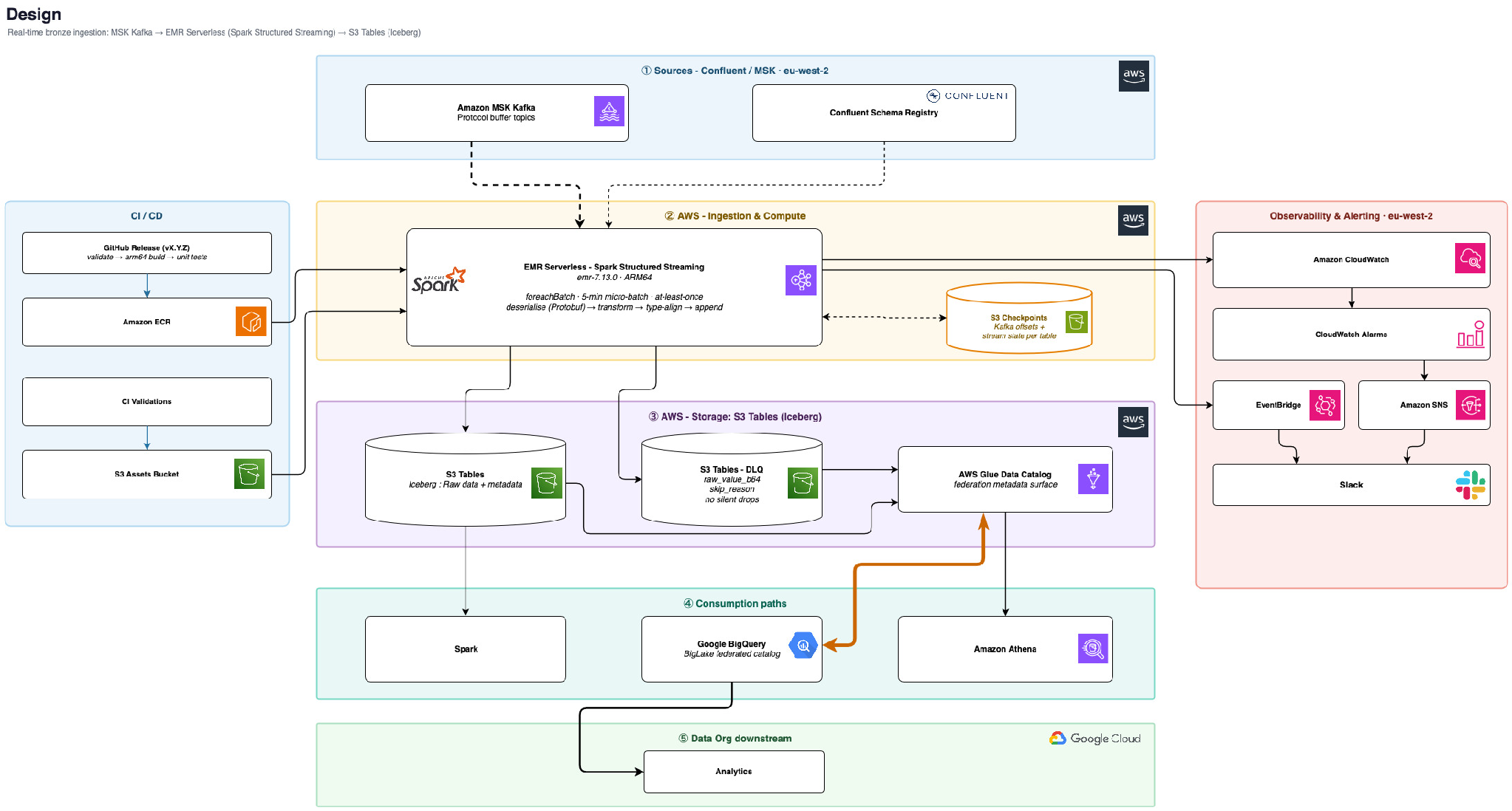
Figure 2: End-to-end architecture from event ingestion through storage to consumption paths
The write path: Short, local, and reliable
We run one Amazon EMR Serverless Spark Structured Streaming job per Kafka topic (with a prebaked Docker image, emr-7.13.0 on ARM64/Graviton) in the same AWS Region (eu-west-2) as Amazon MSK. Co-locating compute with the event backbone minimizes the data transferred per micro-batch, saving cost and latency. Each job runs the Spark foreachBatch operation with a trigger interval of roughly one to five minutes and at-least-once delivery. Every micro-batch performs five steps:
- Consume from Kafka.
- Decode Protocol Buffers using the registered schema.
- Transform to the target Iceberg schema.
- Append to the Iceberg table in Amazon S3 Tables.
- Commit offsets.
The cycle repeats without interruption.
This path touches only AWS. There is no cross-cloud dependency, only one deliberate cross-Region hop: compute in the Europe (London) Region (eu-west-2), storage in the US East (N. Virginia) Region (us-east-1). This incurs standard AWS inter-Region data transfer cost, a deliberate choice so that the cross-cloud read from BigQuery stays within the same Region.
Bad records don’t block the stream. They land in a dedicated dead-letter queue (DLQ) table (<table>_dlq) in a separate S3 Tables bucket, storing the raw payload (raw_value_b64) and a skip_reason. Nothing is silently dropped. The DLQ tables are registered with the AWS Glue Data Catalog through Lakehouse, so engineers can inspect failures from Amazon Athena or BigQuery.
From this point on, Amazon S3 Tables is the source of truth.
The crux: Cross-cloud handshake
This is the heart of the design. BigQuery reads the S3 Tables Iceberg data through a Lakehouse federated Apache Iceberg REST catalog, a read-only catalog on the Google Cloud side that points at the AWS resident tables. Three mechanisms make it work.
- An open catalog contract (Iceberg REST).
Amazon S3 Tables exposes an Apache Iceberg REST catalog interface, and Google Lakehouse speaks that same standard. Because both sides agree on the Iceberg on-disk format and REST catalog protocol, no translation layer or data copy is required. BigQuery reads the identical Iceberg data files that Athena and Spark read.
On the Google Cloud side this is a single Lakehouse federated catalog. A table surfaces to analysts as
talabat-data.s3tables-glue.catalog.orders.
- Cross-cloud identity and trust (IAM and OIDC).
The Lakehouse catalog authenticates to AWS as a Google-managed service identity (the Lakehouse REST-catalog service account) that an AWS Identity and Access Management (IAM) role trusts through OpenID Connect (OIDC) federation with
accounts.google.com, usingsts:AssumeRoleWithWebIdentitywith the service account’s numeric ID pinned in the role’s trust policy. Requests to the S3 Tables Iceberg endpoint are SigV4-signed. It’s the same AWS request-signing scheme that any AWS SDK uses, scoped to the S3 Tables service. In other words, the handshake isn’t a proprietary connector. It’s standard AWS request signing performed by a trusted external identity.The trust is codified as infrastructure as code (IaC) on the AWS side: granted least-privilege, and revocable at any time. The following diagram shows this authentication sequence.
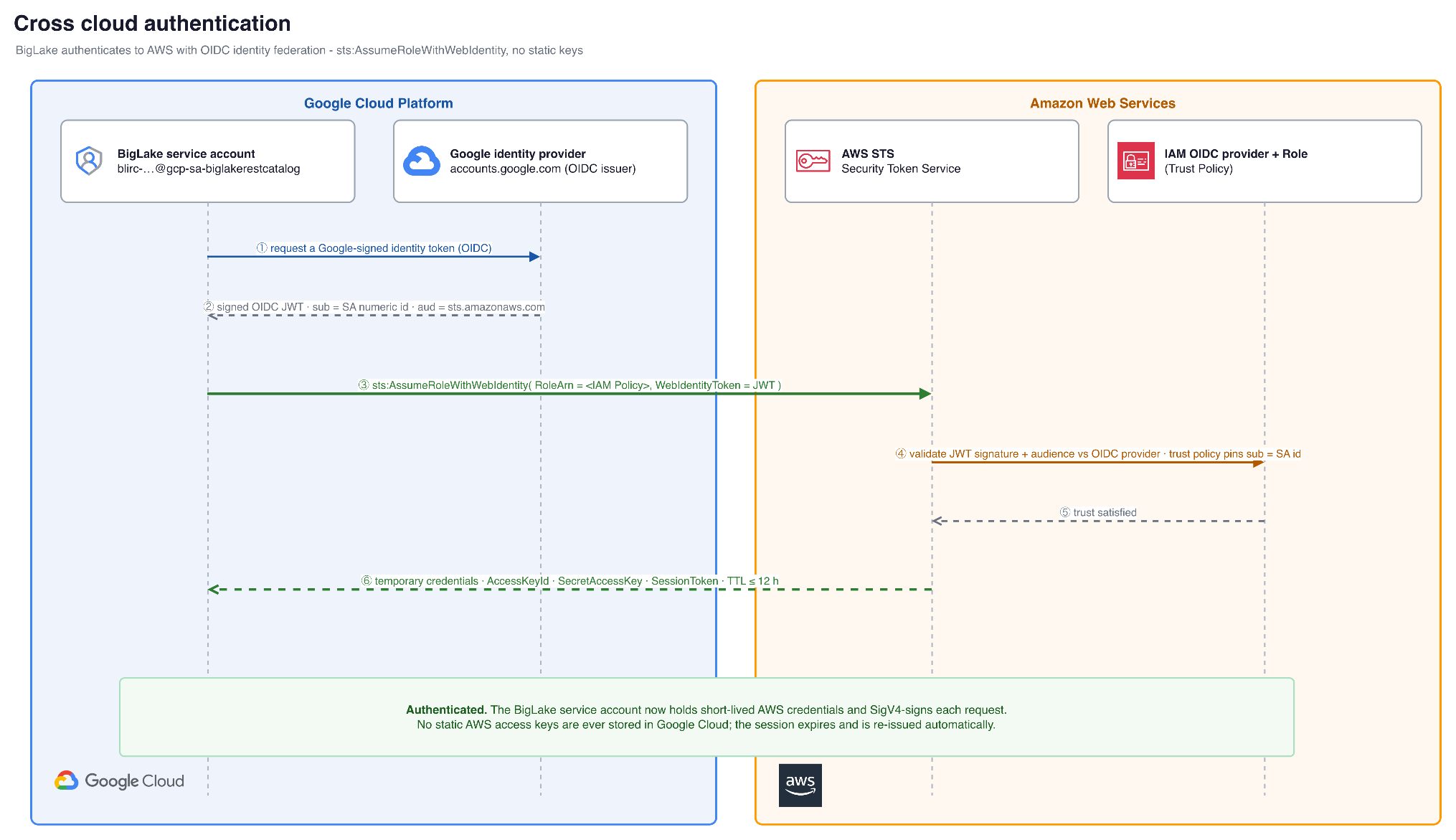
Figure 3: Cross-cloud authentication sequence between the Lakehouse catalog and AWS IAMFor a step-by-step walkthrough of this trust relationship, creating the IAM role, validating the token’s audience and subject, and pinning the Lakehouse service-account identity in the trust policy, see Create and manage AWS Glue federated datasets and Set up cross-cloud Lakehouse for AWS Glue.
- Metadata synchronization (approximately five-minute refresh).
The federated catalog periodically synchronizes table metadata from the AWS Glue Data Catalog that fronts S3 Tables. Newly created tables and new data become visible to BigQuery on a short refresh cycle (approximately 300 seconds). Reads are served against the live Iceberg data. Only the catalog pointers are synchronized.
The result is that a table written once on AWS appears in BigQuery as an ordinary catalog object and can be queried with standard SQL, while the bytes don’t leave AWS and the format stays open.
Infrastructure as code: The cross-cloud trust surface
The following section explains the authentication handshake shown in the architecture diagram. The Lakehouse catalog service account presents a Google OIDC JSON Web Token (JWT), which AWS validates through the IAM OIDC provider, returning short-lived credentials scoped to read-only S3 Tables access.
- Register Google as a trusted identity provider. Scoped to our Lakehouse catalog’s service account:
- Pin the trust to exactly that one identity. This is the security crux. The role can only be assumed through a Google-signed token whose subject matches our service account. A condition on the sub claim closes the door to every other principal:
- Grant read-only, least privilege. The assumed role carries only enough to read the catalog metadata through AWS Glue and access the Iceberg data through S3 Tables, secured entirely by IAM policy and nothing writable:
- The Google-side catalog is bound to this role. The Lakehouse federated catalog itself is created out of band (a one-time gcloud call), pointed at the preceding role so that every read presents that trusted identity. No AWS keys ever live in Google Cloud:
Together these four steps are the whole handshake: a trusted issuer, a role that only our service account can assume, a least-privilege read grant, and a catalog bound to that role.
Operational lessons: Metadata as a first-class concern
Operating an open, federated catalog across clouds taught us to treat table metadata as a first-class operational concern. In practice this means:
- Snapshot retention: Keeping Iceberg snapshot retention short so that per-table metadata stays compact and synchronizes reliably.
- Compaction: Standardizing table maintenance (compaction and snapshot expiry) as a uniform, service-managed policy through the S3 Tables built-in maintenance configuration.
- Schema evolution: When a Protobuf schema evolves (backward-compatible additions), the Spark job appends or removes columns in the Iceberg schema in S3 Tables. The federated catalog picks up the change on its next sync cycle, and BigQuery reflects the changes without manual intervention.
These are small, well-understood settings once we know how to set them, and they are the difference between a catalog that simply works and one that drifts.
Consuming the data is a choice of engine, not a choice of copy
After a source is live, the same Iceberg table is available three ways over one physical dataset.
- A BigQuery user queries it in standard SQL and joins it to the rest of the Google Cloud warehouse.
- An infrastructure engineer runs the identical query in Amazon Athena for ad hoc checks and continuous integration (CI) validation.
- A data scientist reads the table directly with Spark, with no BigQuery or Athena in the path.
Nobody waits for a nightly export, and nobody reconciles three divergent copies. There is only one.
Performance and cost impact
The qualitative benefits are already clear:
- Minutes-fresh raw data for near-real-time analytics. The previous architecture’s latency was not a volume problem. It was a design constraint. Ingestion ran every five minutes, but a downstream hourly batch job gated end-to-end freshness to 60–90 minutes. With catalog federation, that same data is queryable within minutes of being produced: under five minutes for 95 percent of events, with the option to tune the pipeline to cover 100% of events for latency-sensitive or mission-critical workloads.
- One storage copy in S3 Tables, three compute engines. BigQuery, Athena, and Spark or another Iceberg-compatible engine read a single physical Iceberg dataset in Amazon S3 Tables, avoiding duplicate storage and the reconciliation tax of keeping copies in sync.
- No cross-cloud egress on the hot path. Ingestion is local to AWS. The only cross-cloud traffic is read-time metadata synchronization and query reads, not a continuous write stream. Based on an internal comparison of monthly AWS and Google Cloud data-transfer charges, orchestration overhead, multi-layered ETL workflow costs, and storage backup charges, talabat reduced data-movement costs by approximately 40 percent for comparable data volumes. The comparison spanned a two-month period before and after removing the continuous replication pipeline, and the change eliminated hundreds of terabytes of recurring cross-Region and cross-cloud data transfer per month.
- Open table format, no lock-in. Because the raw bronze data layer is Apache Iceberg in Amazon S3 Tables, the data isn’t captive to any single query engine or cloud. New consumers adopt it by speaking Iceberg, not by requesting an export.
- Governable cross-cloud access. The cross-cloud boundary is secured by an IAM trust relationship (least-privilege, auditable, and revocable) rather than a standing data pipeline. End-user access control within BigQuery is managed separately through the native role-based access control (RBAC) in GCP and fine-grained access controls on the federated catalog.
Future enhancements
Looking ahead, we plan to broaden source coverage by onboarding the remaining high-value event streams and batch stores onto a hybrid one-configuration pattern. We’re formalizing end-to-end freshness objectives and the observability around them: batch-level metrics, dead-letter monitoring, and catalog-synchronization health. We will continue tuning snapshot retention and compaction so the cross-cloud catalog stays fast and reliable as the number of tables grows. More broadly, we intend to make “written once, read by any engine” the default for new datasets beyond the bronze layer, leaning further into open table formats as the connective tissue between cloud service providers.
Conclusion
Being on two clouds is often framed as a problem to migrate away from. It’s simply the terrain for talabat. The event backbone is prominent on AWS, and the analytics community operates on BigQuery. By making Amazon S3 Tables with Apache Iceberg the single source of truth on AWS and letting BigQuery consume it read-only through a Lakehouse federated Iceberg REST catalog secured by cross-cloud IAM trust, we turned a two-cloud constraint into a single governed dataset that engines can read within minutes. The write path stays short, local, and reliable. The cross-cloud concern lives on the read path, where it belongs, expressed as open standards and identity, not as data movement.
That is the handshake: one copy of the data on AWS, an open catalog contract, and a signed, trusted, revocable identity reaching across the cloud boundary to read it.
This post focuses on reading AWS resident data from BigQuery. For the broader multi-cloud Lakehouse pattern, including federating catalogs from other systems into the AWS Glue Data Catalog, see Multi-cloud Lakehouse architecture on AWS for agentic AI.