AWS Database Blog
Faster scaling for Aurora serverless to support agentic AI and other spiky workloads
Agentic AI workflows issue sudden bursts of database queries. SaaS platforms trigger batch jobs at unpredictable hours. Social media apps absorb viral traffic spikes. These workloads need a database that responds instantly when demand spikes. Aurora serverless is built for exactly this. Aurora serverless is an on-demand, autoscaling configuration for Amazon Aurora. It automatically scales up to meet your most demanding workloads, and scales to zero capacity when there are no connections, so you pay only for the capacity your application uses.
With the recently launched faster scaling, your database now automatically adds 12 Aurora Capacity Units (ACUs) to its current capacity within a second. It continues scaling up to 256 ACUs as your workload grows. Each ACU provides approximately 2 GiB of memory with corresponding CPU and networking. This improvement is turned on by default for Aurora serverless clusters running on platform versions 3 and 4, with no configuration changes required. You can confirm your platform version on the AWS Management Console under the instance configuration section. You can also check the ServerlessV2PlatformVersion parameter through the Amazon Relational Database Service (Amazon RDS) API.
In this post, we show how an Aurora serverless cluster responds to a sudden workload spike, and we compare its throughput against a provisioned db.r8g.xlarge instance using benchmark data.
Scale in a second
Aurora serverless automatically allocates CPU and memory resources when the workload starts and releases them efficiently when the workload completes. Aurora serverless regulates scaling speed to provide non-disruptive, predictable scaling behavior. Recently, Aurora serverless improved its scaling behavior, including 2x faster scaling rate and improved price performance. Building on that, Aurora serverless further optimized its scaling so that instances can scale instantly to higher capacity. It can scale up 12 ACUs in a second and continues to scale up to 256 ACUs as your workload demands. Instant scaling is supported at any ACU level within the configured minimum and maximum capacity range.
To demonstrate this, we ran a benchmark on an Aurora serverless cluster running Amazon Aurora PostgreSQL-Compatible Edition on platform version 4. We set capacity to a minimum of 0.5 ACU and a maximum of 12 ACUs. We used the Sysbench oltp_write_only.lua workload to load a table with sample data. Then we ran a simple query: select pad, c from sbtest1 order by pad, c limit 1. We monitored the Amazon CloudWatch metric ServerlessDatabaseCapacity. It showed that the Aurora serverless DB instance completed the full scaling operation from 0.5 ACU to 12 ACUs within 1 second, as demonstrated in Figure 1.
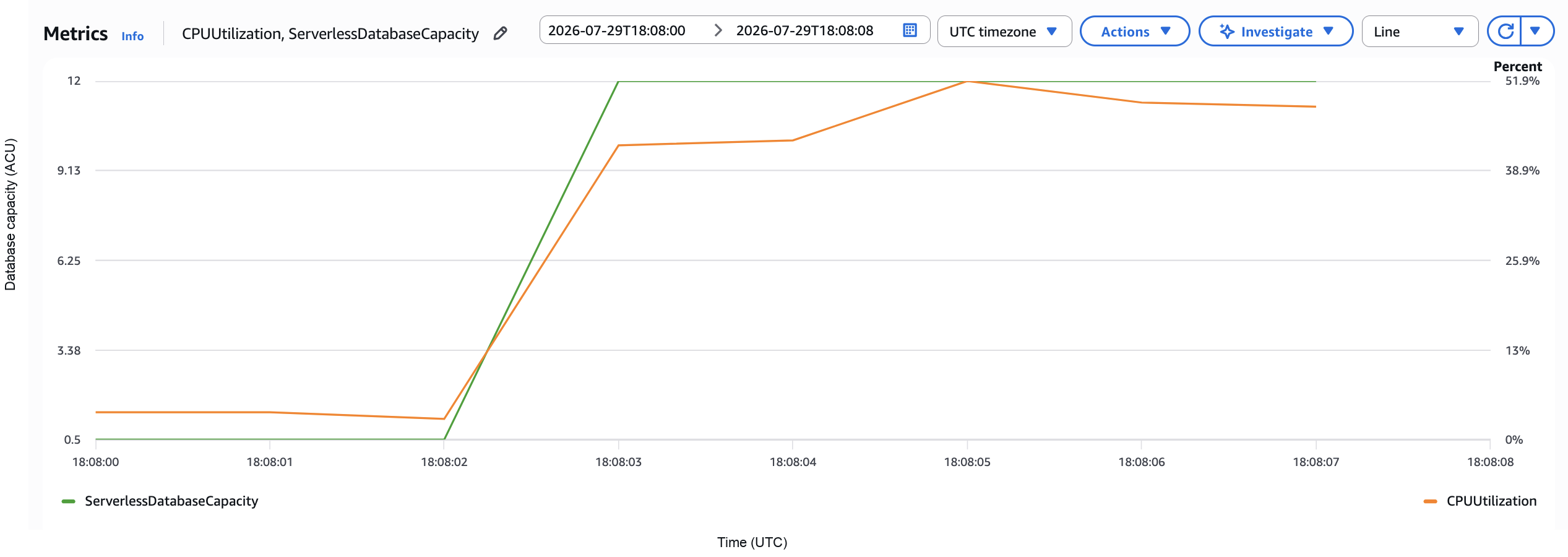
Figure 1: Aurora serverless capacity scales from 0.5 to 12 ACUs in under a second to meet workload demand
Fast, non-disruptive scaling
Adding 12 ACUs in a second means little if queries stall along the way. With instant scaling, Aurora serverless raises throughput quickly to meet workload demands, reaching peak performance faster than before. Application performance improves as the database scales up, with no degradation in query processing capacity during the transition. After Aurora serverless reaches peak capacity, it can achieve throughput levels comparable to provisioned DB instances. To illustrate this, we compared an Aurora serverless cluster against a provisioned db.r8g.xlarge instance over the first 120 seconds of a write-heavy workload. The Aurora serverless cluster ran platform version 4 with 4 ACUs minimum capacity and 16 ACUs maximum capacity. Figure 2 shows Sysbench queries per second (QPS) as Aurora serverless (blue) scales up compared to a provisioned db.r8g.xlarge instance (green).
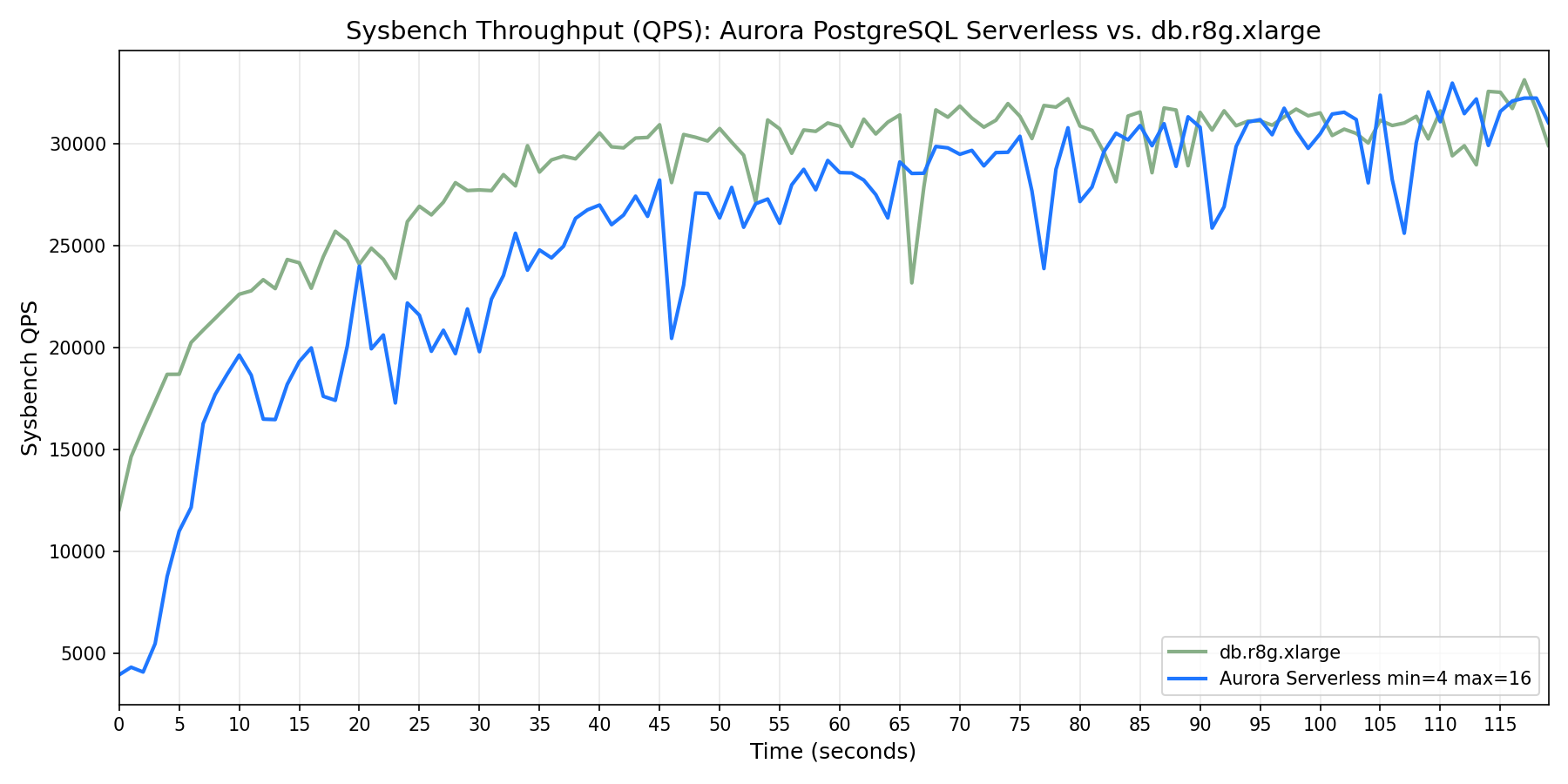
Figure 2: Aurora serverless (blue) matches a provisioned db.r8g.xlarge instance (green) in Sysbench queries per second
In this example, we ran the same workload on both clusters. We used the Sysbench
oltp_write_only.lua workload to load 100 tables totaling 16 GiB of data, then ran transactions across them with 256 threads. Based on the figure showing Sysbench client-side QPS in 1-second intervals, both clusters demonstrate a comparable level of performance. The throughput gap during the first 10 seconds exists because the provisioned instance has the full 16 GiB dataset already fully cached in its shared buffer. Aurora serverless starts with a small cache but scales instantly, closing the gap after approximately 1 minute, and then matches provisioned performance for the remainder of the workload. This demonstrates that Aurora serverless delivers provisioned-class performance for write-heavy workloads without requiring you to manage fixed capacity.
Summary
Aurora serverless now adds 12 ACUs within a single second and continues scaling to 256 ACUs as demand grows, all without disrupting in-flight queries. Your AI agents might issue unpredictable bursts of database calls, or your SaaS platform might process batch jobs. In both cases, your database adapts in real time and you never pay for idle capacity. This improvement is turned on by default on platform versions 3 and 4 with no configuration changes required. For more information about scaling, see Aurora serverless. To get started, create an Aurora serverless database on the AWS Management Console.
Special thanks
Special thanks to Jiaming Yan, Nashad Safa, and Jihoun Im for their contributions to this work.