AWS for Industries
Building an Insurance Policy AI Assistant using Amazon Bedrock
Introduction
In working with insurance providers, we have observed a consistent challenge: making complex policy information accessible and understandable to customers across their preferred channels. When customers seek coverage details, they often encounter dense policy documents, generic chatbot interactions, or lengthy call wait times. These friction points create customer frustration, drive up operational costs, and represent missed opportunities to build trust through clear, personalized service.
This blog post and its included artifacts will show you how to build an AI assistant that uses generative AI to transform how customers interact with their insurance policies. We provide an architecture diagram, a video of the implementation, and a link to the AWS Samples GitHub repository so you can deploy this solution in your own environment. This solution enables customers to access accurate policy information, understand coverage details, and receive assistance 24/7, with no lengthy phone queues or tedious searches through policy documents.
Customer Opportunity
Insurers can modernize the policy information experience through generative AI-powered assistance to:
- Transform complex policy documents into clear, conversational guidance that customers understand.
- Deliver personalized responses tailored to each customer’s specific coverage and terms.
- Provide instant, accurate support 24/7 while reducing operational costs.
- Strengthen compliance by ensuring consistent, documented responses with source citations.
- Reduce call center volume by empowering customers to self-serve.
Organizations that embrace generative AI can convert policy comprehension —traditionally a customer pain point — into a competitive advantage that drives customer satisfaction and retention.
Solution Overview
We will show you an implementation pattern for an insurance policy AI assistant that processes unstructured policy documents and customer queries to create personalized, conversational experiences. The solution combines Amazon Bedrock’s retrieval augmented generation (RAG) capabilities through Amazon Bedrock Knowledge Bases with customer-specific policy data to deliver accurate, tailored responses.
For response generation, Amazon Bedrock provides access to multiple foundation models. This implementation uses Anthropic Claude 4.5 Haiku, which offers an optimal balance of speed, cost, and quality for conversational interfaces. Its fast response times keep conversations fluid while maintaining the sophistication needed to interpret complex insurance terminology and generate accurate, personalized guidance. Amazon Bedrock Guardrails helps maintain response quality by filtering inappropriate content and verifying factual grounding. The design separates general policy documents from customer-specific ones in Amazon Simple Storage Service (S3), enabling tailored answers while maintaining data isolation. A Streamlit application running on Amazon Elastic Compute Cloud (EC2) behind an Application Load Balancer provides the user interface, with Amazon Cognito handling authentication. Amazon CloudFront and AWS WAF deliver optimal performance and protection from external threats.
The implementation pattern and code repository provide insurance companies with a proven starting point to build, test, and deploy production-ready solutions that deliver measurable business value.
Architecture
The following diagram illustrates the architecture of the solution. For illustration purposes, this implementation uses Streamlit running on Amazon EC2 to provide a user interface that showcases the capabilities of the AI assistant. While this approach effectively shows the solution’s functionality, production environments must evaluate frontend options that align with their organization’s security, scalability, and architectural standards.
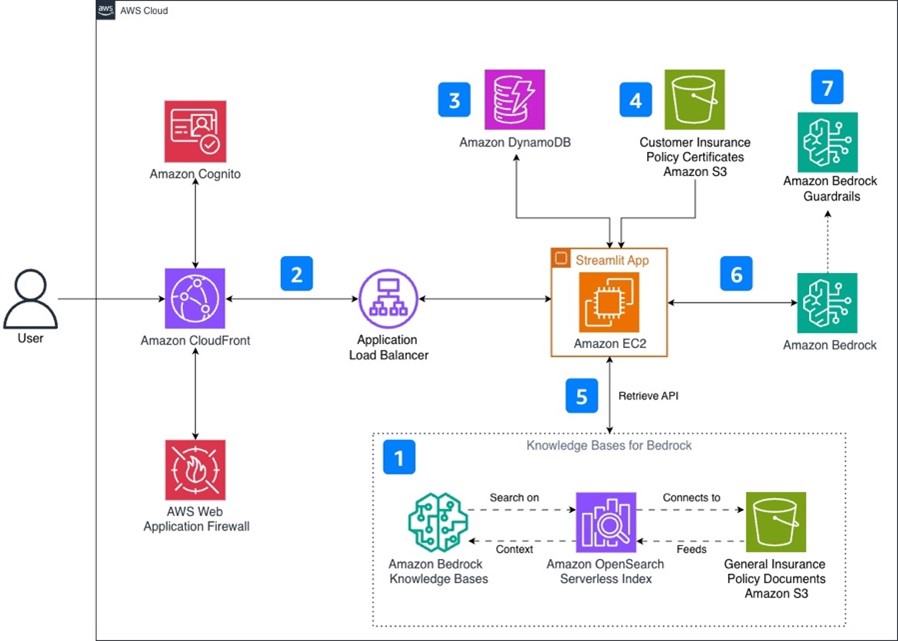
Figure 1: Solution Architecture
Solution Workflow
The following section explains the different parts of the architecture, each point referencing the labelled number on the architecture diagram.
- Knowledge Base Foundation: Amazon Bedrock Knowledge Base ingests general, non-customer specific insurance policy documents from Amazon S3, generating embeddings using Amazon Titan Text Embeddings V2. We chose this embedding model for its optimal balance of accuracy, cost-effectiveness, and native AWS integration — critical factors when processing high volumes of insurance documents. The embeddings are stored in Amazon OpenSearch Serverless for scalability and high performance vector similarity search.
- Secure and Resilient Application Architecture: Users access the Streamlit application through Amazon CloudFront, protected by AWS WAF against common web attacks. Amazon Cognito handles authentication, while Application Load Balancer distributes traffic to Amazon EC2 instance hosting the application.
- Session History: Amazon DynamoDB captures session IDs and chat interactions. While not implemented in this solution, organizations can analyze this data to identify frequently asked questions, recognize customer interaction patterns, and drive continuous service improvements.
- Customer Document Management: Customer’s insurance policy documents, securely stored in Amazon S3, have a naming convention that matches the authenticated username. When a customer logs in through Amazon Cognito, the Streamlit application uses their username to retrieve the corresponding policy document from S3 (for example, user “john_doe” maps to “john_doe.txt”). This ensures each customer only accesses their own policy information and receives personalized responses based on their specific coverage details. This direct username-to-filename mapping simplifies the demonstration and helps readers understand the personalization concept. For production implementations, consider using more robust mapping mechanisms such as unique customer identifiers stored in a database or metadata service.
- Intelligent Query Processing: When users ask questions, the application uses the Amazon Bedrock Knowledge Base’s Retrieve API to perform a semantic search against the general insurance policy documents (pre-processed and stored as embeddings during the initial setup). These documents contain terms, conditions, and coverage information applicable to all customers. The system identifies and retrieves the most relevant chunks based on the user’s query.
- Personalized Response Generation: Amazon Bedrock combines the retrieved knowledge base chunks with the customer’s specific policy document (retrieved from S3 based on their authenticated username). Claude 4.5 Haiku processes this combined information to generate contextually accurate and personalized responses.
- Guardrails for Responsible AI: Amazon Bedrock Guardrails help implement responsible AI principles including safety, explainability, and fairness. The service applies multiple protection layers: blocking prompt injection attempts, filtering harmful content, verifying factual grounding against source documents and enforcing relevance thresholds. These controls work together to promote fair treatment of all users while maintaining explainable, trustworthy responses.
Amazon Bedrock Guardrails in this implementation uses asynchronous mode to deliver an optimal user experience. In asynchronous mode, response chunks stream to users immediately as they become available, while guardrails policies apply in the background. This reduces latency and maintains natural conversation flow, which is essential for customer satisfaction. While asynchronous mode might allow initial chunks through before scanning completes, this approach works well for insurance policy assistance where the controlled nature of policy information and customer-specific data reduces the risk of showing inappropriate content.
For use cases requiring complete content validation before delivery or sensitive information masking, consider using synchronous mode, which scans all chunks before sending them to users. To learn more about choosing between processing modes, see the Amazon Bedrock Guardrails documentation.
Solution Walkthrough
This solution provides an intuitive way for insurance customers to understand their policies through natural language conversations. To demonstrate the core capabilities, this implementation showcases the essential workflow from user authentication to personalized response generation.
In the following animated GIF, you can see the solution’s personalization capabilities in action. We demonstrate logging in as two different users — each with unique motor insurance policies — and asking the same questions to showcase how responses are tailored to individual coverage details. This personalization transforms a generic chatbot into a valuable customer service tool.
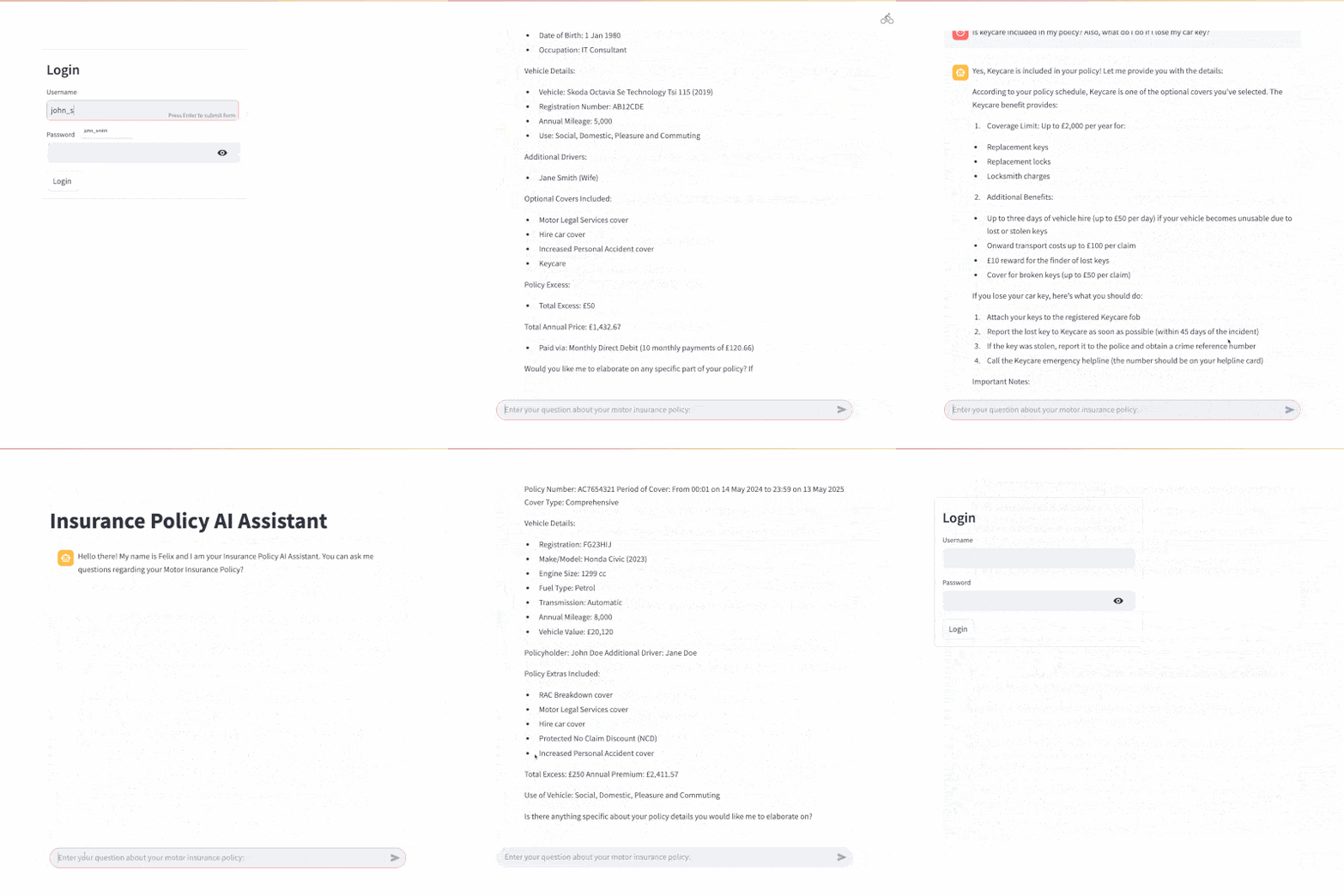
Figure 2: Animated GIF of the Insurance Policy AI assistant
What makes this solution particularly valuable is its ability to transform complex insurance terminology into clear, understandable language while maintaining accuracy through the combination of RAG and advanced large language models. When retrieving policy information, the system pulls relevant sections from the knowledge base, then uses Anthropic Claude’s natural language capabilities to rephrase dense legal text into conversational responses while preserving the original meaning and citing source documents. For example, customers ask questions like, “Am I covered for windshield damage?” or “What’s my deductible for collision claims?” and receive personalized answers based on their specific motor insurance policy terms, complete with relevant citations from the source documents.
AWS Samples GitHub Repository
We have made this an open source solution available on GitHub. This enables developers and organizations to use, customize, and extend the solution to meet their specific business requirements. This repository provides a proof-of-concept implementation of the discussed architecture.
To deploy the solution, follow the implementation guide provided in the GitHub repository. The deployment process begins with verifying the prerequisites, including ensuring access to Claude 4.5 Haiku model in Amazon Bedrock in your target AWS Region. The repository includes detailed AWS Cloud Development Kit (CDK) deployment instructions that guide you through the infrastructure setup process.
This Infrastructure as Code (IaC) approach ensures consistency, repeatability, and reduces the potential for configuration errors during setup. The CDK stack provisions all necessary AWS services. While our implementation focuses on insurance policy assistance, we designed the architecture for extensibility. Organizations can customize the solution by:
- Incorporating customer service operational guidelines into the system prompt and Guardrails to align responses with company standards.
- Integrating the solution into existing customer portals.
- Selecting different foundation models in Amazon Bedrock to optimize for cost, latency, accuracy, or specific language capabilities based on business priorities
- Extending the authentication flow to integrate with existing identity providers.
The repository includes sample policy documents, deployment scripts, and architectural guidance to help teams successfully implement and customize the solution.
Before deploying to production, consider your specific requirements, such as
- Implementing proper data governance and retention policies for chat history.
- Scaling considerations for handling concurrent user sessions.
- Enabling omnichannel experiences and chat monitoring for consistent support across all customer touchpoints.
- Customizing Amazon Bedrock Guardrails based on your compliance requirements.
By releasing this as an open source solution, we hope to accelerate the insurance industry in their digital transformation journey. Organizations can build upon this foundation to create sophisticated AI powered customer service solutions that improve policyholder satisfaction while reducing operational costs through automated assistance available 24/7.
Conclusion
In this post, we showed how Amazon Bedrock’s capabilities can transform insurance customer service by delivering personalized policy guidance. The implementation showcases a scalable pattern using Amazon Bedrock combined with supporting AWS services.
Through this implementation, we learned that AWS services and foundation models can create effective insurance assistants by providing proper grounding in factual information, implementing security measures, and enabling careful handling of personal data. This personalization capability transforms generic information into actionable, relevant guidance for each customer, differentiating the solution from typical FAQ systems.
The solution demonstrates automated personalized responses for insurance customers, enabling them to interact with policy information through natural conversation. Built on Amazon Bedrock, Amazon EC2, Amazon S3, Amazon DynamoDB, and Amazon Cognito, it provides personalized responses based on individual coverage, explains complex terms clearly, and operates 24/7. Amazon Bedrock Guardrails help customers ensure responses meet financial services compliance standards while preventing prompt injection attacks.
It also shows how generative AI can reduce operational costs for insurance providers while improving customer satisfaction.
Get started by exploring the GitHub repository and deploying the solution in your AWS environment. To learn more about building generative AI applications, visit the Amazon Bedrock documentation and explore our generative AI resources.
Additional Resources
- Build responsible AI applications with Amazon Bedrock Guardrails
- Build verifiable explainability into financial services workflows with Automated Reasoning checks for Amazon Bedrock Guardrails
- Automated Insurance claims processing using Amazon Bedrock, Knowledge Base, and Agents
- Zero Touch Claims – How P&C insurers can optimize claims processing using AWS AI/ML services