Migration & Modernization
How Grupo UPAX modernized its Human Capital Management solution with AWS
In this blog post, we will describe how Grupo UPAX, a Mexican Professional Services Company specializing in technology, innovation and creativity for business, modernized one of its core applications (Talento Zeus) using AWS Serverless Technology, increasing business agility, while reducing costs and operation effort.
The challenge Grupo UPAX wanted to solve for Talento Zeus
Talento Zeus is a mobile front-end application focused on managing and tracking corporate tasks for companies. This application includes functionalities for human management, promotions and discounts, general communications, corporate private chats, attendance management, and performance tracking of registered employees. It can be customized based on the company using the platform.
In 2018, Talento Zeus was developed based on Amazon Elastic Compute Cloud (Amazon EC2) and Amazon Relational Database Service for Oracle (Amazon RDS for Oracle). This allowed them to handle several hundred concurrent users and leverage their previous experience managing on-premises equipment.
When Talento Zeus started to handle more than 10,000 concurrent users and more business requirements, the underlying technologies placed an increasing burden on their infrastructure team. Patching, scalability configurations, and security management consumed their time. The infrastructure team struggled with the rapid pace of business changes.
The journey to serverless on AWS
In 2020, Grupo UPAX modernized their application with AWS serverless technology. This allowed them to focus less on managing their infrastructure and more on managing the business requirements. They used several AWS services, including:
AWS Lambda: Grupo UPAX uses AWS Lambda as their main back-end service. They scale from zero transactions up to several thousands, paying only for the actual compute time used. The AWS Lambda functions are invoked through Amazon API Gateway, using public custom domains and private custom domains for internal workflows.
During their modernization journey, Grupo UPAX encountered challenges with AWS Lambda function cold-start latency. Since most of their microservices were developed in Java, some functions experienced significant cold-start times that impacted both user experience and internal performance metrics. Grupo UPAX’s service level agreement requires invocations to complete within three seconds, but cold-starts were consuming a substantial portion of this time.
To address this challenge, they implemented two strategies:
- For critical workload invocations: UPAX implemented provisioned concurrency to pre-initialize AWS Lambda functions virtually eliminating the cold-start. To ensure cost efficiency and avoid idle infrastructure, provisioned concurrency utilizes auto-scaling groups that respond to the number of incoming requests.
- For general workload transactional invocations: UPAX used AWS Lambda Snap-start because it reduces the cold-start latency by taking snapshots from the memory and disk state from an initialized execution environment. Snap-start reduced cold-start latency by 50%, keeping their application highly scalable without further changes to the application behavior. Moreover, snap-start incurs no additional cost when using Java managed runtimes.
Code reusability was another challenge. When the application was deployed on Amazon EC2, developers had established efficient workflows by sharing common libraries and code that resided directly on virtual machines. The transition to AWS Lambda functions initially caused frustration due to its modular nature and isolated execution environment. Working closely with AWS, the team identified AWS Lambda Layers as the optimal solution. This enabled Grupo UPAX to re-use code and functionalities across multiple microservices.
Amazon Cognito: Grupo UPAX uses Amazon Cognito for API authentication and authorization. The direct integration with Amazon API Gateway and serverless nature allows it to be deployed without provisioning infrastructure.
Amazon SQS: Amazon Simple Queue Service provided asynchronous workflow invocation and automatic retry handling in case of errors for Grupo UPAX analytics workloads to process files and generate reports.
Amazon SNS and Amazon SES: Amazon Simple Notification Service (Amazon SNS) and Amazon Simple Email Service (Amazon SES) enables Grupo UPAX to send automated email notifications to end users, including both individual activity alerts and broadcast messages to all users or specific user groups.
Talento Zeus AWS architecture
Talento Zeus uses different digital channels for interacting with their applications. There is a mobile app for end-users (corporate employees) and a web portal for portal administrators. The main Talento Zeus workflows are described in the following diagram:
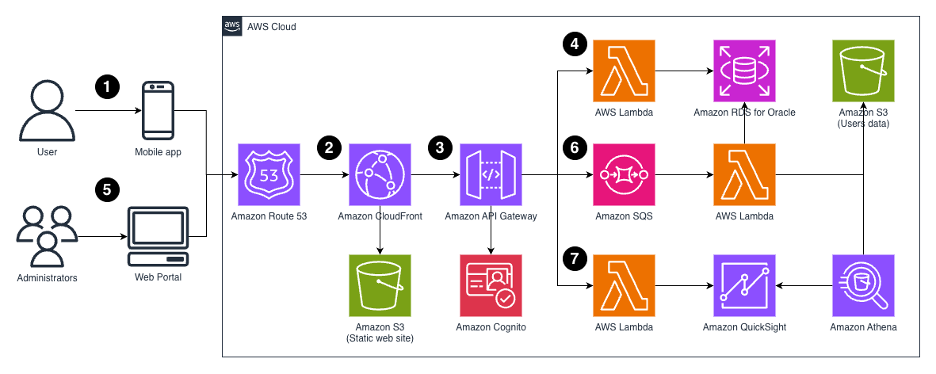
Figure 1 – End-user and administrator architecture
- Employees access their Talento Zeus deployment using a mobile app.
- Static assets are served from Amazon CloudFront (CDN) while dynamic content is retrieved by invoking APIs in Amazon API Gateway through a custom domain managed by Amazon Route 53.
- Employees authenticate with Amazon Cognito to access the APIs. Amazon API Gateway is configured with different AWS Web Application Firewall (AWS WAF) rules to protect the application against common security exploits, rate limits, and bots.
- Transactional activities are executed through synchronous AWS Lambda functions that store data in Amazon RDS for Oracle.
- Administrators use a web portal to manage activities and generate employee reports. The portal is a static website served by Amazon CloudFront with an Amazon S3 origin. APIs are invoked as in steps 3 and 4.
- Administrators generate reports and assign activities to employees using asynchronous processes. Amazon API Gateway sends events to Amazon SQS, which invoke AWS Lambda functions to analyze transactional data from Amazon RDS for Oracle and store results in Amazon S3 buckets. For certain activities, the workflow also sends notifications to employees via Amazon SNS and Amazon SES.
- Amazon QuickSight reports are embedded in the portal for analyzing the previously generated data. Since these reports are infrequently accessed, Amazon QuickSight invokes Amazon Athena on demand for querying and obtaining the data from the bucket.
Outcomes
The serverless back-end implementation improved Grupo UPAX’s business agility, reduced costs, and streamlined infrastructure management.
The first modernization from a monolithic architecture to serverless microservices reduced their AWS infrastructure cost by approximately 90% while maintaining the same number of concurrent users. This cost savings was based on a pay-as-you-go cost model. Currently, this application handles more than 28 million invocations monthly, supports over 56,000 users, and scales to around 200,000 concurrent invocations during peak usage. Moreover, they increased their application availability from 82% up to 99% monthly.
Using AWS serverless technology enabled them to increase their CI/CD pipeline deployments from 20 monthly changes to more than 400 monthly changes. They reduced deployment times from one hour to five minutes with the microservices approach. The modular service architecture promoted team autonomy, enabling parallel development across features without cross-team interference. This division allowed the developer team to grow from 15 in 2018 to over 200 in 2025, managing over a thousand different AWS Lambda functions.
The serverless architecture provides robust security and scalability benefits. Amazon API Gateway secures requests with built-in authentication, authorization, and throttling, reducing operational overhead. Additionally, AWS serverless services distribute workloads across availability zones in a region to provide high availability.
Talento Zeus currently manages over 90 different APIs and around 1200 AWS Lambda functions with different functionalities. Each Talento Zeus tenant currently manages more than 56,000 users’ petitions per month.
“AWS serverless services have allowed us to deploy applications more agilely, optimizing development times and reducing operational costs. Thanks to this architecture, our team can focus on innovation without worrying about infrastructure.” – Bernardo Perez – Chief Operations Officer Grupo UPAX.
Conclusions
Grupo UPAX’s serverless transformation demonstrates how strategic technology choices enable business growth at scale. By migrating Talento Zeus to AWS serverless architecture, the company eliminated operational overhead, accelerated development velocity, and positioned itself for sustainable expansion through a pay-as-you-go model that aligns costs with usage.
Organizations considering similar modernizations should address two key technical challenges early: cold-start latency (mitigated through provisioned concurrency and AWS Lambda SnapStart) and code reusability (solved using AWS Lambda Layers). The modular microservices design enables independent feature development and delivers sustained value through reduced operational complexity and increased development agility.
About Grupo UPAX
Grupo UPAX is dedicated to work for companies and businesses through research, strategy, creativity, technology and execution with the single objective of creating success for their customers. With over 10 years of experience and presence in several Latin-American countries, they started their journey to the cloud in 2017. Since then, they keep innovation on behalf from their customers.