AWS Physical AI Blog
How Physna and AWS use geometric intelligence to bridge engineering design and procurement
Introduction
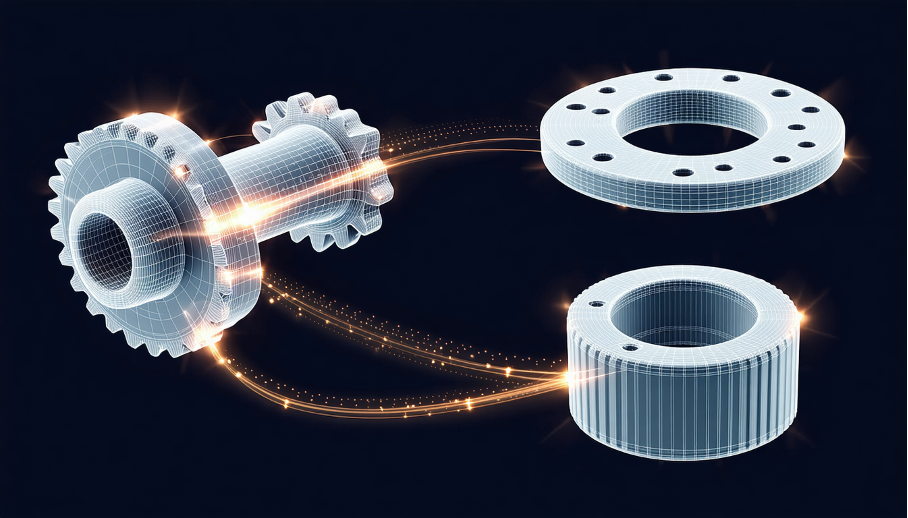
Geometric intelligence visualization showing 3D CAD wireframe parts connected by AI matching arcs
Every original equipment manufacturer faces the same invisible cost. An engineer designs a component, unaware that a functionally identical part already sits in a warehouse at another facility, cataloged under a different name in a different system. A procurement team launches a new sourcing cycle for something the organization already owns. For original equipment manufacturers (OEMs) in automotive, industrial, and general manufacturing, this gap between design intent and sourcing execution remains a persistent and expensive problem in the product lifecycle. A single large OEM can have millions of parts across dozens of facilities, managed in separate systems with inconsistent naming, and no reliable way to answer the question: “Do we already have a part that does this?”
Physical AI applies machine learning to real-world physical objects and environments, enabling systems to perceive, reason about, and act on the physical world. In manufacturing, one powerful application is geometric intelligence, where AI reads the physical DNA of engineered components (the complete geometric identity, structural relationships, and dimensional characteristics that make each part unique) to drive decisions across design and sourcing workflows. Physna, an AWS Partner, has built a geometric intelligence platform that enhances Physical AI by analyzing three-dimensional data and identifying part similarity, interoperability, and redundancy with high precision.
To put this kind of intelligence in the path of every engineering and procurement decision, manufacturers need a place where their spatial data already lives, not a separate silo. The Visual Asset Management System (VAMS) is an AWS-native open-source spatial data plane purpose-built for managing, orchestrating, and visualizing 3D data.
With a Physna add-on, supported 3D files stay synchronized with a customer’s Physna environment. Engineers can intelligently search for computer-aided design (CAD) models and preview native CAD files directly in their browser through VAMS’s Physna-powered viewer. Combined with scalable cloud infrastructure from AWS, this approach lets manufacturers move faster from design to deployment, transforming how physical products are built, sourced, and optimized.
The Challenge
Across the manufacturing industry, engineering and procurement teams operate with competing constraints. Engineers build products by exploring new designs, refining product categories, and improving performance. They optimize for function, weight, material properties, and manufacturability. Meanwhile, procurement teams must source highly specific components while managing limited supplier availability, tariff volatility, and the risk of supplier failure or obsolescence. These two groups often work in different systems, use different terminology, and operate on different timelines.
This friction compounds across the product lifecycle. According to Physna customer data, engineers can spend 20% of their time redesigning components that already exist within their own PLM systems, while procurement teams source new parts at a premium because they lack visibility into existing alternatives. These inefficiencies can extend time-to-production by over 40% based on Physna’s research, affecting both time-to-revenue and cost structures. A leading appliance OEM using Physna avoided nearly $800 million in costs through part standardization alone, identifying redundancies across product lines that had accumulated invisibly for years.
Organizations need more than visibility into their parts catalogs. They need systems that connect engineering intent with procurement reality, and cloud infrastructure that can scale that connection across facilities and supply chains. Physna and AWS VAMS solve that problem.
The Solution: Physna and VAMS on AWS
Physna and VAMS together provide a joint solution that lets manufacturing organizations ingest, understand, and operationalize physical-world data at scale. At its core, Physna uses geometric analysis of three-dimensional CAD data to identify industrial part similarity and interoperability with high precision, enabling AI systems to understand and learn about physical objects from 3D models and scans. VAMS provides the spatial data plane on AWS where those CAD files, related metadata, and downstream artifacts live as a single source of truth. AWS provides the infrastructure to scale both across datasets, teams, and environments.
Physna transforms raw CAD models and 3D data into structured insights that engineering and sourcing teams can query on demand. Unlike traditional part-matching systems that rely on naming conventions, part numbers, or ERP metadata (all of which are inconsistent across facilities, suppliers, and legacy systems), Physna matches parts based on their actual three-dimensional shape. The system recognizes two identical components with completely different names in two different ERP systems as the same part, delivering up to a 5x improvement in engineering productivity, according to Physna customer engagements, when teams stop rebuilding designs that already exist. This geometry-driven approach directly bridges design and sourcing: when an engineer designs a bracket that is geometrically identical to one already in the supply chain, the system surfaces that match before a new sourcing cycle begins. The result is fewer redundant parts, faster sourcing decisions, and lower procurement costs.
VAMS provides the operational foundation for that workflow. Engineering teams upload CAD assemblies, point clouds (dense sets of 3D coordinate data captured by lidar or photogrammetry), and reference imagery into VAMS through its web interface, command-line tool, or API. Physna optimizes its models to recognize and classify components in complex, real-world conditions, then keeps every supported CAD file synchronized with the customer’s dedicated Physna environment. The synchronization covers asset metadata, file metadata, and file attributes alongside the file bytes themselves. Engineers stop juggling two disconnected libraries: a part loaded into VAMS appears in Physna with the same identifiers and metadata, and any update applied in one system propagates to the other automatically. That continuity means geometric matches, similarity searches, and inventory analyses always run against the latest state of the engineering catalog rather than a stale export. The solution supports multiple engagement models, from packaged offerings to consumption-based deployments, allowing organizations to align investment with outcomes as they grow.
Architecture Overview
The solution follows a four-stage architecture that moves data from enterprise source systems into VAMS as a spatial data plane, then into Physna’s geometric AI analysis, and back out into engineering and procurement workflows. Native CAD viewing is available at every step.
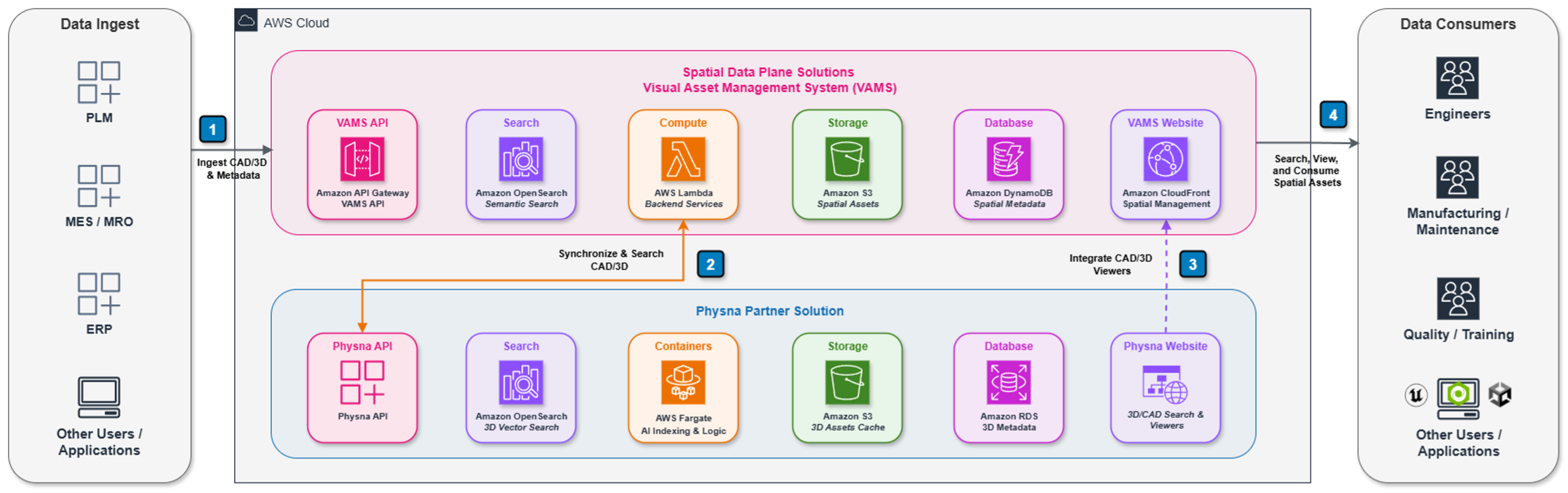
Figure 1: Solution architecture for Physna and VAMS on AWS. CAD models and component data flow from enterprise sources into VAMS, sync to Physna’s geometric AI models for analysis, and return to engineering and procurement workflows. VAMS also embeds the Physna viewer so engineers can inspect native CAD files directly in the browser.
Data ingestion (1). The process begins at this stage, where the platform ingests CAD/3D files and component metadata from product lifecycle management (PLM), manufacturing execution systems and maintenance, repair, and operations (MES/MRO), enterprise resource planning (ERP), and other enterprise systems. Manufacturers commonly store this data across disconnected systems, each with its own part numbering scheme and metadata conventions. The ingestion stage handles these variations through multiple integration patterns. Source systems (such as Siemens Teamcenter, PTC Windchill, or SAP) can push CAD/3D files and metadata into the VAMS solution via API, command-line interface, or website upload. Alternatively, source data retrieval can occur through scheduled pulls or event notifications from the source system’s own API, enabling direct integration where source systems push data to VAMS without manual intervention.
Spatial data plane (1 and 2). Ingested files land in VAMS, where AWS Lambda processes each asset, stores files in Amazon Simple Storage Service (Amazon S3) for durable versioned storage, persists metadata and permission state in Amazon DynamoDB, and indexes content through Amazon OpenSearch Service for semantic search across the entire catalog. VAMS provides the central store for raw and processed component data, with attribute-based access control over every database, asset, and file. As CAD files arrive, VAMS synchronizes and allows search lookup of CAD/3D data to and from the Physna API. The Physna add-on consumes ingestion events, authenticates against a customer-owned Physna tenant, and keeps the supported CAD files plus their VAMS metadata in lock-step with Physna. Engineering teams interact with a single catalog while Physna’s geometric intelligence stays current with the latest uploads and edits.
Geometric AI (2). On the Physna side, ingested files are processed and normalized through AWS Fargate containers that run Physna’s specialized 3D embedding and indexing logic. Normalization converts disparate CAD formats, coordinate systems, and unit conventions into a consistent geometric representation so that components from different source systems can be compared directly regardless of how they were originally authored. The system uses geometric embeddings stored in Amazon OpenSearch Service for similarity-based search lookup and persists 3D asset caches in Amazon S3 and structured metadata in Amazon Relational Database Service (Amazon RDS). Physna’s geometric identification, classification, and mapping models analyze the geometry of each component to find matches, near-matches, and interchangeable parts across the entire dataset. Rather than comparing metadata strings, the models compare the actual shapes of parts, which means the system matches a flanged bracket from one supplier to a geometrically equivalent bracket from another supplier regardless of how either is labeled. As new engineering data is ingested, Physna continuously expands its geometric knowledge base, allowing Physical AI workflows to reason over a richer set of real-world components without requiring engineers to manually curate relationships between parts. Beyond shape alone, the system ties geometric correlations to metadata correlations, combining what a part looks like with what is known about it across procurement records, supplier catalogs, and engineering specifications. This combination surfaces insights that neither geometric analysis nor metadata search could produce independently.
Integration and viewing (3 and 4). Finally, this stage exposes insights through APIs and SDKs that design and sourcing teams can embed directly into their existing workflows. While the geometric AI stage performs deep shape analysis, normalization, and indexing, the integration stage delivers those results as lightweight API calls and event-driven alerts that fit naturally into existing design and sourcing tools. An engineer working in a CAD application can query the system to check whether a newly designed part already exists in inventory. A procurement analyst can receive automated alerts when a sourcing request matches an existing part or when an alternative supplier offers a geometrically compatible component. Inside VAMS itself, Amazon CloudFront delivers the web application that integrates Physna’s viewer assets, letting users open native CAD files directly in the browser without round-tripping through a desktop CAD application. Beyond engineers and procurement teams, the solution also serves manufacturing and maintenance operators, quality and training teams, and other end-users and applications that search, view, or consume spatial and CAD/3D assets through the VAMS website, CLI, or API. Organizations can also deploy the solution through AWS Marketplace for simplified adoption and billing.
Native CAD Viewing in the Browser
Video: Physna’s geometric search in action. An engineer selects a sub-component within a CAD assembly, triggers a shape-based similarity search across the part catalog, and reviews geometric comparison results — all without leaving the browser-native Physna viewer.
Most CAD formats (STEP, IGES, JT, CATPart, SLDPRT, and dozens of others) historically require a desktop CAD tool to open, even for a quick look. That gate slows down everyone outside engineering: a procurement analyst checking that a sourced part matches the spec, a program manager reviewing a supplier submission, a quality engineer triaging a non-conformance report. Each of them either waits for an engineer to share a screenshot or installs a license they will rarely use again.
This integration eliminates that gate. Once a CAD file is uploaded to VAMS and indexed by Physna, anyone with VAMS permission to see the asset can open the file in a browser tab through VAMS’s Physna-powered viewer. The viewer renders the original native geometry without requiring manual conversion to intermediate exchange formats or polygon meshes, with measurement, exploded-view, and isolation controls inherited from Physna’s hosted viewer. VAMS’s two-tier authorization verifies every viewer load, ensuring only users entitled to see the underlying file can open it.
The browser-based viewer pairs naturally with the geometric intelligence story above. When Physna surfaces a similar part during a sourcing review, a procurement analyst can click straight from the match into the VAMS asset page and visually confirm the equivalence in seconds. Engineering and procurement now share a single visual reference for every part conversation, removing the screenshot-and-email loop that used to bridge the two roles. VAMS already supports a wide range of file types, and a Physna integration extends that coverage to native CAD formats.
Customer Use Case
A global manufacturing organization with operations spanning multiple facilities needed to optimize its supply chain and component sourcing. The company managed hundreds of thousands of parts across separate PLM and ERP systems, with no unified way to determine whether a given component already existed in inventory at another site.
The goal
Improve visibility into component usage, reduce duplication, and accelerate sourcing decisions across facilities.
The approach
- Ingest CAD and component data from existing systems into VAMS as the spatial data plane on AWS, with versioning and access controls applied uniformly across facilities
- Synchronize every supported file in VAMS with the customer’s dedicated Physna environment, including asset metadata, file metadata, and file attributes
- Use Physna to identify and classify interoperable parts across datasets, surfacing duplicates and near-matches that text-based searches had missed
- Open native CAD files in the browser through a VAMS Physna-powered viewer so engineering, procurement, and supplier-facing teams share a single visual reference
- Integrate outputs into procurement and supply chain processes through Physna APIs and VAMS asset pages
The results
- Reduced component duplication — The organization identified parts that were functionally identical but cataloged under different names across facilities, eliminating redundancies that had accumulated invisibly across product lines.
- Faster sourcing decisions — Procurement teams could see existing alternatives before initiating new supplier negotiations, discovering that parts they assumed were single-source were available domestically from vendors they already worked with.
- Stronger supply chain resilience — The system surfaced alternative sourcing options for critical parts, reducing single-supplier risk.
- Up to 5x engineering productivity gain — Engineers stopped rebuilding existing designs and redirected time to work that required their expertise.
- Scalable framework — The team expanded the analysis to additional facilities without re-implementing for each site.
This approach transforms fragmented component data into a unified system of record for physical assets. Across Physna engagements, the pattern repeats at scale. A leading appliance OEM avoided nearly $800 million in costs through part standardization, while a defense shipbuilder avoided $1 billion in forward costs by comparing components across the Virginia and Seawolf class submarine programs, an analysis that took 544,000 man hours manually but that Physna completed in weeks.
Getting started
Organizations interested in exploring this solution can:
- Access Physna on AWS Marketplace
- Engage in a proof of concept through guided sessions
- Review overall reference architectures and solution materials and VAMS solution guidance
- Connect with the Physna team to explore tailored deployments
Conclusion
This post showed how Physna and AWS work together to bridge the gap between engineering design and procurement execution using Physical AI. By analyzing the geometry of physical components rather than relying on text labels or database metadata, and by keeping that geometric intelligence synchronized with VAMS as the spatial data plane, manufacturers can reduce part duplication, accelerate sourcing decisions, and build more resilient supply chains. Native CAD viewing in the browser extends that value beyond engineering, giving procurement and supplier-facing teams a shared visual reference for every part. The four-stage architecture handles the full lifecycle from data ingestion through geometric analysis to workflow integration, and it scales from pilot deployments to enterprise-wide rollouts on AWS infrastructure.
As this space matures, the ability to reliably act on real-world data will become a defining competitive advantage. Physna and AWS make that transition faster, more accessible, and scalable, turning complex physical environments into intelligent, deployable systems.
Organizations ready to explore this next phase can visit the AWS Physical AI blog channel or ask questions in the AWS re:Post community.
If you have questions or feedback, leave a comment on this post.
Further reading
- Physna — geometric intelligence platform for manufacturing
- Physna blog — latest updates from the Physna team
- Manufacturing intelligence with Amazon Nova multimodal embeddings — multimodal AI for CAD and technical manufacturing documents
- AWS for Manufacturing — cloud solutions for smart manufacturing and supply chain
- AWS Architecture Center — reference architectures for manufacturing and industrial workloads
- AWS re:Post community — ask questions and share knowledge about building on AWS