AWS Public Sector Blog
Category: Uncategorized

Alberta Motor Association transforms member experience and optimizes cost on AWS Cloud
The Alberta Motor Association (AMA) is a multi-service member-run organization that provides driving education, rewards, roadside assistance, travel, insurance, banking, and many other member-focused services. When AMA wanted to launch its community membership — their first true subscription-based membership — AMA decided to rethink its existing membership system

NUS Urban Analytics Lab scales research globally with AWS
The Urban Analytics Lab at the National University of Singapore (NUS) spearheads research in geospatial data analysis and 3D city modelling. The lab’s work underpins the development of smart cities and provides scientists, architects, urban planners, and real estate developers with data insights. These insights help parties make informed decisions about projects ranging from energy modelling to urban farming. To meet rising global demand for its data analytics and planning tools, Urban Analytics Lab turned to Amazon Web Services (AWS).

Serverless GIS with Amazon S3, open data, and ArcGIS
If you are hosting an ArcGIS web app today, then you are probably hosting it on a Windows or Linux server using traditional web server software like IIS or Apache. With the web hosting capability of Amazon S3 you can remove the need to run these servers and the maintenance, management, and monitoring overhead that comes with it. Serverless services like Amazon S3 can scale automatically and can be as simple as copying over your website assets to get up and running in minutes. This blog focuses on web app implementations using ArcGIS API for JavaScript (as other ArcGIS web apps have additional considerations).

Hacking COVID-19: Hackathons take on the challenges of the pandemic
Novel challenges require novel solutions. To address the COVID-19 pandemic, public sector organizations are holding virtual hackathons to solve problems that arise from the virus and its effects on society. Hackathons #WirVsVirus in Germany, Hack the Crisis in Sweden, and #EUvsVirus brought together thousands of stakeholders to brainstorm and create innovative solutions using technology and cloud computing to address the ongoing challenges of the pandemic. Attendees at these virtual events worked to find solutions for problems like faster diagnosis of COVID-19 and connecting food with those in need. From technical mentorship to AWS Promotional Credit and providing access to technologies like AI, AWS supported these hackathons, their participants, and their solutions.

How CloudEndure Disaster Recovery opens the door to IT resilience for the public sector
For public sector organizations, there is no room for service disruption. When faced with a natural disaster, emergency, or cyberattack, these organizations need to continue running mission-critical applications to power essential platforms such as call centers, patient and judicial databases, and online learning sites. A disaster recovery (DR) strategy is necessary for public sector organizations that need to be there for their communities. CloudEndure Disaster Recovery, offered by AWS, can help organizations reduce DR total cost of ownership (TCO) and achieve business continuity.

Scaling to share unprecedented volume of election donation data, quickly and cost-effectively
Campaign contributions have grown exponentially in the United States. In 1980, there were around 500,000 contributions made; in 2020 alone, the Federal Election Commission (FEC) expects 500 million contributions. Meanwhile, the evolution of technology has changed the way Americans contribute to political campaigns, making it easier to make many small contributions. To meet unprecedented demand for data transparency, the FEC turned to the cloud.
Coming soon: The AWS Public Safety and Disaster Response Technology Competency
Last year, we launched the AWS Public Safety and Disaster Response Competency for Consulting Partners, recognizing top APN Advanced and Premier Consulting Partners with proven public sector success and deep technical proficiency. Building on these efforts, today we’re excited to pre-announce the launch of the AWS Public Safety and Disaster Response Technology Competency. Coming later this year, the expansion will include the addition of Independent Software Vendor (ISV) solutions that deliver APN Partner technology in the areas of emergency management operations, justice and public safety applications, infrastructure resilience and recovery, 911 and emergency communications, and public safety and disaster response data and analytics.

In case you missed it: April 2020 top blog posts round up
In April 2020, the AWS Public Sector Blog covered stories on AWS launching machine learning enabled search capabilities for COVID-19 dataset, supporting healthcare with technology in response to COVID-19, and building a chatbot for your school in less than an hour. For more blog highlights from this month, you can also check out The Brief, hosted this month by Ray Rogers, the host of the Fix This podcast.
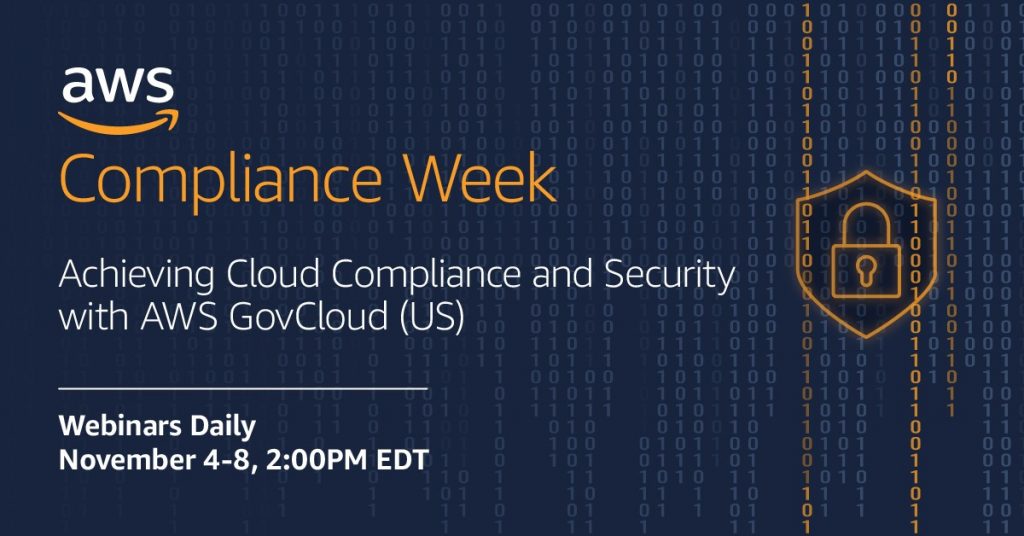
Join AWS Compliance Week to learn how to navigate security and compliance in the public sector
AWS GovCloud (US) isn’t just for government agencies – U.S. commercial companies in aerospace, defense manufacturing, law enforcement, healthcare, financial services, and energy with regulated workloads, sensitive data, and export-controlled data rely on AWS GovCloud (US) to modernize IT. Learn more during next week’s AWS Compliance Week. Themed “Achieving Cloud Compliance and Security in the AWS Cloud,” AWS solutions architects will discuss in five webinars how customers can meet cloud security and compliance challenges using AWS GovCloud (US).

Will you run Windows on AWS or Microsoft Azure? IDC’s new TCO report weighs in
IDC, a global market intelligence firm, interviewed Amazon Web Service (AWS) customers running Windows workloads in the AWS Cloud to find out what the benefits were from running Windows on AWS, and the results are telling. IDC’s “The Business Value of Efficiently Running Windows Workloads on AWS” released in July 2019, interviewed AWS customers that averaged 28,579 employees, and represented multiple industries.