AWS Public Sector Blog
Signal-activated generative AI: How agencies can reach more people and react faster
Government agencies exist to serve people. Each day, millions of constituents depend on federal, state, and local agencies for benefits, safety, infrastructure, and essential services. The faster your agency can identify a need, reach the right person, and deliver the right information, the better it serves its mission.
But there has historically been a gap between the technology agencies deploy and the humans who consume its output. Data sits in dashboards. Insights live in reports. The value is there—but it requires people to find it, interpret it, and decide what matters to them. Everyone looks at the same spreadsheet, visualization, or report, and each person must extract their own meaning from it.
Technology needs a bridge to the human element that understands not just what the data says, but what each individual person needs from it. A researcher and a policymaker might both look at the same dataset, but need entirely different dimensions of value from it. The researcher needs statistical depth. The policymaker needs decision-readiness. With current solutions, each person must manually extract their dimension from a generic view.
Signal-activated agentic design provides that bridge. Rather than asking each user to consume the same static output and extract their own meaning, a signal-activated system understands what each consumer needs and delivers precisely that value dimension—proactively, in real time, personalized to each person’s role, context, and current priorities.
This two-part series introduces the Signal-Activated Agent Pattern—an architectural approach, backed by a deployable Amazon Web Services (AWS) reference implementation, that helps government AI platforms move from generic, reactive question-answering to proactive, contextually personalized decision support. With this solution, agencies can reach more people, respond faster, and deliver the right value to the right official at each decision point.
The next step for government AI
Most government generative AI deployments today follow a straightforward model: an official asks a question, the AI provides an answer. This is valuable. It accelerates research, simplifies policy interpretation, and reduces the burden on subject matter experts.
But imagine what becomes possible when the AI doesn’t have to wait, and it understands who is asking well enough to shape its response accordingly. It can watch incoming data—benefit applications, sensor readings, case updates, compliance filings—and surface insights to each official in the form that is most useful to them, at the moment those insights become relevant.
This is the shift from reactive AI to contextual signal-activated AI: systems that are continuously aware of what is happening across your agency’s data landscape, understand what each consumer needs from that data, and proactively deliver personalized value before small issues become large ones. The reference implementation built on AWS is deployable today using Amazon EventBridge for event ingestion, AWS Lambda for deterministic filtering, Amazon Bedrock for contextual reasoning, and Amazon DynamoDB for persistent consumer profiles.
Same data, different value: Why personalization is key
The fundamental insight behind signal-activated design is that the same data means different things to different consumers. A single data event—say, updated program enrollment numbers—carries entirely different value depending on who receives it:
- A researcher needs the analytical dimension: What is the enrollment trend? How does it compare to projected models? Are there statistically significant deviations in specific demographics or geographies?
- A policymaker needs the decision dimension: Are enrollment numbers approaching a threshold that triggers additional funding requirements? What are the implications for next quarter’s budget request? Do I need to act?
- A field coordinator needs the operations dimension: Which office locations are seeing increased foot traffic? Do we need to adjust staffing for the next 2 weeks? Are wait times exceeding service standards?
- A communications director needs the narrative dimension: How does this compare to what we communicated publicly last month? Do we need updated messaging? What questions will stakeholders ask?
A traditional system presents the same dashboard to all four people and leaves it to each of them to find their value. The signal-activated pattern presented in this series uses a consumer context store in DynamoDB to maintain each person’s identity, role, and value dimensions. When an event arrives, a hot-path filter Lambda function evaluates it against per-user watch conditions. Events that pass escalate to an agent invoker that calls Amazon Bedrock with the full assembled context for that consumer—producing a role-shaped response without users needing to search, filter, or ask.
This is why contextual personalization is at the core of the pattern, not just an additional feature. Without it, proactive AI is just automated broadcasting. With it, proactive AI becomes a genuine service layer that makes each person more effective at their specific job.
The following figure illustrates this contextual fan-out: a single data event enters the pipeline and produces four distinct, role-appropriate insights—each shaped by the consumer’s unique value dimension and delivered through their preferred channel.
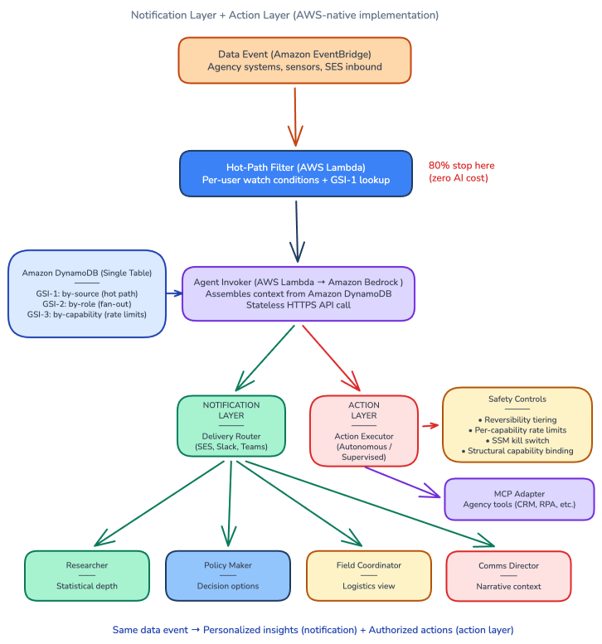
Figure 1: A single data event produces four different, role-appropriate insights—each shaped by the consumer’s unique value dimension
Three dimensions of consumer context
For the system to deliver the right value dimension to the right person, it needs deep consumer context. In the reference implementation, this context lives in a single DynamoDB table with three logical layers:
- Identity context – Who is this person, and what value dimensions matter to them? A regional director needs different signals than a frontline caseworker; a grants program officer cares about compliance thresholds; a researcher cares about statistical significance. The system stores each consumer’s role, expertise, decision authority, and the specific dimensions of data that are relevant to their work.
- Operational context – What are they working on right now? The same signal has different urgency depending on timing. An enrollment spike matters differently to a policymaker who has a budget hearing next week compared to one whose review cycle is months away. The system tracks active decisions, open questions, and current priorities so it knows not just what to deliver but when and how urgently.
- Signal context – What has been accumulating? Rather than interrupting with each individual data point, the system synthesizes: “Three things changed in your portfolio overnight that relate to the decision you’re working on.” A digest runner Lambda function aggregates signals on a configurable schedule, producing synthesized briefings that respect attention while confirming that nothing falls through the cracks.
Together, these three layers support a system that is precise rather than noisy—delivering the right value, to the right person, at the right time, in the right format for how they think and decide.
Why now: The infrastructure is ready
Building proactive, contextually personalized AI solutions for government has historically been complex. The foundational infrastructure presented in this post uses managed cloud services, and the reference implementation demonstrates how they combine into a production-ready topology:
- Real-time event processing with Amazon EventBridge – Serverless event bus routing millions of events per second with content-based filtering rules.
- Foundation models from Amazon Bedrock – Contextual reasoning and personalized generation accessible as a stateless HTTPS API, no model hosting required.
- Persistent consumer context using Amazon DynamoDB – Single-table design maintaining per-user profiles, watch conditions, and signal buffers at any scale with single-digit-millisecond reads.
- Multi-channel personalized delivery with Amazon SES and Amazon API Gateway – Email (inbound and outbound), webhook callbacks to Slack/Teams, and extensible delivery routing.
- Cost-efficient filtering using AWS Lambda – Deterministic per-user watch condition evaluation at sub-cent cost, invoking Amazon Bedrock only for events requiring contextual judgment.
- Infrastructure as code deployment with AWS CDK – A single top-level construct provisions the complete stack. One deployment command and one AWS CloudFormation stack configure the services together.
The building blocks are in place and proven composable.
What comes next
In Part 2, we detail the Signal-Activated Agent Pattern architecture: how the notification layer delivers role-shaped insights, how the action layer enables agents to take action under human-supervised or autonomous conditions, and how a single-table DynamoDB design with three indexes supports the hot path at scale. We walk through how EventBridge, Lambda, Amazon Bedrock, and DynamoDB map to each layer, and show how the same data event produces four completely different, role-appropriate insights for four different consumers.
The Signal-Activated Agent Pattern offers AI that doesn’t just answer questions generically, but understands each official as an individual and delivers the specific dimension of value they need—proactively, in real time, at each decision point.