AWS Public Sector Blog
The transformative impact of generative AI on business workflows in a highly regulated industry
The aerospace industry represents one of the most complex regulatory environments for software development, where system failures can result in catastrophic consequences including loss of human life and multibillion-dollar assets. Blue Origin operates within this framework, in which software systems control every aspect of rocket propulsion, navigation, life support, and mission-critical operations.
Unlike traditional software companies that can iterate rapidly, aerospace companies must adhere to safety and mission-critical standards such as DO-178C (Software Considerations in Airborne Systems and Equipment Certification) and NPR 7150.2D (NASA Software Engineering Requirements). These standards mandate extensive verification and validation processes, creating a unique environment where innovation must be balanced against rigorous safety protocols—making it an ideal case study for examining how generative AI can be integrated into highly regulated development workflows using Amazon Web Services (AWS).
The current state of aerospace software development
Current aerospace software development operates under a safety-first methodology that prioritizes risk mitigation over time-to-market. Such development must adhere to the following principles:
- Extensive documentation requirements – Documentation often comprises 60–80% of total development effort, with requirements for configuration management, change control records, and verification matrices.
- Formal verification processes – Software must undergo extensive static analysis and testing that can include thousands of test cases. Hardware-in-the-loop simulations are standard practice.
- Multilevel reviews and approvals – Design reviews involve cross-functional teams that include systems engineers, safety engineers, and regulatory compliance specialists. Independent verification and validation (IV&V) teams provide objective assessment of software quality and compliance.
- Long development cycles – Aerospace software development cycles typically span 2–5 years for major systems, with minor updates requiring months of verification before deployment.
These stringent requirements call for a strict software development lifecycle (SDLC) with many lengthy verification steps (Figure 1). This V-Model approach progresses from mission and stakeholder requirements through system design and software requirements on the descending left side, then validates through corresponding verification phases (from unit testing through integration and system verification to final mission validation) on the ascending right side.
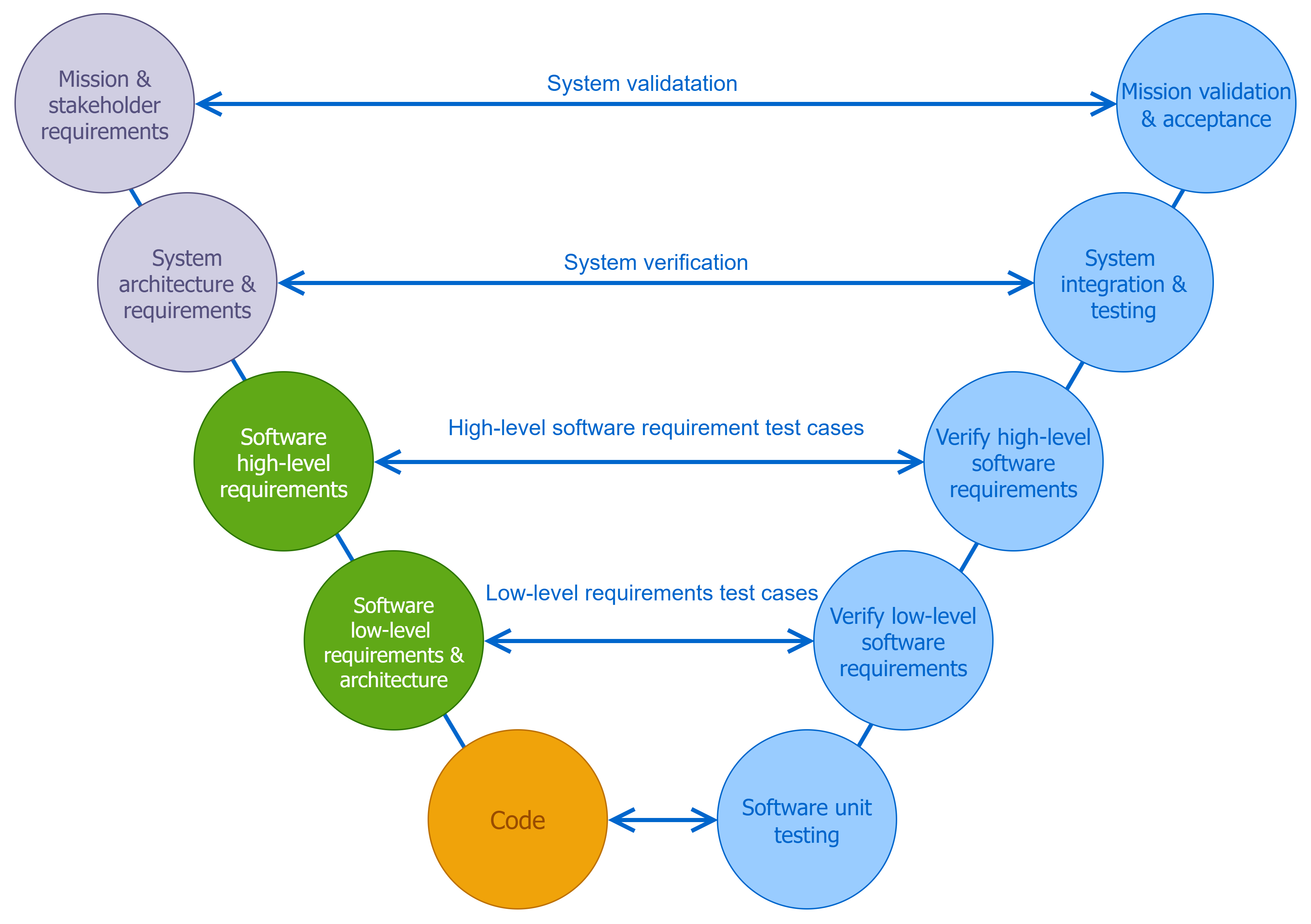
Figure 1: Aerospace software development lifecycle (V-Model) showing the relationship between requirements definition phases on the left and corresponding verification phases on the right, from mission requirements through system validation
Generative AI as a workflow catalyst
Current aerospace SDLC workflows might not adequately meet the industry’s growing demands for speed, accuracy, and agility. Generative AI provides an opportunity to streamline these processes.
One powerful application lies in augmenting the requirements generation process. The following diagram shows a typical requirements workflow, where requirements gathering and analysis are thorough but time intensive. Engineers must collect and analyze stakeholder needs, then document them in comprehensive specifications focused on feasibility, correctness, completeness, and consistency. The workflow proceeds from change requests through requirements analysis and documentation, followed by formal review processes, and finally to version-controlled requirements storage. The AI requirement checker integrates into this flow between initial documentation and formal review, automatically validating requirements against quality standards.
Requirement defects become exponentially more expensive to fix as development progresses. Generative AI solutions, such as requirement checkers, address this by identifying issues before formal review begins, substantially reducing review time and costly downstream issues.
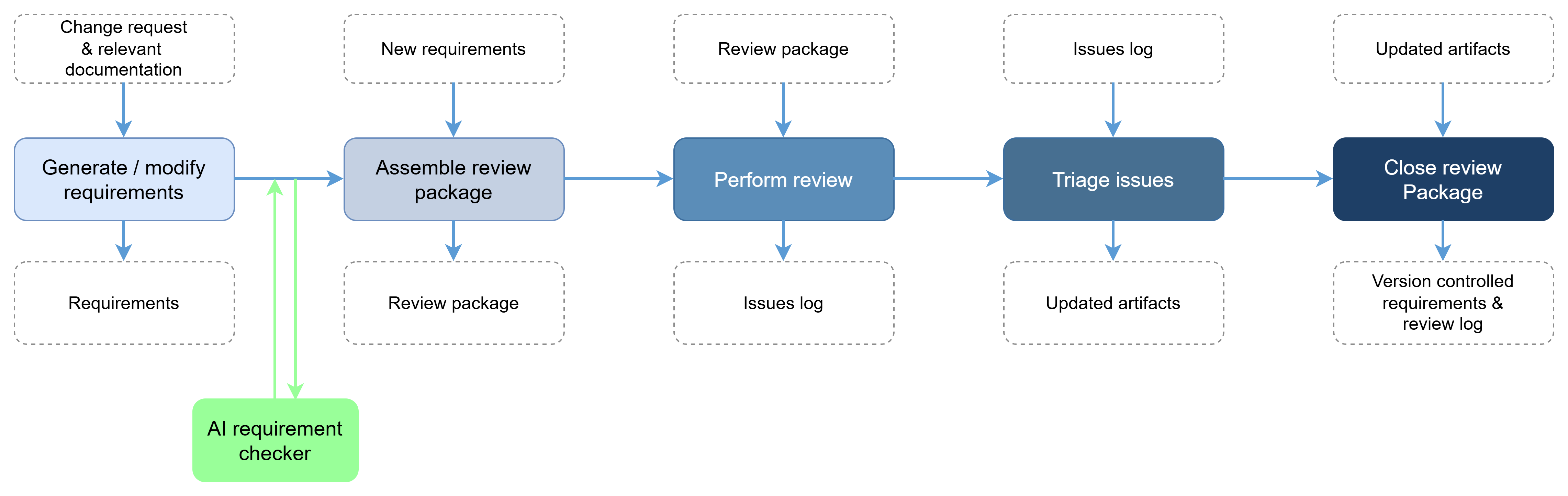
Figure 2: Typical aerospace software requirement generation process, showing the workflow from change requests through version-controlled requirements, with AI requirement checker integration highlighted in green
High-quality, validated requirements enable more effective testing. Generative AI can help eliminate defects in requirements, and similarly it can automatically generate test plans from requirements. As illustrated in the following figure, AI can analyze requirements documentation and create corresponding test plans for complete requirements coverage, automatically populating test plan templates while maintaining full traceability throughout the verification process. The workflow begins with requirements and relevant standards as inputs to the AI system, which uses predefined templates to generate comprehensive test cases that directly trace back to specific requirements, ensuring complete coverage and regulatory compliance.
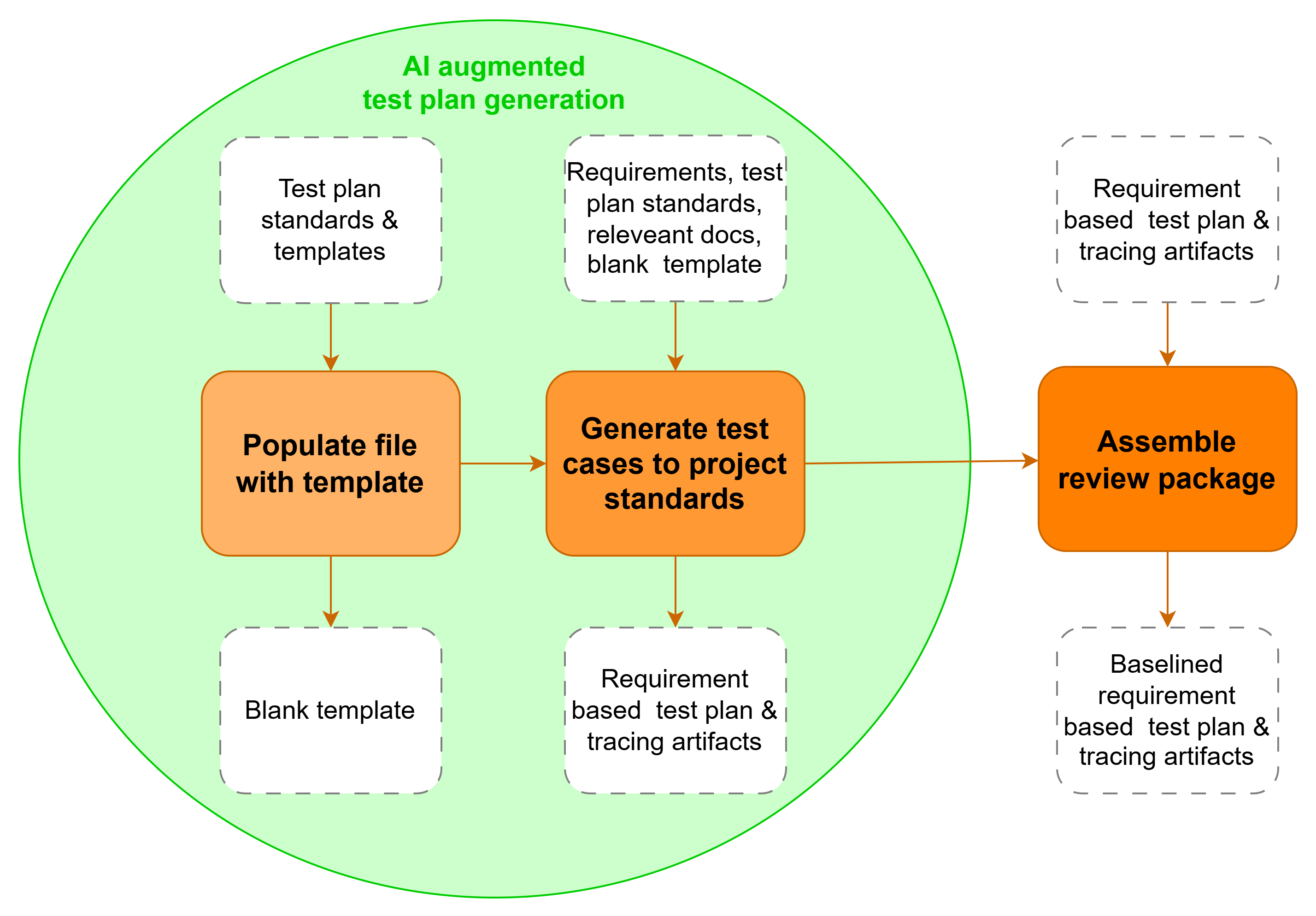
Figure 3: AI augmentation in the typical aerospace requirement-based test plan generation, showing how AI generates test cases from requirements, standards, and templates to produce requirement-based test plans with full traceability.
Generative AI solutions for aerospace software development
The ideal generative AI solution for aerospace software development requires automated documentation and traceability, integrated compliance into agentic AI operations processes, continuous risk assessment, and abilities to incorporate aerospace domain-specific knowledge.
Most existing commercial software solutions lack the comprehensive capabilities needed, making a custom-built solution using AWS not only preferable, but necessary. Agentic AI represents a fundamental shift from traditional automation to autonomous problem-solving, ushering in an era of AI-augmented SDLC management.
At its core, an AI agent functions as an intelligent entity that perceives its environment, processes complex information, and makes informed decisions. In software development, these agents understand intricate requirements while using contextual information to review requirements for accuracy and completeness. They can intelligently decompose complex requirements, generate comprehensive test plans, produce executable code and tests, and integrate seamlessly with the entire development ecosystem.
Agentic AI in the aerospace industry
The generative AI solutions built for Blue Origin incorporate these key agentic AI characteristics:
- Autonomy – Agents operate independently, making decisions about requirement correctness and maturity or generating test plans with minimal human supervision, using AWS agentic capabilities that provide the appropriate level of context to support these autonomous workflows.
- Reasoning and planning – Agents analyze requirements, understand the environment in which they exist, and formulate strategic plans.
- Tool use – Agents using existing software tools, APIs, Model Context Protocol (MCP), and AI models.
- Memory and learning – Agents retain information from past interactions and learn from successes and failures.
- Goal-oriented – Agents work toward specific objectives, continuously refining their approach.
The following figure illustrates how aerospace software development workflow changes with the adoption of agentic AI. Traditional software development lifecycle includes six main steps from planning, requirement analysis, to defining requirements followed by design, development, testing, and finally deployment and maintenance. These rigorous and labor-intensive steps are required to ensure software robustness and reliability for highly regulated mission critical applications. With agentic AI, it augments the existing process and shortens the software development lifecycle by reducing labor-intensive task durations such as requirements discovery, code generation, and testing. Furthermore, AI agents are employed to streamline code release management, and post-release performance monitoring and debugging.
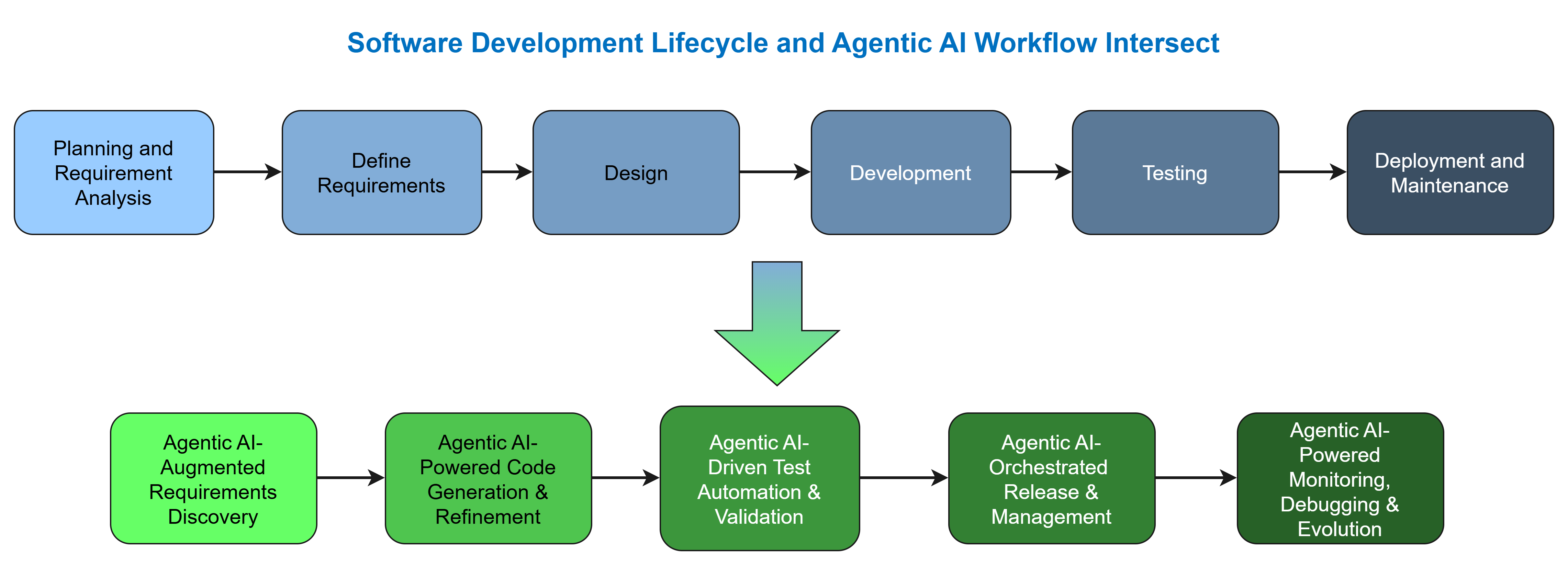
Figure 4: Software development lifecycle and agentic AI workflow intersect, showing traditional SDLC phases at the top and corresponding AI-augmented processes underneath, from requirements discovery through monitoring and evolution.
The AI orchestration platform in Amazon Elastic Kubernetes Service (Amazon EKS) through Amazon Bedrock operates as a centralized intelligent development assistant that integrates multiple data sources and knowledge repositories in Amazon Relational Database Service (Amazon RDS). The platform uses AI agents powered by large language models (LLMs) such as Claude Sonnet by Anthropic in Amazon Bedrock and Amazon Nova to process developer requests through a unified interface such as an integrated developer environment (IDE) or command line interface (CLI). When users interact with the system, the platform dynamically routes Amazon OpenSearch Service queries to specialized agents that access relevant Amazon Bedrock knowledge bases containing relevant project data. These agents employ reasoning capabilities to understand context, retrieve information, and generate responses such as requirement analysis. The following diagram shows this architecture.
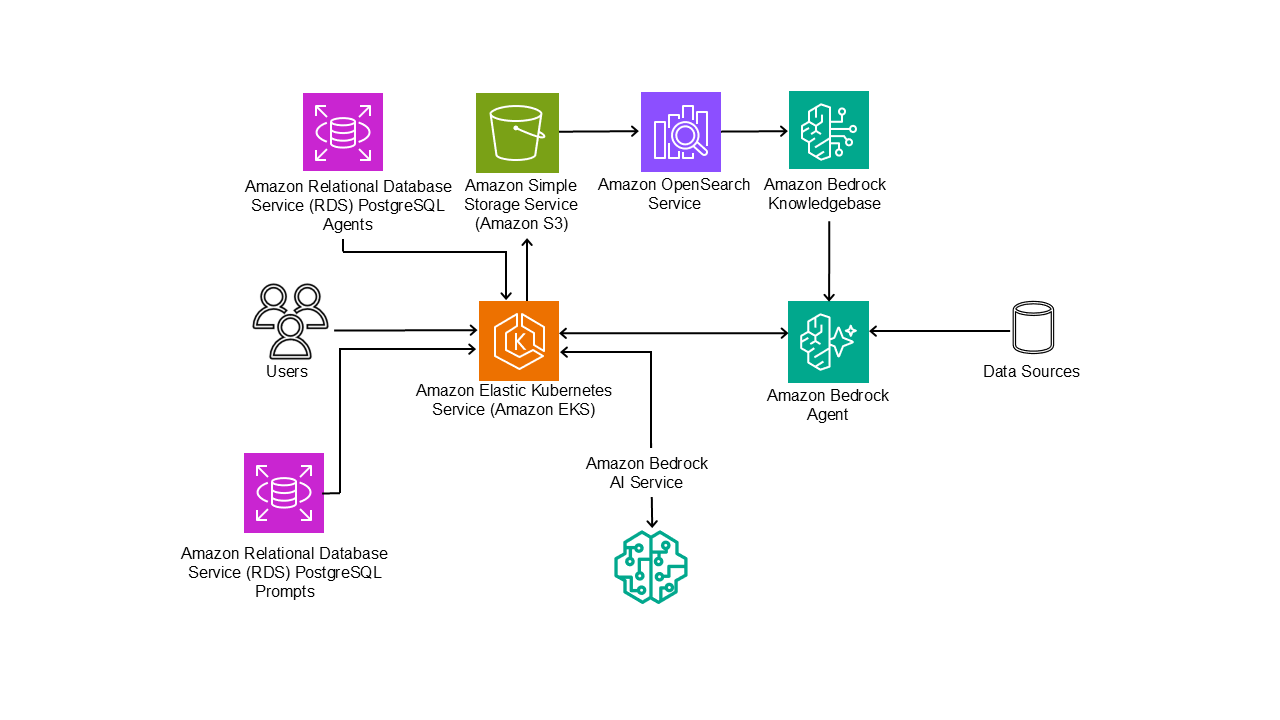 Figure 5: Architecture showing the integration of Amazon OpenSearch Service, Amazon Bedrock knowledge bases and agents, Amazon EKS, Amazon RDS for PostgreSQL, and Amazon Simple Storage Service (Amazon S3) to create an AI-powered development assistance platform
Summary
At Blue Origin, generative AI has revolutionized software development by reducing the documentation burden 40-60% through automated generation of traceability matrices, specifications, and compliance reports while performing real-time safety assessments and requirement-based test plan creation. This AI-augmented approach maintains rigorous safety standards while dramatically reducing development timelines by 40%, accelerating innovation cycles without compromising the process assurance requirements of human spaceflight software development.
Beyond aerospace, this workflow transformation extends to other highly regulated industries such as healthcare, finance, and defense. Generative AI creates dynamic, intelligent systems capable of continuous learning, so human developers can focus on strategic thinking while autonomous agents handle repetitive tasks. AWS provides the robust platform for deploying these transformative solutions, creating a harmonious blend of human intelligence and AI capabilities for more efficient and innovative enterprises.
Organizations can capture the significant reduction in documentation burden and faster development timelines that AI-powered requirement checkers and automated test plan generation delivers with the comprehensive AWS AI services supporting the secure AI deployment with guardrails and observability. These will free engineering teams from repetitive tasks so they can focus on strategic innovation while maintaining the rigorous safety standards your industry demands, with applications extending to healthcare, finance, and defense sectors facing similar regulatory challenges. To learn more about how AWS helps public sector organizations deploy AI-driven solutions, connect with the AWS Public Sector Team today.