What Is Multithreading?
What is Multithreading?
Multithreading is the process of splitting a single computing task into smaller parts for concurrent processing across multiple compute units. For example, to double all the values in an inventory database, you might split the operation across numerous compute cores, with each core doubling a single value. Multithreading can speed up many types of computing operations, such as handling large volumes of user requests, non-sequential calculations, and input and output tasks, thereby improving overall performance. Multithreading is supported by most modern computers, including cloud instances, desktops, and mobile devices.
How does multithreading work?
A thread is the smallest sequence of computing instructions that can run as an independent unit. Processes running in an operating system (OS) typically comprise one or more threads.
Multithreading is the computing technique of separating these threads and running them on multiple cores. The threads still share the main process's memory space, which allows the operating system to coordinate their work. It is also possible to run multiple threads on a single processor or CPU core, where the OS schedules CPU cycles to specific threads or uses hyperthreading.
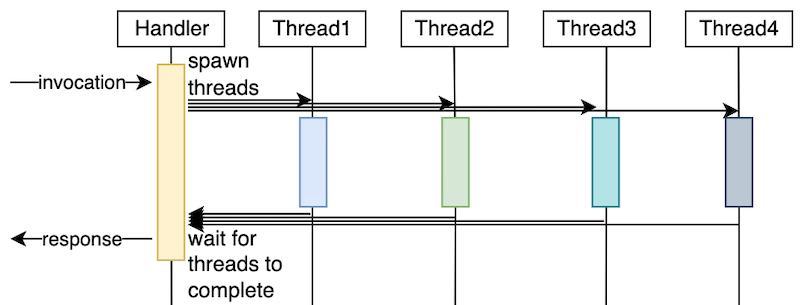
Thread creation, scheduling, and operating models
Threads are created either by an operating system (kernel-level threads) or within user-space libraries (user-level threads). These allow several different program operating models:
- Worker threads: These threads handle high-volume background tasks, such as file I/O and network requests.
- Thread pools: Thread creation can be computationally intensive at scale. Creating and recycling a set pool can reduce that overhead.
- Fork-join model: In this model, you split large tasks into subtasks that run simultaneously and later combine the results.
Thread lifecycle and states
The 5-state model is a fundamental concept in computing that describes the states in which a process or thread can exist: new, ready, running, blocked/waiting, and exit. The OS and runtime environments manage transitions between these states to improve overall efficiency.
- New: The new thread is created but not yet started.
- Ready: A thread is ready to run, but waiting for the scheduler to allocate central processing unit (CPU) time.
- Running: A thread runs on a processor.
- Blocked/Waiting: A thread is paused, waiting for an event, such as I/O completion or a signal from another thread.
- Exit: The thread has run to completion or halted prematurely.
Thread synchronization mechanisms
Because threads share memory, they must coordinate access to shared resources, or you risk them attempting to modify the same data simultaneously, resulting in data loss. These are called race conditions.
Several common synchronization tools exist to mitigate race conditions:
- Locks (or mutexes): A lock or mutex forces threads to make system calls or access a resource one at a time.
- Semaphores: Where a lock allows one connection at a time, a semaphore allows a limited number of connections to a set pool of resources.
- Condition variables: Condition variables are a communication mechanism for threads to tell each other to wait until certain conditions are met.
- Atomic operations: Atomic operations are multistep operations that either run to completion or not at all, for example, checking and incrementing a counter. Atomic operations allow you to complete straightforward operations without locks.
Although synchronization helps improve data integrity, overuse of synchronization mechanisms can lead to performance issues or threads being blocked.
- Bottlenecks: A bottleneck occurs when a thread locks too large a portion of code, so that little work can be done by other threads.
- Deadlocks: A deadlock occurs when two threads are stalled, each waiting for a resource held by the other thread.
Context switching and overhead
When the operating system switches a CPU from one thread to another while running one instruction, it performs a context switch, saving the current thread’s state before loading the next thread. Although context switches are necessary for multithreaded programs to operate, they consume more computing resources, which can be problematic at scale if not properly managed.
What are the types of multithreading?
You can implement parallel multithreading in several different ways within a program. The three main types of multithreading are kernel-level, user-level, and hybrid threading. The primary difference between them is how the OS kernel interacts with the threads.
Kernel-level threads
“Kernel-level threads” is also known as one-to-one threading. In this model, threads are created and managed directly by the operating system kernel. This makes each thread visible to the OS scheduler so that it can assign each thread to a single core. Kernel-level threads are widely used in modern operating systems and are well-suited to applications that need high throughput or responsiveness at scale, such as when you need to cloud burst a workload.
User-level threads
User-level threads are also known as many-to-one threading. Here, separate threads are managed entirely by a user-space library without direct OS involvement. To the kernel, all these threads created by the library appear as a single process. User-level threading is useful in environments where pooled, lightweight processing is more important than true parallelism. An example use case is a database connection pool that handles many small queries.
Hybrid threading
Hybrid threading is also known as many-to-many threading. In this model, you map multiple user threads to an equal or smaller number of kernel threads. This means, for example, that an application could spawn 100,000 logical threads (user-level threads) while the OS manages only 16 physical threads (kernel-level threads) and their associated cores.
What are the benefits of multithreaded applications?
By dividing work into multiple, parallel programming operations, multithreading can improve computing performance and help optimize resource utilization, offering many advantages.
Improved performance and throughput
By multitasking across many central processing unit (CPU) cores or virtual processors, multithreading allows work to run concurrently rather than sequentially. Parallel processing can dramatically increase speed, especially for operations where you want to perform many repeated or identical tasks. For example, concurrent operations are useful in data transformations, batch processing, or handling repeated user requests.
Better resource utilization
Modern computing environments, including cloud instances, can have underused CPU capacity. Multithreading can help to maximise the concurrent use of all available hardware.
Enhanced application responsiveness
Multithreading can improve system responsiveness by moving background tasks to other threads. For example, backgrounding a large file transfer. This helps to prevent the process’s main thread from freezing, as it is often responsible for the user interface.
Scalability for concurrent workloads
Multithreaded applications running in cloud environments can scale efficiently by using additional cores to handle requests that run concurrently. Web servers, APIs, and microservices benefit greatly from this ability. These applications can use thread pools to manage multiple threads or hundreds or thousands of simultaneous connections without requiring extra processes.
What is the difference between multithreading and multiprocessing?
Multithreading and multiprocessing are both techniques for achieving concurrency. They differ in how they run and handle system resources.
Multithreading
Threads share memory, enabling relatively fast communication. However, multithreading requires careful synchronization to help prevent bottlenecks or deadlocks. Threads are fast to create with relatively low overhead. This model is ideal for I/O-intensive tasks where different threads often wait on external systems, such as performing a large file transfer.
Multiprocessing
Creating multiple processes is more resource-intensive than creating multiple threads, but each process will have its own and isolated memory space. Although this makes it typically slower compared to the shared memory model of multithreading, running isolated processes can be more stable, as one process failing won’t affect others. Inter-process communication occurs through mechanisms such as pipes or queues. Multiprocessing is well-suited to CPU-intensive workloads, such as data processing and machine learning.

How can AWS support your multithreading requirements?
AWS offers multithreading capabilities across our range of compute instances, serverless functions, and containerized workload management solutions. Discover multithreading for developers and software applications on AWS:
- AWS Batch is a fully managed batch computing service that plans, schedules, and runs your containerized batch ML, simulation, and analytics workloads across the full range of AWS compute offerings, such as Amazon Elastic Container Service, Amazon Elastic Kubernetes Service, AWS Fargate, and Spot or On-Demand Instances.
- Amazon EC2 provides a wide range of compute instances with single and multithreaded capabilities. The Optimize CPUs feature allows you to specify a custom number of vCPUs during and after instance launch, and you can disable Intel Hyper-Threading Technology for workloads that perform well with single-threaded CPUs, such as high-performance computing applications.
- Amazon Elastic Container Service (ECS) is a fully managed container orchestration service that enables teams to build, manage, and run even the most demanding containerized workloads without the complexity of infrastructure management, freeing up development teams to innovate faster.
- AWS Lambda empowers you to focus solely on your code, while it handles all infrastructure management, including multithreading. Lambda enables faster development, improved performance, enhanced security, and cost efficiency.
Get started with multithreading on AWS by creating a free account today.
Browse all cloud computing concepts
Browse all cloud computing concepts content here:
Did you find what you were looking for today?
Let us know so we can improve the quality of the content on our pages