What Is a Real-Time Internet Backbone?
- What is a real-time internet backbone?
- How does a real-time internet backbone work?
- What are the key features of a real-time internet backbone?
- What are the benefits of using a real-time internet backbone?
- What are the different types of real-time internet backbone architecture?
- How can AWS support your real-time internet backbone requirements?
What is a real-time internet backbone?
A real-time internet backbone is a network infrastructure that supports high-speed, high-volume data transmission worldwide. Backbone infrastructure is owned and managed by various telecommunications providers, governments, and other large organizations. Each network connects to other backbones through mutual agreements to allow traffic flow across the entire internet. The real-time availability of an internet backbone depends on where and how the infrastructure is built, including its protocols, redundancies, and network design.
How does a real-time internet backbone work?
The internet backbone is not a single system. It is a decentralized, interconnected set of high-speed core networks and routers that can deliver data between regions or across continents in milliseconds. Fiber-optic cables are one of the most common communication media for backbone networks. Fiber can provide considerable bandwidth and, when fiber cabling is isolated from other transmission mediums in backbone networks, has low attenuation and signal loss.
Data traveling across this infrastructure is broken into packets and sent to exchange points, where it moves to its destination network.
Decentralization
Instead of relying on a single point of control, the internet operates as a decentralized network of networks, with routing decisions handled locally by individual routers and endpoint devices. Internet backbone architecture serves as the highways for long-haul data transfer. Because there is no single point of failure in the internet’s core architecture, it is highly fault-tolerant and adaptable to network events such as congestion or outages.
Internet backbone routing
Internet backbone networks and other major networks use the Border Gateway Protocol (BGP) to exchange routing information and dynamically reroute traffic when issues arise. For example, the absence of BGP traffic coming from a major route reveals an outage. The backbone’s core router begins rerouting traffic to avoid that outage.
BGP also supports anycast DNS (Domain Name System), which allows a single IP address to be hosted in multiple locations worldwide. When an end user requests an anycast DNS-enabled destination, their ISP routes it to the nearest available server. This routing helps reduce response times and minimizes the amount of traffic that would need to travel long-haul over real-time internet backbones.
Edge processing
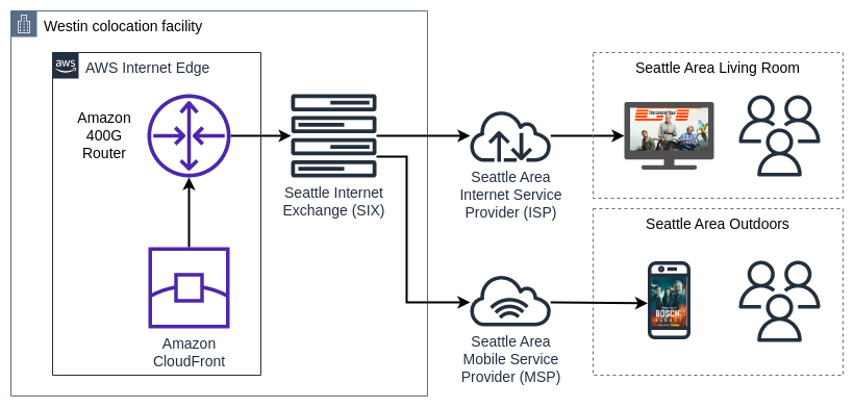
In response to the growing volume of services and media delivered over the internet, more and more data processing now happens at the network edge. The edge is closer to customers in terms of network hops than core internal systems. Content Delivery Networks (CDNs), such as Amazon CloudFront, and cloud providers deploy compute resources close to users at edge locations to increase the speed and reliability of content delivery.
What are the key features of a real-time internet backbone?
Traditional local networks, such as those used by a small business, typically have a few endpoints connecting to a few core resources. For example, a local network might consist of several desktops, laptops, and printers connected to file and application servers. There is a defined network perimeter in which all these resources operate. Internet backbone architecture follows different design principles because backbone networks are built for data transit at scale rather than dedicated internet access.
A backbone outage can have a significant impact on internet availability worldwide. By design, there is no single point of failure. Traffic will automatically reroute through alternative backbone paths or regional networks if necessary. The BGP protocol is widely used for local, automated routing intelligence. However, some links, such as major undersea cables between continents, are significant enough to cause significant disruptions if they experience an outage.
Fiber optic cabling
High-capacity, low-latency fiber optic cables are the primary medium for core network infrastructure. These cables transmit data as pulses of light. Fiber-optic cables have a large bandwidth relative to most other transmission media. These cables are resistant to electromagnetic interference, especially when inside shielded cabling, as is common in backbone infrastructure. Internet backbone providers run these fiber-optic cables between major hubs, across continents, and under seas.
Core routers
A “core router” is one of the most powerful, high-bandwidth routers of the current technological generation. They are specifically engineered to forward network traffic at the maximum possible rate and work with all current network protocols employed on the internet backbone.
Internet Exchange Points (IXPs)
Backbone providers exchange data bound for each other’s networks at physical locations called Internet Exchange Points (IXPs). When this exchange is performed freely, this model is called public peering. A dedicated IXP data center is where providers with many connections to their participant networks interconnect. The primary alternative to IXPs is a direct or private peering agreement. In this model, providers will directly exchange data, and there is usually some form of monetary compensation between providers.
Edge computing and CDN integration
Although traditional real-time internet backbones were primarily data transport architectures, modern backbones blur the line between transport and service delivery. Major providers now push content and compute resources closer to their users by integrating their private real-time internet backbone architecture with Content Delivery Networks (CDNs) and other services operating at network edges.
What are the benefits of using a real-time internet backbone?
Real-time internet backbone architecture is engineered to deliver data at maximum speed and reliability across the world.
Reduced latency
Latency is the delay between a network request and the server’s response. An internet backbone operating at maximum efficiency helps keep latency low. This is important for applications that require near-instant delivery over long distances, such as real-time communication, financial trading, and gaming. Organizations will often use private internet backbones integrated with their CDNs to do this.
Reliability
The backbone is built with extensive redundancy. If a break occurs in one continental line, or there is traffic congestion, core routers can quickly identify it using BGP and reroute to the next fastest available route.
Scalability
The growth in enterprise AI use, cloud services, and video streaming is driving increased demand for bandwidth. Internet backbones typically use ultra-high-capacity fiber optics to transport data that can accommodate surges in traffic. The ability to dynamically reroute traffic also helps make sure that the backbone infrastructure can scale with massive spikes in data.
Consistent network performance
Backbone systems must be designed for maximum performance due to their role in internet architecture. Redundant pathways to move internet traffic across continents and high-speed rerouting to adjust traffic pathways automatically help ensure services perform consistently.
What are the different types of real-time internet backbone architecture?
You can implement a real-time internet backbone in several different configurations. Public peering is the classic open internet model many will be familiar with. Private peering, hybrid, and software-defined networking architectures also exist.
Public peering
Public peering is the sharing of traffic that occurs at network interconnection points. For real-time internet backbones, that is typically IXPs, where multiple Tier 1 internet service providers, cloud providers, and CDNs connect and exchange traffic bound for each other’s networks. Major data centers with many of these preexisting connections are typically designated as IXPs. By mutual agreement, providers do not charge each other for carrying others’ traffic, making this model both efficient and cost-effective.
Private peering
Private peering is a direct, dedicated connection between two major networks. It is like a private one-to-one IXP. Providers will typically use private peering when they must manage high volumes of data moving directly to each other’s networks. They can bypass other third-party networks entirely to help offer higher bandwidth and better performance. They will also gain greater control over the internet backbone traffic flow. Large companies such as Amazon use private peering, such as AWS Direct Connect, to ensure high-quality delivery of their cloud services.
Hybrid approaches
Since both private and public peering models have their advantages, larger organizations will typically use a combination in a hybrid approach. For example, a company might use private peering with its largest traffic partners to maintain reliable performance by avoiding the public internet. Then they may use public peering at IXPs for other general traffic. Hybrid approaches to peering are popular as they can help organizations balance cost and performance based on specific use cases.
Software-Defined Networking (SDN)
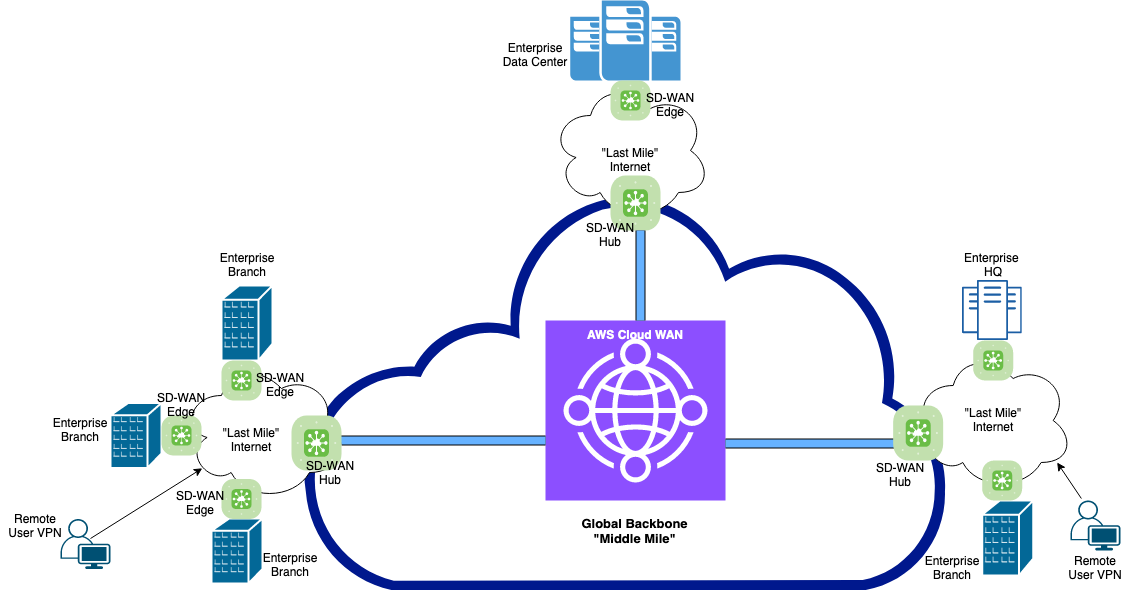
In traditional networking, the hardware handles both traffic forwarding and the routing decision-making. Software-defined networking decouples those functions, which means you can manage network logic centrally. This can have significant advantages when applied to the internet backbone architecture. Operators can automate traffic management to respond instantly to congestion and deploy new services rapidly.
How can AWS support your real-time internet backbone requirements?
AWS offers a range of services that help support your real-time network connections and requirements.
Amazon CloudFront is a content delivery network service that allows you to securely deliver content with low latency and high transfer speeds around the world.
AWS Direct Connect creates a dedicated network connection between your on-premise networks and AWS, for the fastest link to your cloud resources and applications.
AWS Global Accelerator improves application availability, performance, and security using the AWS global network. Onboard your user traffic at one of the Global Accelerator edge locations and enjoy deterministic routing independent of DNS.
AWS Local Zones allows you to easily run latency-sensitive portions of applications locally to end-points and resources in a specific geography.
Get started with real-time networking on AWS by creating a free account today.
Browse all cloud computing concepts
Browse all cloud computing concepts content here:
Did you find what you were looking for today?
Let us know so we can improve the quality of the content on our pages