AWS Partner Network (APN) Blog
Designing governance-first AI agents with Fenergo using Amazon Bedrock
By: Richi Pandey, Technical Account Manager – AWS
By: Evangelos Liatsas, Director of Engineering – Fenergo
By: Bilal Karaduman, Senior Partner Solutions Architect – AWS
 |
| Fenergo |
 |
In regulated industries, trust transforms AI into a competitive advantage and trust starts with governance. Fenergo designed governance-first AI agents on Amazon Bedrock, helping financial institutions to automate compliance with full traceability and oversight.
Autonomous AI agents can now screen transactions, extract data from unstructured documents, and resolve entities across global deny lists. But in regulated industries like financial services, healthcare, and insurance, capability alone doesn’t drive adoption. Trust does. Earning the trust of your customers requires being accountable for the decisions and actions of AI agents, which requires understanding why they do what they do.
This question shaped the approach Fenergo took to designing AI for financial services compliance. In regulated environments, organizations need visibility into how AI-supported decisions are reached, including the data, rules, and controls involved.
This post explores the Fenergo agentic governance-first approach using Amazon Web Services (AWS) managed services, including Amazon Bedrock, Amazon DynamoDB, Amazon Simple Notification Service (Amazon SNS), Amazon Simple Queue Service (Amazon SQS), and Amazon Timestream for InfluxDB. Amazon Bedrock underpins the architecture with multi-model access, built-in invocation logging, Regional data processing, and guardrails-based content filtering, freeing Fenergo to focus on governance rather than infrastructure.
Why governance matters for agentic AI adoption
Foundation models (FMs) can classify documents, match entities, and evaluate compliance rules with impressive accuracy. But when Fenergo began deploying autonomous agents for financial services clients, accountability, not accuracy, was the blocker.
Compliance officers, risk managers, and regulators don’t ask about accuracy. Instead, they want to know whether you can trace every decision back to the data that informed it, explain a decision in language they understand, and produce tamper-proof audit records years from now if a regulator asks. These aren’t theoretical concerns. They map directly to regulatory expectations across the EU AI Act, NIST AI Risk Management Framework (AI RMF), Singapore MAS FEAT principles, and UK FCA guidance on AI governance.
A governance layer for agentic AI workflows
To address these considerations, Fenergo architected the Agent Operating System (Agent OS), a compliance-first governance layer that sits between autonomous agents and the AWS infrastructure powering them. Agent OS orchestrates agentic AI across financial services workflows that include client onboarding, know your customer (KYC), and transaction monitoring.
Agent OS is designed for multi-tenant software as a service (SaaS) operation on AWS managed services. It gives compliance officers visibility into why an agent made a decision, and the ability to intervene when human judgment is required.
The architecture follows two levels, illustrated in the following graphic. First, every agent action is captured as a structured event, maintained in causal order for a defensible audit trail, and routed to purpose-built storage. Second, a human-led Command Center translates AI outputs into clear business logic, provides full decision provenance, and escalates high-risk exceptions. This delivers 50% faster reviews, 40% improved query speeds, and 100% causal ordering.
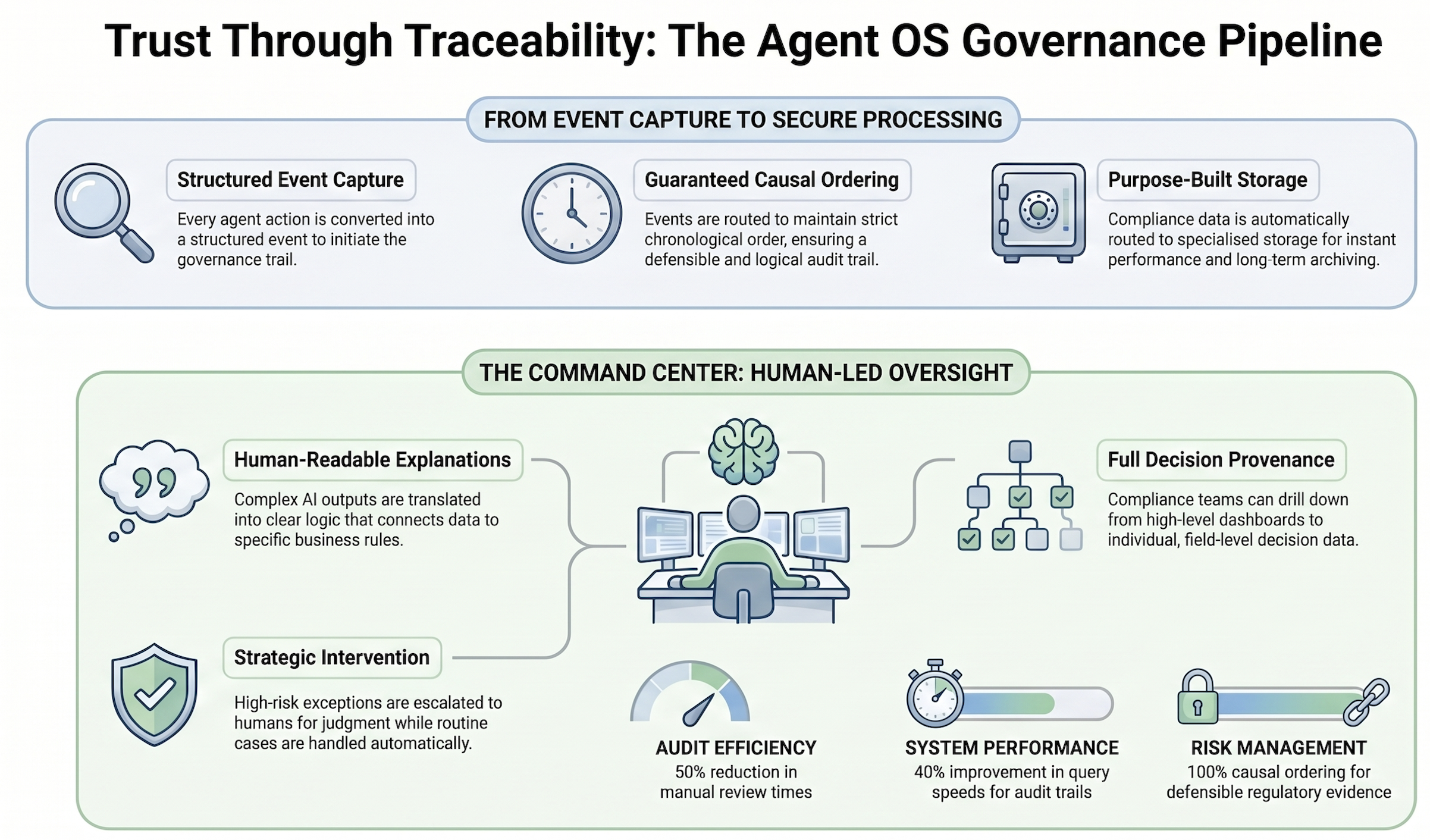 Figure 1: Solution architecture
The key insight: governing AI agents requires tracking decision provenance, policy enforcement, and explainability, not merely system health.
Designing AI systems that earn trust
The mental model behind Agent OS follows four principles that apply broadly to organizations building accountable AI systems: event-driven design for traceability, explainability, matching storage to purpose, and model flexibility.
Every agent action, including document classification, screening decision, and rule evaluation, produces a structured event flowing through a multistage governance pipeline. Agents interact through a governed framework that enforces event publication as an architectural requirement, meaning the pipeline can’t be bypassed. Events are published to Amazon SNS First-In-First-Out (FIFO) topics and routed through Amazon SQS FIFO queues, preserving causal ordering for defensible audit trails.
When a compliance officer asks why a screening agent flagged a transaction, they need a human-readable explanation connecting data inputs, compliance rules, and conclusions—not raw JSON. Agent OS uses Amazon Bedrock to synthesize decision context into business-rule language on demand, so explanations reflect the full context of the original decision. Amazon Bedrock processes inference requests within the customer’s selected AWS Regions, supporting data locality and applicable data protection requirements. Its Converse API provides an integration point for accessing supported foundation models, simplifying vendor management.
Different types of compliance data have fundamentally different access patterns, so Agent OS uses a purpose-built storage strategy matched to each. Amazon Timestream for InfluxDB supports time-series analytics such as agent performance trends and anomaly detection. Amazon DynamoDB stores operational compliance records that require fast point queries by entity. Amazon Simple Storage Service (Amazon S3) stores immutable event archives with lifecycle policies that support long-term regulatory retention.
Agent OS runs multiple foundation models through Amazon Bedrock, matching models to workloads based on complexity, latency, and cost. Fenergo uses the Amazon Bedrock Converse API to abstract model selection, enabling swaps without rewriting application logic. A key enabler is Amazon Bedrock Knowledge Bases, which maintains tenant-specific compliance context—regulatory rules, internal policies, and client requirements—without fine-tuning, making each client’s requirements part of the decision-making context at inference time.
The architecture spans five layers, illustrated in the following graphic. Tenant-specific guardrails and compliance rules feed into specialized AI agents handling document extraction, screening, autocompletion, data sourcing, and compliance checks. The unified interface in Amazon Bedrock routes workloads to the optimal foundation model—Claude by Anthropic for document processing, Amazon Nova Pro for high-volume matching, and Llama 3.3 by Meta for binary decisions. A multilayer safety shield enforces content validation and prompt injection prevention, and a secure audit trail maintains causal ordering.
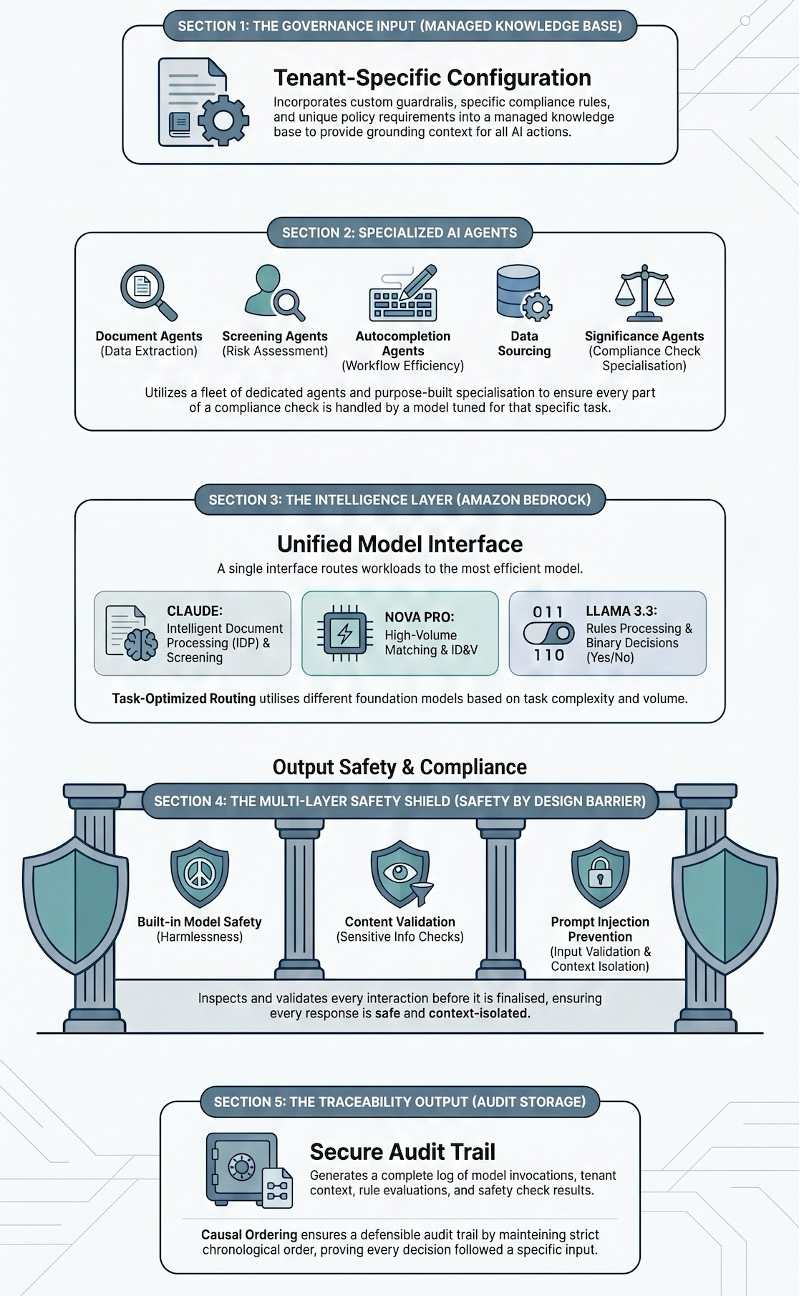 Figure 2: Agent OS architecture overview
Designing human oversight into the workflow
A common misconception is that “human-in-the-loop” means that humans approve every decision. That approach defeats the purpose of automation. The right model is one where humans focus on decisions that genuinely require human judgment, and agents handle routine cases competently and transparently.
Agent OS uses a command center to focus human judgment where it’s needed most, with configurable escalation rules per tenant. For example, when entity screening produces a match above a risk threshold—such as a 94% confidence hit against high-risk geography grounded in Global AML Policy v3.2—the system escalates to a compliance officer rather than automatically approving. Officers can drill into individual decisions, override, request evidence, or approve, all captured in a tamper-proof audit trail. The following graphic illustrates this capability.
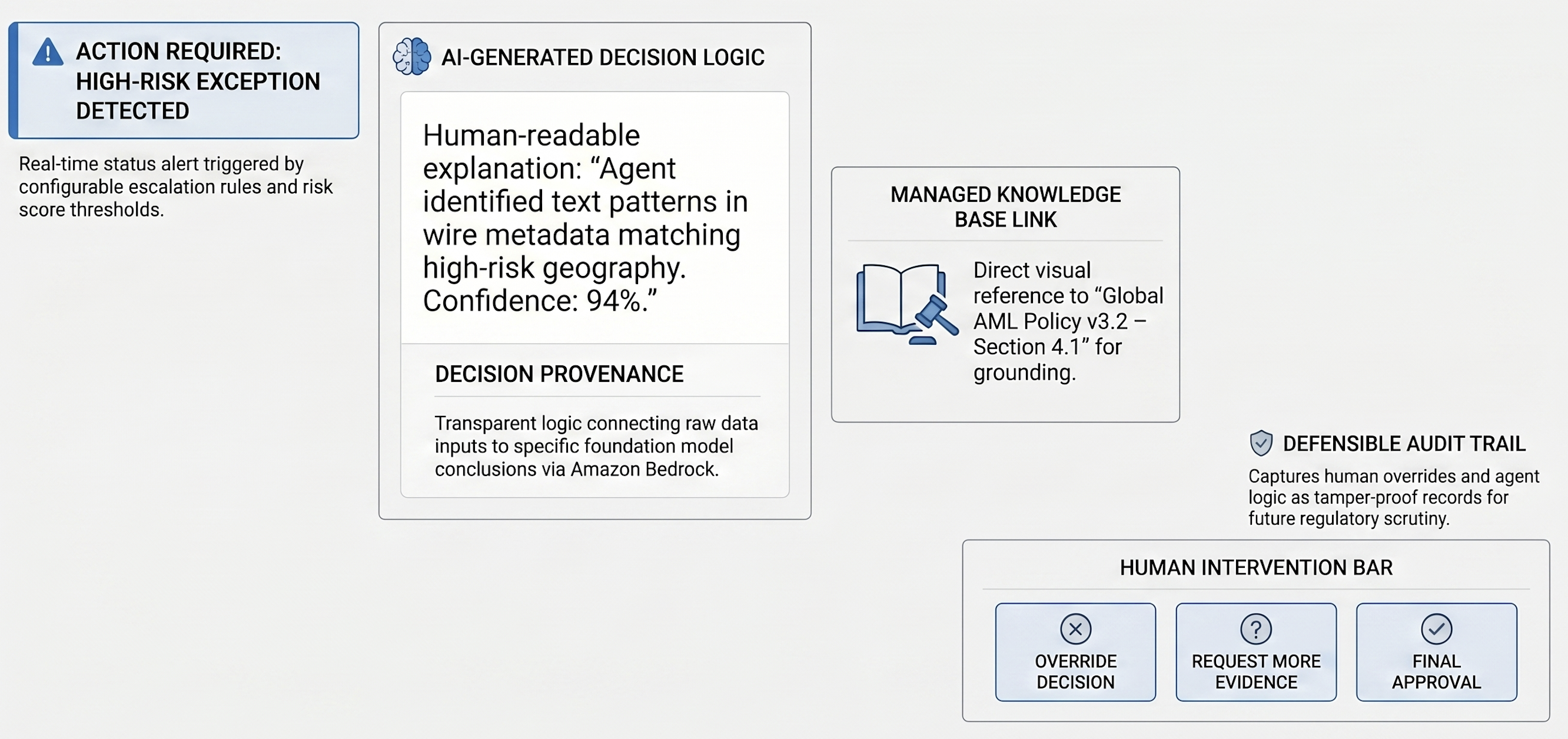 Figure 3: The Governance Command Center provides a human-readable explainability interface for rapid audit and human oversight
In a demonstration scenario, a compliance officer asked why the document agent chose articles of incorporation over an operating agreement. The system returned a detailed explanation with confidence scores and pattern matches.
Driving business value and innovation for AWS Partners
Customer expectations in regulated industries are shifting. Enterprise stakeholders want to know whether your AI can do something, but more than that, they want to know if you can prove how the tool did it. The governance blueprints, traceability patterns, and explainability features in this post extend well beyond financial services to healthcare, insurance, and government.
The Fenergo FinCrime OS and AI agents deliver measurable operational improvements and strengthen governance:
- Up to 45% shorter periodic review timeframes – AI agents automate data reconciliation, document classification, and screening, so compliance teams can focus on higher-risk exceptions.
- 72% faster document handling – AI-assisted classification and extraction accelerate the preparation of review-ready client records.
- Up to 93% lower operational costs – Automation across siloed systems and manual processes reduces the effort required for repetitive, low-risk activities.
Fenergo FinCrime OS and AI agents also help strengthen governance and oversight. Amazon Bedrock is included within the scope of AWS ISO/IEC 42001:2023 Artificial Intelligence Management System certification.Fenergo combines Amazon Bedrock with other AWS managed services and its own ISO 27001 and SOC 2 Type II certified controls to provide a foundation that can help customers address their data protection obligations under applicable regulations. Customers remain responsible for assessing whether their implementation meets applicable legal and regulatory requirements.
This combination makes governed AI a reality, turning regulatory compliance from a constraint into a competitive advantage. Results are based on measurements by Fenergo and can vary depending on the customer, workflow, data, configuration, and deployment.
Key takeaways for building governed AI systems
This architectural approach provides several patterns that can help organizations strengthen governance in compliance-sensitive environments:
- Design governance into the workflow – Prioritizing traceability, explainability, and human oversight can help organizations evaluate AI-supported decisions alongside model accuracy.
- Preserve event ordering – Maintaining the sequence of inputs, actions, and decisions can help organizations create clearer and more reviewable audit trails.
- Architect for model portability – Using the Amazon Bedrock Converse API can reduce application dependencies on individual foundation models and streamline future model changes.
- Treat documentation as a core deliverable – Documenting decision flows, controls, and interventions can help organizations support internal review, audit, and governance processes.
Conclusion
The most powerful AI is AI that people trust. The experience Fenergo had demonstrates that trust is built by designing governance into the architecture from day one, not by bolting it on afterward.
This creates a reinforcing cycle in which traceable, explainable agents earn trust, trust expands use cases, and expanded use cases grow business value. Governance isn’t a constraint—it drives adoption.
To explore the AWS services discussed in this post, visit Amazon Bedrock for enterprise agentic AI applications. To learn more about the principles that underpin this approach, visit ISO/IEC 42001:2023 and Responsible AI: From principles to practice. To learn more about the approach Fenergo took to governed AI for financial services, visit Fenergo.

Fenergo – AWS Partner spotlight
Fenergo is an AWS Partner holding the AWS AI Software Competency and the AWS Financial Services Specialization. Their SaaS platform runs exclusively on AWS and is available in AWS Marketplace, covering KYC, AML compliance, client onboarding, and transaction monitoring for global financial institutions.