AWS Architecture Blog
Digital Transformation at Santander: How Platform Engineering is Revolutionizing Cloud Infrastructure
This post is cowritten by Julio Bando from Santander.
Santander faced a significant technical challenge in managing an infrastructure that processes billions of daily transactions across more than 200 critical systems. The expansion into diverse financial services, including investment banking, wealth management, insurance, and payment solutions, had created unprecedented technological complexity, requiring a robust, agile, and scalable infrastructure solution. This raised two main issues. Santander needed to ensure that provisioned services followed established architecture definitions, and they needed to reduce infrastructure provisioning time, which took up to 90 days. This situation demanded intensive operational effort. The solution emerged through an innovative platform engineering initiative called Catalyst, which transformed the bank’s cloud infrastructure and development management. This post analyzes the main cases, benefits, and results obtained with this initiative.
The Catalyst solution
Santander is a global financial services company present in more than 10 countries, with over 160 million customers worldwide. They conceived Catalyst in conjunction with the Platform Strategy Program (PSP), an Amazon Web Services (AWS) program specialized in infrastructure platform design. Implemented through a partnership between AWS Professional Services and Santander, the platform was designed to abstract infrastructure provisioning complexity, standardize architectural compliance, and create a framework that enables new technologies in the bank.
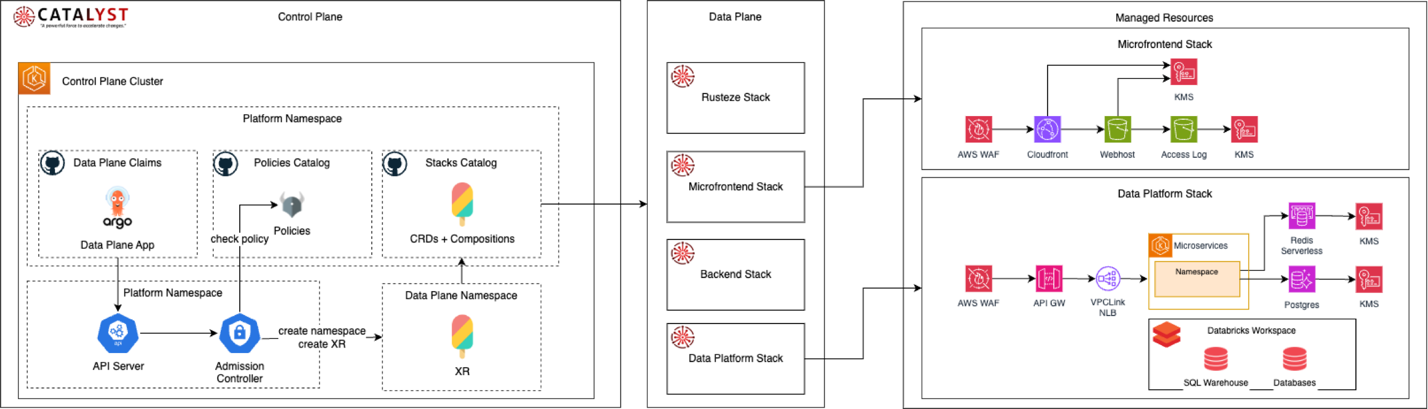
The platform’s in-house frontend was developed as an intuitive developer portal, offering a unified interface for all provisioning and resource management needs. At the platform’s core is the control plane cluster, based on Amazon Elastic Kubernetes Service (Amazon EKS). This cluster is the brain of the operation, orchestrating all components and workflows. Within the cluster, Crossplane plays a fundamental role, acting as a universal resource provisioner that Santander uses to manage resources across multiple cloud providers consistently and declaratively.
The control plane cluster has three components:
- Data plane claims – Managed by ArgoCD, a continuous delivery tool, the component is responsible for continuous synchronization and deployment of application stacks (integrated sets of cloud resources) and configurations, exploring the GitOps concept.
- Policies catalog – A central repository of policies ensuring compliance and security across all operations using Open Policy Agent (OPA).
- Stacks catalog – A library of composite resource definitions and Compositions enabling quick and standardized creation of complex environments.
Santander used this innovative architecture to significantly reduce provisioning time from 90 days to only a few hours and in some cases only minutes. Catalyst brought significant benefits in terms of standardization, security, and governance. The provisioning cycle decreased from 30 days to 2 days, and proof of concept preparation time jumped from 90 days to only 1 hour. The consolidation of over 100 pipelines into a single control plane will further simplify infrastructure management. The following diagram shows the Santander catalyst architecture.
Key platform capabilities
Catalyst’s implementation enabled the creation of strategic workloads demonstrating the platform’s versatility and robustness:
- Generative AI agents stack – The first success case was implementing a complete stack for AI agents integrating:
- Amazon Bedrock for foundational model consumption
- Amazon Simple Storage Service (Amazon S3) for data storage
- AWS Key Management Service (AWS KMS) for cryptographic key management
- Custom AWS Identity and Access Management (IAM) policies for security
- Modern data platform – One of the most complex workloads implemented through Catalyst was the new data platform, including:
- Built-in integration with Databricks
- Data lakes
- Automated extract, transform, and load (ETL) workflows
- Integration with centralized data catalog
- Segregated environments for experimentation. With this implementation, the bank significantly reduces approximately 3,000 monthly tickets related to data experimentation environment provisioning.
- Cloud process orchestration – creation of a modern process orchestration environment with significant results:
- Migration of legacy workflows to AWS Step Functions
- Implementation of retry patterns and error handling
- Centralized process monitoring
Overall result
This stack reduced AI agent implementation time from 105 days to only 24 hours, eliminating dozens of provisioning tickets per environment. The success of these workloads demonstrates Catalyst’s technical capability and the solution’s versatility in meeting different business needs. Each implementation brought valuable learnings that were incorporated into the platform, creating a virtuous cycle of continuous improvement. The variety of implemented workloads also shows how Catalyst has the potential to be a universal platform, capable of supporting everything from traditional use cases to the most innovative ones involving AI and legacy system modernization. Catalyst’s success wasn’t limited to operational efficiency. The platform also catalyzed a cultural change within Santander, promoting an automation and self-service mindset among development teams. This resulted in faster overall development velocity, more agile teams, and enhanced capability to respond quickly to market changes.
Conclusion
Catalyst represents more than merely a technological tool—it’s a digital transformation enabler that’s redefining cloud development standards at the bank. With the platform, Santander addressed the challenges of a scaled environment and established a solid foundation for continuous innovation and future growth.
With these practical cases, Santander proves that investment in platform engineering solves technical problems and enables new business possibilities, keeping the bank at the forefront of digital transformation in the financial sector.