AWS Big Data Blog
Category: Amazon SageMaker Data & AI Governance
Navigating multi-account deployments in Amazon SageMaker Unified Studio: a governance-first approach
In this post, we explore SageMaker Unified Studio multi-account deployments in depth: what they entail, why they matter, and how to implement them effectively. We examine architecture patterns, evaluate trade-offs across security boundaries, operational overhead, and team autonomy. We also provide practical guidance to help you design a deployment that balances centralized control with distributed ownership across your organization.
Automating data classification in Amazon SageMaker Catalog using an AI agent
If you’re struggling with manual data classification in your organization, the new Amazon SageMaker Catalog AI agent can automate this process for you. Most large organizations face challenges with the manual tagging of data assets, which doesn’t scale and is unreliable. In some cases, business terms aren’t applied consistently across teams. Different groups name and tag data assets based on local conventions. This creates a fragmented catalog where discovery becomes unreliable and governance teams spend more time normalizing metadata than governing. In this post, we show you how to implement this automated classification to help reduce the manual tagging effort and improve metadata consistency across your organization.
Implement a data mesh pattern in Amazon SageMaker Catalog without changing applications
In this post, we walk through simulating a scenario based on data producer and data consumer that exists before Amazon SageMaker Catalog adoption. We use a sample dataset to simulate existing data and an existing application using an AWS Lambda function, then implement a data mesh pattern using Amazon SageMaker Catalog while keeping your current data repositories and consumer applications unchanged.
Build a trusted foundation for data and AI using Alation and Amazon SageMaker Unified Studio
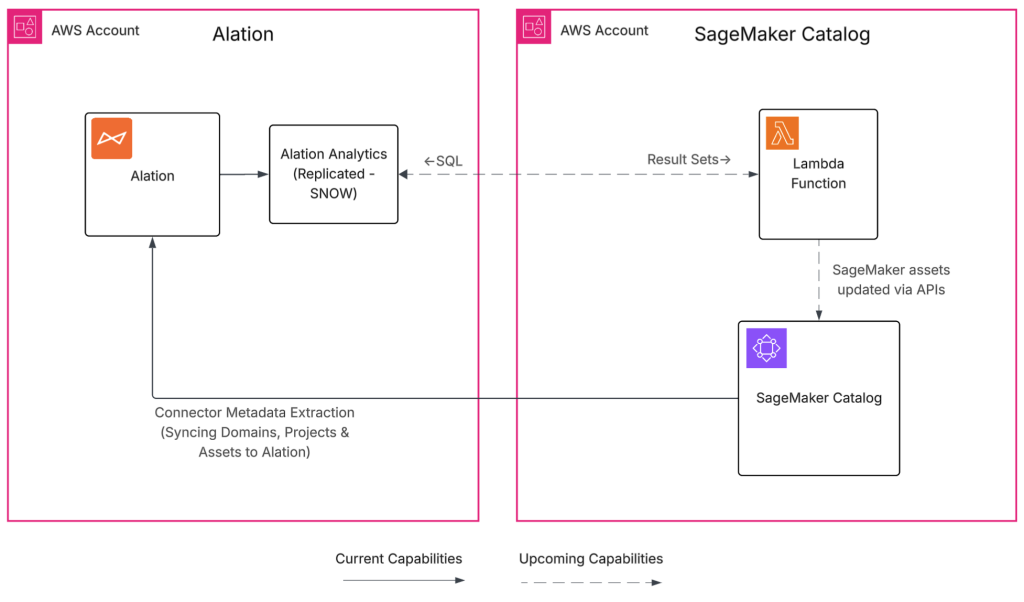
The Alation and SageMaker Unified Studio integration helps organizations bridge the gap between fast analytics and ML development and the governance requirements most enterprises face. By cataloging metadata from SageMaker Unified Studio in Alation, you gain a governed, discoverable view of how assets are created and used. In this post, we demonstrate who benefits from this integration, how it works, the specific metadata it synchronizes, and provide a complete deployment guide for your environment.
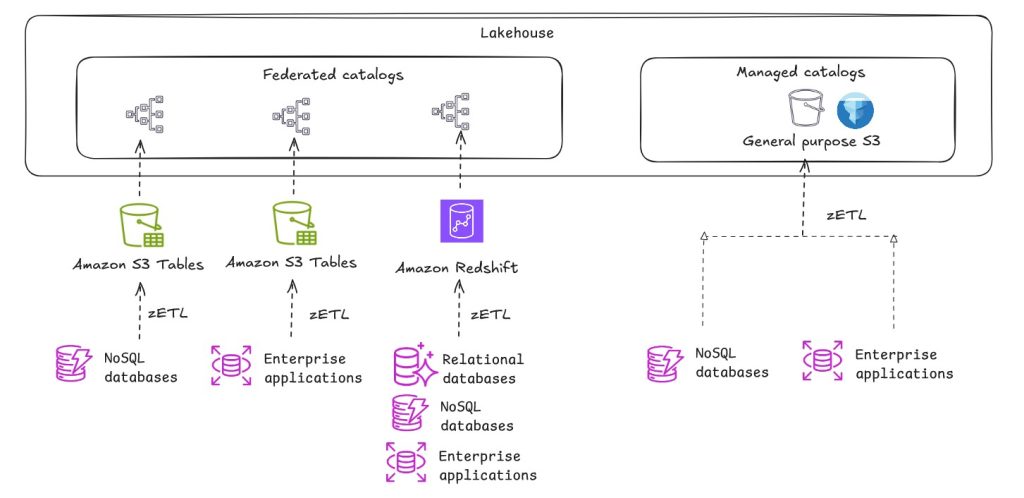
Navigating architectural choices for a lakehouse using Amazon SageMaker
Over time, several distinct lakehouse approaches have emerged. In this post, we show you how to evaluate and choose the right lakehouse pattern for your needs. A lakehouse architecture isn’t about choosing between a data lake and a data warehouse. Instead, it’s an approach to interoperability where both frameworks coexist and serve different purposes within a unified data architecture. By understanding fundamental storage patterns, implementing effective catalog strategies, and using native storage capabilities, you can build scalable, high-performance data architectures that support both your current analytics needs and future innovation.
AWS analytics at re:Invent 2025: Unifying Data, AI, and governance at scale
re:Invent 2025 showcased the bold Amazon Web Services (AWS) vision for the future of analytics, one where data warehouses, data lakes, and AI development converge into a seamless, open, intelligent platform, with Apache Iceberg compatibility at its core. Across over 18 major announcements spanning three weeks, AWS demonstrated how organizations can break down data silos, […]

Reference guide for building a self-service analytics solution with Amazon SageMaker
In this post, we show how to use Amazon SageMaker Catalog to publish data from multiple sources, including Amazon S3, Amazon Redshift, and Snowflake. This approach enables self-service access while ensuring robust data governance and metadata management.

How Bayer transforms Pharma R&D with a cloud-based data science ecosystem using Amazon SageMaker
In this post, we discuss how Bayer AG used the next generation of Amazon SageMaker to build a cloud-based Pharma R&D Data Science Ecosystem (DSE) that unified data ingestion, storage, analytics, and AI/ML workflows.
Enforce business glossary classification rules in Amazon SageMaker Catalog
Amazon SageMaker Catalog now supports metadata enforcement rules for glossary terms classification (tagging) at the asset level. With this capability, administrators can require that assets include specific business terms or classifications. Data producers must apply required glossary terms or classifications before an asset can be published. In this post, we show how to enforce business glossary classification rules in SageMaker Catalog.
Enhanced data discovery in Amazon SageMaker Catalog with custom metadata forms and rich text documentation
Amazon SageMaker Catalog now supports custom metadata forms and rich text descriptions at the column level, extending existing curation capabilities for business names, descriptions, and glossary term classifications. Column-level context is essential for understanding and trusting data. This release helps organizations improve data discoverability, collaboration, and governance by letting metadata stewards document columns using structured and formatted information that aligns with internal standards. In this post, we show how to enhance data discovery in SageMaker Catalog with custom metadata forms and rich text documentation at the schema level.