AWS for Industries
From chaos to control: Transforming intralogistics using SYNAOS on AWS
Manufacturers are facing a workforce shortage that is reshaping how intralogistics operations run for the next decade. According to Deloitte’s 2025 Manufacturing Industry Outlook, 1.9 million manufacturing jobs could go unfilled over the next ten years if talent challenges aren’t addressed. To close that gap, manufacturers are reshaping floor operations around faster, more automated material movement.
Many manufacturers are already responding by adding mobile robots, but multi-vendor fleets without unified control create a coordination problem that automation alone can’t fix. A typical factory floor runs Automated Guided Vehicles (AGVs) and Autonomous Mobile Robots (AMRs) from multiple vendors. Each has its own control system and no shared view of orders or traffic. The result is an isolated automation that falls short of the operational gains manufacturers expect.
In this post, we discuss how SYNAOS on AWS delivers multi-fleet orchestration, bringing mixed-vendor robots under one platform that coordinates material flow in real time.
The multi-vendor coordination problem
When a manufacturer buys robots from multiple vendors, they inherit a separate fleet management system per vendor. These systems run independently, with no shared view across vendors. As a result, teams manage order priorities, traffic conflicts, route planning, and resource allocation manually across disconnected platforms.
Managing a disconnected robot fleet is only part of the problem. Many factories already run Manufacturing Execution Systems (MES), Warehouse Management Systems (WMS), or Enterprise Resource Planning (ERP) systems that govern production schedules, inventory, and orders. A robot fleet that can’t connect to those systems creates a second layer of manual overhead. Operators constantly bridge the gap between enterprise data and shop floor reality.
Beyond vehicles and enterprise systems, the shop floor itself contains infrastructure that affects material flow: gates, traffic lights, conveyors, sensors, and automated storage systems, each running in its own isolated silo.
Solving all three layers at once is what separates coordinated automation from costly, disconnected operations.
How SYNAOS fixes the coordination gap
SYNAOS addresses this through its Intralogistics Platform, a cloud-native system that manages the three layers from a single point of control. SYNAOS applies demand-driven optimization, putting material demand at the center. It creates “Intralogistics Jobs” based on what materials are needed, where, and when. It then assigns each job to the best-matched available resource by analyzing vehicle availability, location, load capacity, and order priorities. The platform also calculates optimal routes in real time, using live data from sensors and traffic lights to prevent deadlocks and bottlenecks.
SYNAOS integrates more than 80 robot vendors through its platform, connecting through VDA 5050, the open communication standard for interoperability between mobile robots and fleet control systems. This allows customers to combine vehicles from multiple vendors into a unified system, improving multi-fleet orchestration and visibility into operations.
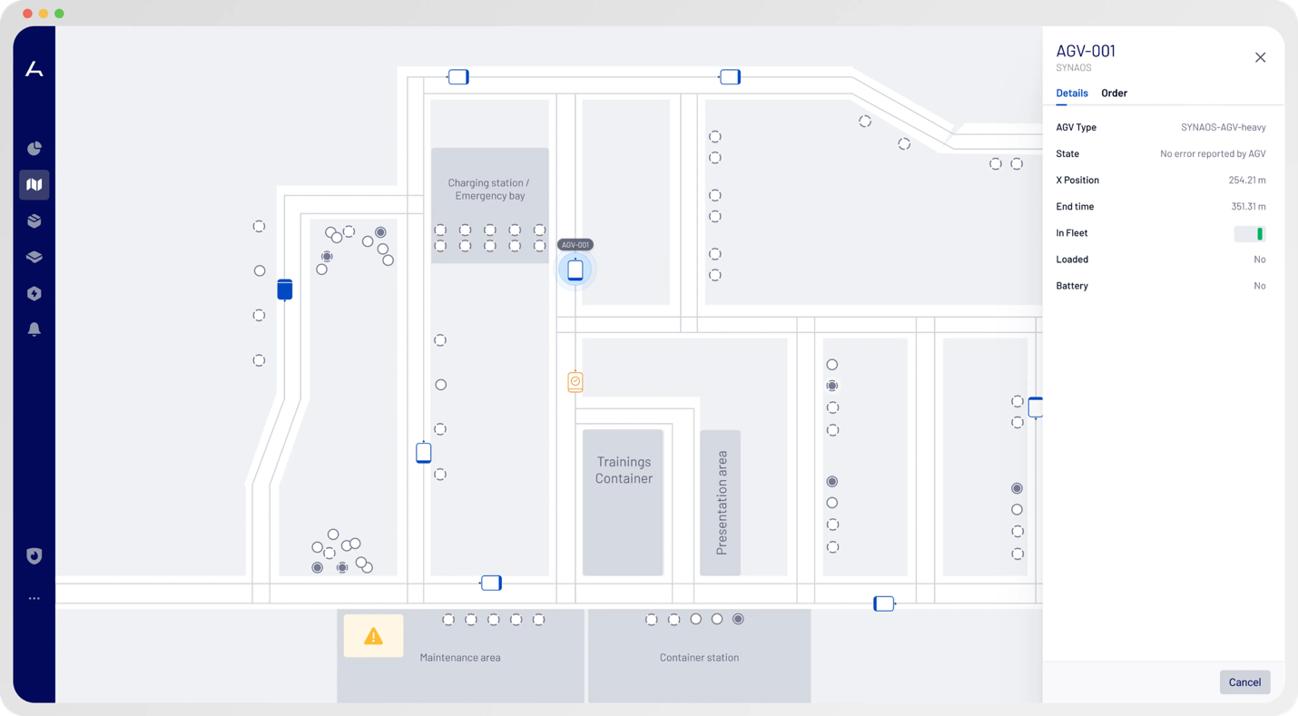
Figure 1: The SYNAOS Intralogistics Platform Control Center showing a live floor map with mobile robot positions, handling stations, charging stations, and real-time vehicle status.
The platform connects directly into MES, WMS, and ERP systems, so manufacturers can extend their enterprise infrastructure rather than replace it. Gates, traffic lights, conveyors, sensors, and automated storage systems on the shop floor all feed into the same unified material flow. Supervisors get a real-time view through clear dashboards, while forklift operators work from purpose-built mobile apps on the floor.
From shop floor to cloud: SYNAOS on AWS solution architecture
The SYNAOS Intralogistics Platform runs on a cloud-native architecture on AWS, built for high availability and designed to scale as operations grow. The following architecture diagram walks through the data flow across six steps, from shop floor assets to cloud services.
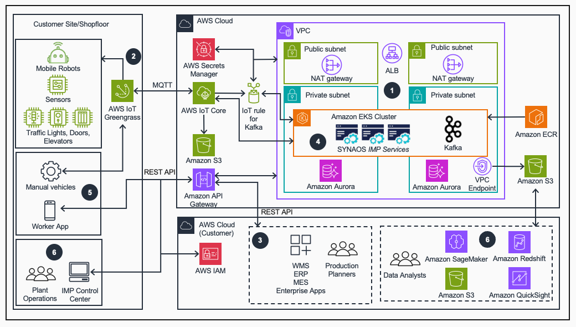
Figure 2: SYNAOS Intralogistics Platform on AWS architecture diagram
- Core SYNAOS services run on Amazon Elastic Kubernetes Service (Amazon EKS) across multiple Availability Zones, with Amazon Aurora handling database operations for high availability. Self-managed Apache Kafka manages real-time event streaming and message distribution between services, and AWS Secrets Manager stores credentials, IoT certificates, and API keys securely.
- On the shop floor, AWS IoT Greengrass connects local MQTT devices to AWS IoT Core in the cloud so that mobile robots, sensors, traffic lights, doors, and elevators communicate in real time.
- SYNAOS receives transport demands from MES, WMS, and ERP systems via Amazon API Gateway. Sensors and push buttons on the shop floor also trigger transport demands directly.
- SYNAOS core services process messages from mobile robots, handling stations, and traffic lights to determine optimal transport solutions. The platform then sends commands to vehicles based on near real-time demands and shop floor status.
- The real-time localization system tracks manually operated forklifts and transport vehicles. Drivers receive transport jobs through the SYNAOS Worker App, while plant operations staff monitor all transport processes through the Intralogistics Platform Control Center and can intervene to resolve shop floor issues.
- Data analysts analyze historical intralogistics data from Amazon Simple Storage Service (Amazon S3), Amazon SageMaker handles machine learning insights, Amazon Redshift queries large volumes of historical transport and order data, and Amazon Quick Sight produces efficiency reports.
Volkswagen Commercial Vehicles: coordinating the floor at scale
The Volkswagen Commercial Vehicles plant in Hannover runs interconnected assembly lines where a single delay in material delivery ripples through the entire system immediately. Keeping those lines continuously supplied, with the right part arriving at the right vehicle body at the right moment, requires coordinating hundreds of automated transport orders every hour.
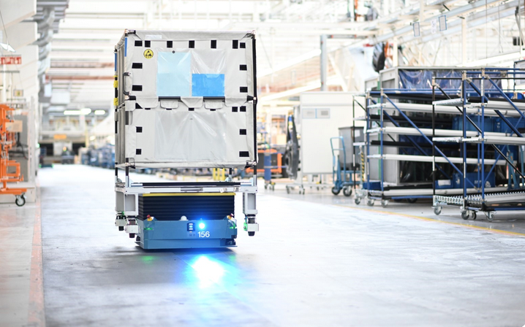
Figure 3: Just-in-sequence: A mobile robot from MLR transports materials to the production line
The plant runs more than 125 mobile robots from two different vendors, including automated underride AGVs and automated tugger trains. SYNAOS connects them through one unified system. It tracks material from arrival at truck transfer ramps, through internal logistics supermarkets, to final delivery at the production line. The moment a sequence container leaves the supermarket, the platform takes over full transport control.
The fleet fulfills over 2,500 automated transport orders per day and moves around 9,000 racks daily through the plant. Across a year, it covers approximately 300,000 kilometers of automated travel.
“With SYNAOS’ fleet management, we have a solution that allows us to scale our fleet effectively and use resources efficiently. Every quarter, we will take another step forward because the system is reliable, highly available, and process-stable” said Dr. Felix Bockholt, Volkswagen Nutzfahrzeuge. Watch the plant in operation in this short video.
Conclusion
In this post, we explored how the SYNAOS Intralogistics Platform on AWS brings unified orchestration to multi-vendor factory floors across fleet management, demand-driven optimization, and enterprise integration, using the Volkswagen Commercial Vehicles deployment as a production-scale example.
If you want to orchestrate AGVs, AMRs, manual forklifts, and human operators on one platform, SYNAOS brings them together. It also connects your enterprise systems and shop floor assets. Explore the SYNAOS Intralogistics Platform to understand its fleet management and orchestration capabilities. Read the full Volkswagen Commercial Vehicles customer story for more on the deployment.
Through the AWS Partner Network, you can find the SYNAOS intralogistics platform technically validated and published as AWS solution guidance.
Further reading
For more details on the platform and the underlying services, see the following resources: