AWS for Industries
Transforming Food Label Verification in Retail with Generative AI
Introduction
In the retail and consumer packaged goods (CPG) industry, accurate food labeling is a critical safety requirement. Retailers face an increasingly complex challenge: manually verifying that thousands of packaged foods comply with FDA regulations—particularly the allergen labeling requirements under the Food Allergen Labeling and Consumer Protection Act (FALCPA) of 2004. Quality assurance teams spend significant manual effort cross-referencing physical labels with ingredient databases, checking that allergens such as soy are properly disclosed. This manual process is time-consuming, error-prone, and creates bottlenecks that increase the risk of non-compliance.
The stakes are significant—a single mislabeled product can trigger FDA investigations, recalls costing millions, and consumer health risks. This blog presents an end-to-end serverless architecture built on AWS that leverages generative AI on Amazon Bedrock to automate food label verification at scale, reducing manual effort, improving accuracy, and ensuring continuous FDA compliance.
The Challenge: Manual verification in a regulated environment
Retailers face interconnected challenges in label verification. Under FALCPA 2004, all eight major allergens must be clearly declared in plain language—including within complex compound ingredients (e.g., “hydrolyzed vegetable protein (soy)”)—creating a dense web of compliance rules. Manual verification is inherently error-prone, especially at high volumes, and printing inconsistencies can introduce undetected discrepancies between intended and actual labels. FDA auditors expect robust documentation trails that manual processes rarely deliver consistently. Meanwhile, quality assurance teams spend disproportionate time on repetitive checks, reducing their capacity for higher-value strategic work.
Benefits of automated label verification
An AI-powered label verification system delivers measurable benefits across the organization:
- FDA Compliance Assurance: Automated, consistent verification against regulatory requirements with full audit trail documentation.
- Accurate Attribute Extraction: AI-powered identification of correct attributes, allergens, and nutritional information from product labels with high precision.
- Faster Time to Production: Reduced verification cycle times from hours to minutes, accelerating product release workflows.
- Reduced Manufacturing Errors: Early detection of label printing errors before products reach distribution.
- Improved Operational Efficiency: Freeing quality assurance teams to focus on strategic initiatives while AI handles routine verification at scale.
The following architecture shows how these benefits are achieved using a fully serverless pipeline on AWS.
Solution architecture
The solution is a fully serverless, event-driven architecture orchestrated by AWS Step Functions, divided into four processing stages: Image Capture and Ingestion, Label Processor, Intelligent Decision Processor, and Reporting and Alerting. Step Functions coordinates the entire pipeline end-to-end—triggered by Amazon S3 event notifications on image upload—with built-in error handling and retry logic. A dedicated Amazon DynamoDB table (Process Metadata) tracks every image through the pipeline, maintaining processing status, timestamps, and stage outputs for real-time visibility. AWS CloudTrail streams all API calls to a dedicated S3 Audit Log Bucket, providing the immutable audit trail required for FDA traceability and regulatory investigations.
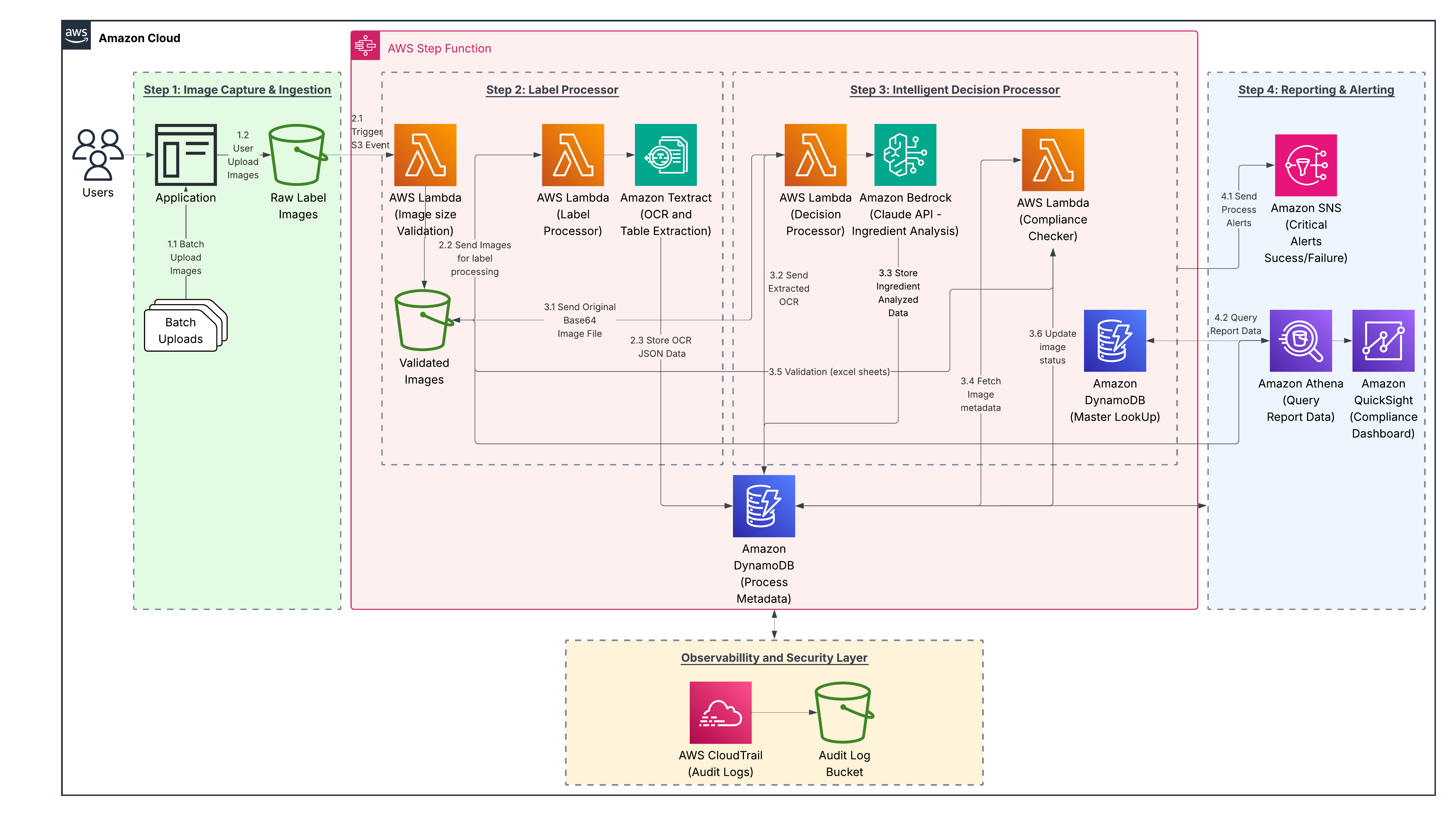
Figure 1: End-to-end solution architecture for food label verification on AWS
Note: The step numbers below (1.1, 2.1, 3.1, etc.) correspond to the sequential data flow labels shown in the architecture diagram and represent the end-to-end processing sequence across all stages.
Step 1: Image capture and ingestion
The label verification pipeline begins with a robust image capture and ingestion stage designed to handle batch uploads from production facilities, vendor partners, and quality assurance teams.
Workflow
- 1.1 – Batch Upload Images: Users upload raw label images through the application interface (web or mobile). The application supports batch uploads, enabling quality teams to submit hundreds of label images from production runs simultaneously.
- 1.2 – User Upload Images: Individual uploads are also supported for ad-hoc verification requests. All images are stored in the Raw Label Images Amazon S3 bucket, which serves as the ingestion point for the pipeline.
- 2.1 – Trigger S3 Event: Each image upload to the S3 bucket triggers an S3 event notification that initiates the AWS Step Functions workflow, ensuring real-time processing without manual intervention.
Image size validation (AWS Lambda)
The first Lambda function in the pipeline performs image size validation and quality checks. It verifies that uploaded images meet minimum resolution requirements for accurate OCR processing, validates supported file formats (JPEG, PNG, TIFF), and rejects images that are corrupted or too small to process reliably.
- The function validates image dimensions, file size, and format
- The function rejects images below quality thresholds with appropriate error messaging
- The function stores validated images in the Validated Images S3 bucket for downstream processing
- The function records image metadata (filename, size, upload time, source) to the Process Metadata DynamoDB table
Step 2: Label processor
The Label Processor stage handles the core optical character recognition (OCR) and structured data extraction from validated label images. This stage transforms raw images into machine-readable text and structured JSON (JavaScript Object Notation) data that can be analyzed by downstream AI models.
Workflow
- 2.2 – Send Images for Label Processing: The AWS Lambda Label Processor function retrieves validated images from the Validated Images S3 bucket. It prepares each image for OCR processing by converting to the optimal format and resolution for Amazon Textract.
- 2.3 – Store OCR JSON Data: Amazon Textract performs OCR and table extraction on each label image, identifying text blocks, key-value pairs, and tabular structures (such as nutrition facts panels). The extracted data is stored as structured JSON for downstream processing.
- 3.1 – Send Original encoded Image File: The original label image is encoded and passed alongside the extracted OCR data to the Intelligent Decision Processor stage. This enables the AI model to perform visual verification against the extracted text.
Amazon Textract: OCR and table extraction
Amazon Textract provides advanced OCR capabilities specifically optimized for complex food packaging layouts:
- Table detection and form analysis for nutrition facts panels
- Key-value pair extraction for structured label fields
- Support for multi-column layouts, curved surfaces, and reflective packaging materials
- High-accuracy text extraction even with challenging image conditions
- Automatic detection of ingredient lists, allergen statements, and regulatory declarations
Step 3: Intelligent decision processor
The Intelligent Decision Processor is the core AI-powered stage of the pipeline. It leverages Amazon Bedrock with Anthropic Claude to perform sophisticated ingredient analysis, validates extracted data against master records, and executes compliance checks against FDA regulatory requirements.
Workflow
- 3.2 – Send Extracted OCR: The Decision Processor Lambda function receives the extracted OCR data from the Label Processor stage and prepares it for AI analysis.
- 3.3a – Amazon Bedrock (Anthropic’s Claude API – Ingredient Analysis): The foundation model performs deep semantic analysis of ingredient lists, identifying allergens, interpreting complex compound names, and understanding regulatory language patterns. Anthropic’s Claude analyzes both the extracted text and the original encoded image to verify accuracy.
- 3.3b – Store Ingredient Analyzed Data: The AI-analyzed ingredient data, including identified allergens, nutritional components, and regulatory compliance flags, is stored for validation.
- 3.4 – Fetch Image Metadata: The system retrieves the master product record from Amazon DynamoDB (Master LookUp table) to obtain the expected ingredients, allergens, and label specifications for the given product stock keeping unit (SKU).
- 3.5 – Validation against master product specifications (Excel Sheets): The AI-extracted label data is compared against master validation spreadsheets containing approved ingredient lists, required allergen declarations, and regulatory formatting requirements for each product.
- 3.6 – Compliance Checker (AWS Lambda): A dedicated Compliance Checker Lambda function evaluates the validation results and makes the final compliance determination. It categorizes each label as compliant, non-compliant, or requiring manual review.
- 3.8 – Update Image Status: The compliance verdict is written back to the Amazon DynamoDB Master LookUp table, updating the image status (compliant/non-compliant/review required) along with detailed findings.
Amazon Bedrock: Generative AI for compliance intelligence
Amazon Bedrock with Anthropic’s Claude provides the foundation model capabilities for intelligent label analysis:
- Semantic understanding of ingredient names, chemical compounds, and industry-specific terminology
- Identification of potential allergens within compound ingredients (e.g., lecithin containing soy)
- Recognition of alternative names for common allergens across multiple naming conventions
- Contextual understanding of FALCPA regulatory requirements for allergen disclosure
- Multi-modal analysis combining extracted text with original label imagery for verification
- Confidence scoring for each compliance determination
Step 4: Reporting and alerting
The final stage of the pipeline generates real-time notifications, compliance dashboards, and audit reports to keep stakeholders informed and enable data-driven decision making.
Workflow
- 4.1 – Send Process Alerts: Amazon Simple Notification Service (Amazon SNS) delivers real-time critical alerts for compliance failures and processing successes. Message filtering ensures appropriate stakeholders receive relevant notifications based on severity level, product category, and organizational responsibility.
- 4.2 – Query Report Data: Amazon Athena queries the processed compliance data stored in DynamoDB and S3, enabling ad-hoc analysis and report generation without requiring a dedicated data warehouse.
- 4.3 – Compliance Dashboard: Amazon Quick Sight provides executive dashboards visualizing compliance trends, processing volumes, pass/fail rates, and efficiency metrics. Dashboards update in near real-time as new labels are processed.
Conclusion
By combining Amazon Textract, Amazon Bedrock with Anthropic’s Claude, and AWS Step Functions in a serverless architecture, retailers can transform food label verification from a manual bottleneck into an automated, scalable compliance engine. The result is faster production cycles, elimination of human error in allergen identification, full FDA audit traceability, and operational costs that scale linearly with volume. As product portfolios grow and regulations evolve, this architecture provides the foundation for sustainable, continuous compliance.
We’ve included a reference architecture for your consideration. How you choose to implement any reference architecture will rely on specific business requirements, data volumes, regulatory requirements, and other factors relevant to your business. Think of this as a suggested starting point as you explore building your own food label verification process.
What’s next
This solution addresses FDA allergen labeling compliance as a starting point, but the architecture is designed to scale across additional verification use cases:
- Nutritional claim verification: Validating “low sodium,” “high fiber,” and other nutrient content claims against actual Nutrition Facts panel data per FDA 21 CFR 101.
- International labeling standards: Extending compliance checks to support EU Food Information Regulation (FIR 1169/2011), Canada’s SFCR, and other regional requirements for products distributed globally.
- Label artwork validation: Comparing final printed labels against approved artwork files to catch printing errors, color shifts, or missing elements before distribution.
- Expanded allergen coverage: Incorporating the FDA’s newly recognized allergen, sesame (effective January 2023), and preparing for potential future additions.
- The serverless, modular architecture makes it straightforward to add new compliance rules and validation models without re-engineering the core pipeline.
Call to action
Ready to automate your label verification process? Start by assessing your current compliance workflow to identify manual bottlenecks and error rates. Then pilot with a focused use case—such as allergen verification for a single product category—to demonstrate value quickly. Engage your AWS account team or AWS Professional Services to architect a production-grade deployment tailored to your regulatory environment and scale requirements.