AWS Global Infrastructure and Sustainability Blog
How Bank CenterCredit runs resilient and compliant banking workloads on AWS Outposts
When your regulators require customer data to stay within your own infrastructure, but your development teams need modern platforms to deliver applications faster, you face a challenge that traditional on-premises systems alone can’t resolve. You need the agility of the cloud with the control of local infrastructure, without compromise. AWS Outposts is a family of fully managed solutions delivering AWS infrastructure, AWS services, APIs, and tools to customer premises. With Outposts, you can run the supported AWS services locally and connect to a broad range of services available in the AWS Region. AWS Outposts supports workloads that require low latency, local data processing, data residency, and migration with local network and system interdependencies.
Bank CenterCredit, one of the leading banks in Kazakhstan, serving more than 3 million customers through 20 branches and over 150 offices nationwide, faced exactly this challenge.
When using public cloud services hosted outside of the country, Kazakhstan’s financial regulations require banks to encrypt data in transit and at rest, store encryption keys within their own infrastructure, anonymize customers’ personal data during processing, and keep confidential customer data within the bank’s infrastructure. To address these data residency requirements while modernizing its platform, Bank CenterCredit implemented a hybrid architecture based on Outposts racks deployed across geographically separated data centers in Kazakhstan. By combining AWS cloud services with on-premises infrastructure, the bank created a unified platform for modern cloud-native applications that meets regulatory, security, and availability requirements without sacrificing cloud agility. This post describes the architecture and key design decisions behind the solution.
Solution requirements
The team identified these key requirements:
- Support local data processing and storage to meet data residency requirements
- Provide a Kubernetes-based cloud-native platform
- Support 24/7 availability of critical services
- Operate across multiple data centers
- Integrate natively with AWS services
- Standardize infrastructure management and operations
- Minimize dependency on public internet connectivity
These requirements guided the design of the target architecture.
Architecture overview
Bank CenterCredit designed a hybrid architecture based on multiple logical Outposts racks deployed across two geographically separated data centers to meet its resiliency requirements. The architecture follows these key design principles:
- Eliminate single points of failure
- Execute critical workloads locally
- Support independent operation of each data center
- Build a resilient network architecture
- Standardize platform services
- Adopt cloud-native operational practices
Bank CenterCredit runs containerized banking applications and databases on Outposts. Critical workloads and data are processed locally within the bank’s data centers.
This hybrid architecture integrates AWS Region services, AWS Outposts, and on-premises systems into a unified environment for modern banking workloads.
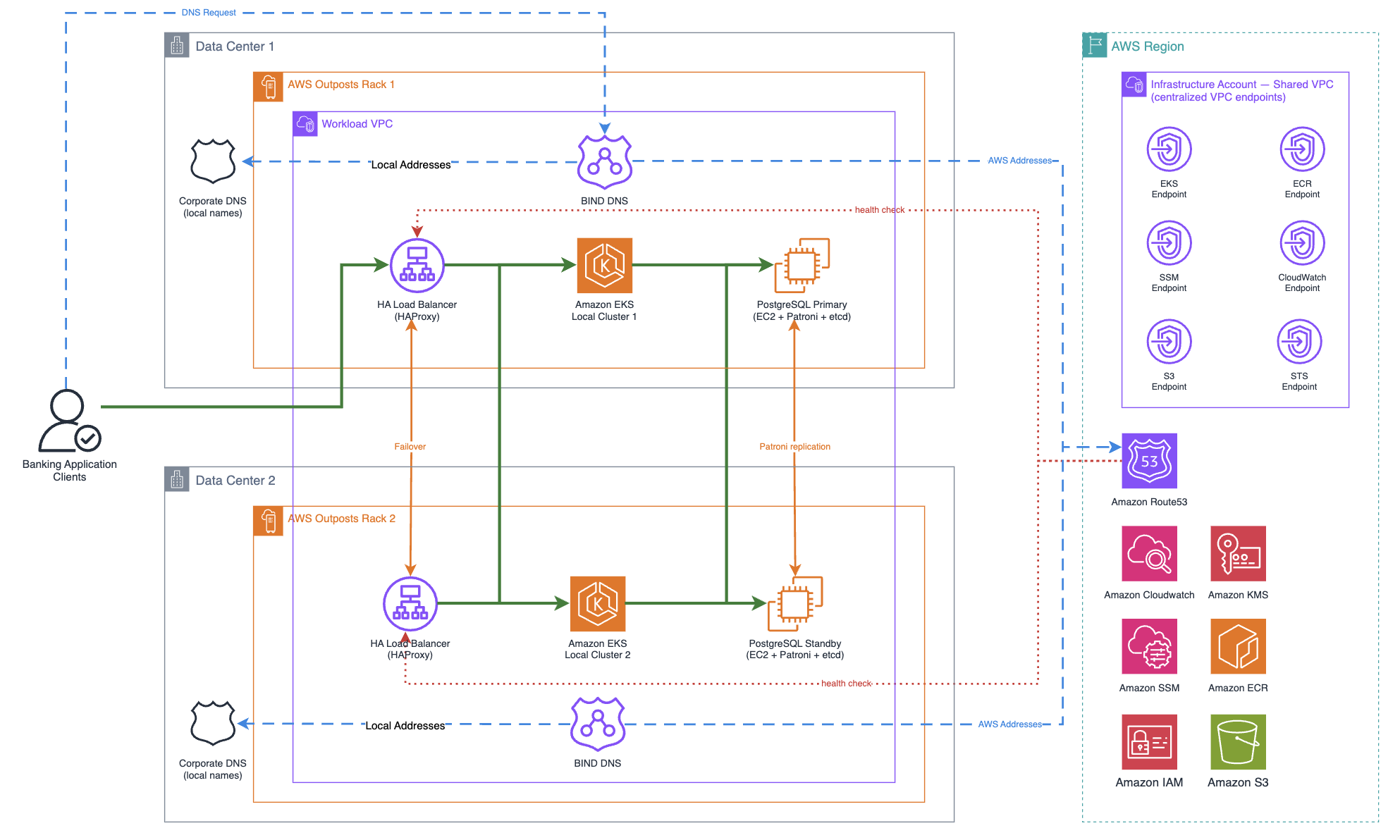
Figure 1 — Bank CenterCredit hybrid architecture across two data centers with AWS Outposts racks
Multi-account architecture and shared infrastructure components
Bank CenterCredit organized its AWS environment into a multi-account AWS Organization. AWS Outposts resources are shared across AWS accounts using AWS Resource Access Manager (AWS RAM). In this model, the Outpost owner account shares Outposts resources with other AWS accounts within the same AWS Organization. By sharing Outpost resources with other accounts, you inherit the isolation properties of these accounts. You can apply distinct security controls by environment or profile to the workload and constrain access to sensitive data. For deeper guidance, refer to Sharing AWS Outposts in a multi account AWS environment: Part 1.
The AWS Organization includes the following accounts. Management account:
- Governance
- Billing
- Policy management
Infrastructure account – shared infrastructure services, including:
- Shared Amazon Virtual Private Clouds (Amazon VPCs)
- Interface VPC endpoints
- Amazon Route 53 Resolver
- Outpost networking components
- Other common infrastructure resources
Monitoring and security account:
- Centralized monitoring
- Logging
- Auditing
- Security services for the hybrid environment
Application workloads run in dedicated AWS accounts, each with separate development, testing, and production environments. This approach provides workload isolation while maintaining centralized management of shared infrastructure services.
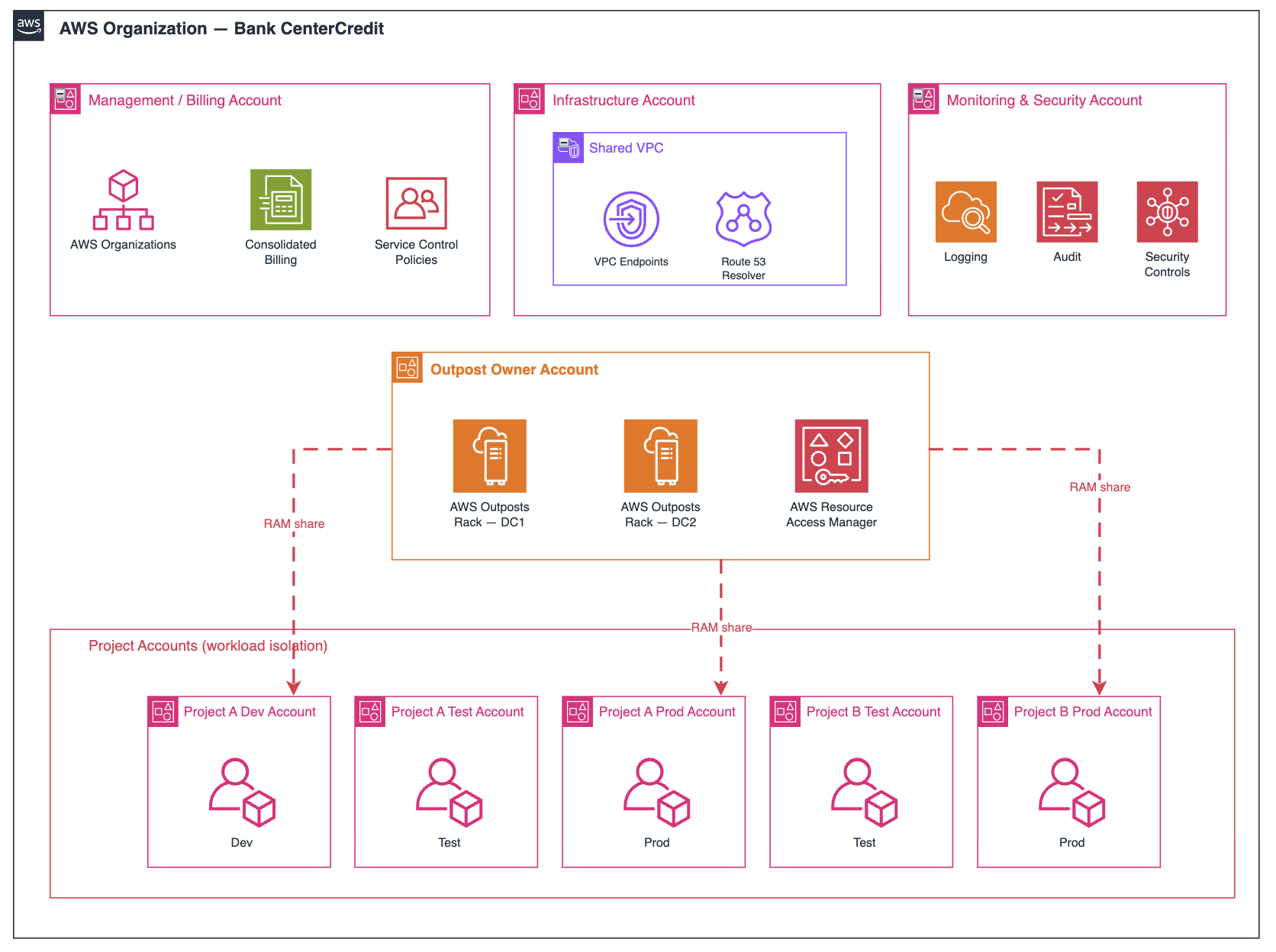
Figure 2 — Multi-account AWS Organization with shared Outposts resources
AWS Outposts and VPC endpoint architecture
Bank CenterCredit uses AWS Outposts as part of its hybrid architecture. Compute resources and customer data remain on the local Outposts infrastructure, while the control plane for AWS services resides in the parent AWS Region. VPC endpoints provide secure access to AWS service control planes in the Region. This approach meets the bank’s data residency requirements while providing access to AWS-managed control plane services.
Because all projects use a shared VPC, the required VPC endpoints are centralized in the Infrastructure account. This provides a consistent mechanism for accessing AWS services across all AWS accounts and environments. The centralized VPC endpoints include:
- Amazon Elastic Kubernetes Service (Amazon EKS)
- Amazon Elastic Container Registry (Amazon ECR)
- Amazon Simple Storage Service (Amazon S3). Outposts supports S3 interface type VPC endpoints.
- AWS Systems Manager
- Amazon CloudWatch
- AWS Security Token Service (AWS STS)
This architecture simplifies operations, reduces duplication of infrastructure components, and provides consistent access to AWS services across the environment.
Hybrid DNS architecture for high availability
A key challenge Bank CenterCredit sought to overcome in its hybrid architecture was DNS integration between AWS services and the bank’s on-premises infrastructure. Using only corporate DNS servers could prevent resolution of AWS-managed DNS names required by services running on Outposts. Conversely, relying only on Amazon Route 53 Resolver would make DNS resolution dependent on the Outposts service link to the AWS Region.
To address this challenge, Bank CenterCredit implemented a highly available hybrid DNS architecture using BIND DNS servers deployed on Amazon Elastic Compute Cloud (Amazon EC2) instances across both Outposts locations. The BIND DNS servers act as the primary DNS layer for workloads, forwarding AWS service domains to Amazon Route 53 Resolver and internal banking domains to the corporate DNS infrastructure. BIND caches DNS responses from Amazon Route 53 Resolver locally, so previously resolved AWS service names continue to resolve during temporary Outposts service link interruptions. New DNS queries for AWS service names resolve after connectivity to the AWS Region is restored.
The team configured conditional forwarding rules as follows:
- AWS service domains forward to Amazon Route 53 Resolver
- Internal banking domains forward to the corporate DNS servers
This architecture provides a unified DNS solution across AWS and on-premises environments while improving resiliency through high availability and DNS caching.
Highly available Amazon EKS on AWS Outposts
Providing high availability for containerized workloads was one of the primary objectives of Bank CenterCredit’s hybrid architecture. Bank CenterCredit deployed two independent Amazon EKS local clusters on separate AWS Outposts racks located in geographically separated data centers. Traffic is distributed between the sites through a highly available on-premises load balancing layer.
Each Amazon EKS local cluster operates independently with its own worker nodes and application workloads. This architecture isolates failures to a single site while maintaining service continuity across both data centers. You can perform Kubernetes upgrades, maintenance activities, and application deployments independently on each cluster without affecting workloads running at the other site. Following implementation, two large-scale banking platforms were successfully deployed into production on EKS running on Outposts, validating the architecture for business-critical workloads.
Alternative database high availability architecture
To meet Bank CenterCredit’s data residency requirements, all production databases remain on AWS Outposts. Although Amazon Relational Database Service (Amazon RDS) Multi-AZ on AWS Outposts provides managed high availability, it saves database snapshots in S3 in the Region, which doesn’t meet Bank CenterCredit’s workload data residency requirements. Because local backups were required, Bank CenterCredit implemented a customer-managed PostgreSQL architecture running on Amazon EC2 with Amazon Elastic Block Store (Amazon EBS). Both Multi-AZ RDS on Outposts and the PostgreSQL architecture described in the following section require two logical Outposts for high availability of your database.
The solution uses PostgreSQL with Patroni and etcd. Each Outpost hosts one PostgreSQL node. Patroni maintains one node as the primary database and the other as the standby replica using a distributed etcd cluster.
Each site hosts a dedicated HAProxy instance, while client name resolution is handled by the highly available BIND DNS layer described previously. Amazon Route 53 failover routing provides automatic DNS failover between HAProxy endpoints without requiring virtual IP addresses or additional network failover mechanisms. Because Route 53 is used only for DNS resolution, it does not add latency to database traffic.
During temporary service link interruptions, BIND continues serving cached DNS responses. If Amazon Route 53 becomes unavailable, a local health-check mechanism updates a fallback DNS record to resolve the healthy HAProxy endpoint. Database connectivity continues independently of AWS Region availability until connectivity to the AWS Region is restored. This architecture provides resilient database connectivity while maintaining local data processing and high availability across both data centers.
Outcomes
The implemented architecture delivered a resilient hybrid platform capable of supporting business-critical banking workloads while meeting strict data residency requirements. Key outcomes included:
- Elimination of major single points of failure
- Independent operation across two AWS Outposts racks
- Centralized access to AWS services through shared VPC endpoints
- Unified hybrid DNS architecture
- Highly available Amazon EKS and PostgreSQL platforms
- Automated failover for applications and database services
- Improved disaster recovery readiness
- Compliance with local data residency requirements
The architecture has been successfully implemented across multiple Bank CenterCredit production banking projects, demonstrating reliable operation for both containerized workloads and mission-critical database services.
Conclusion
Bank CenterCredit built a modern hybrid platform on multiple Outposts racks that combines cloud agility with more control over data stored and processed on-premises. The architecture spans two geographically separated data centers, runs production banking workloads on Amazon EKS, and maintains data residency through local compute and data processing. It has become the technical foundation for future cloud-native workloads and digital banking services on AWS Outposts at Bank CenterCredit.
If your organization faces similar requirements around data residency, high availability, and hybrid operations, explore the AWS Outposts documentation to understand deployment options for your environment, review the multi-account sharing guidance referenced in this post to plan your account structure, or submit this contact form to discuss AWS Outposts or any of the architectures described in this post with an AWS expert.