Artificial Intelligence
Category: Business Intelligence
How GoDaddy transformed its analytics with Amazon Quick
In this post, you will learn how GoDaddy migrated from their legacy business intelligence (BI) tool to Amazon Quick. This was a two-year transformation that delivered results across every dimension of the business: 15,000 hours saved annually, 50% reduction in dashboard count, rendering times cut to under 5 seconds, and AI-powered self-service analytics now accessible to every employee.
Safely Releasing Frontier Models to Customers
It’s our goal for AWS to be the most secure place to run any workload, and in support of that we’ve been deeply investing in security across our services since AWS’s inception more than two decades ago. Our AI services like Amazon Bedrock are built on this foundation and with the same focus.
Built from the inside out: How AWS Professional Services became a frontier team first
AWS Professional Services (AWS ProServe) compressed engagement timelines from months to days, not by adding artificial intelligence (AI) tools to an existing process, but by fundamentally rebuilding how we deliver from the inside out. In this post, we share how AWS ProServe became a frontier team, the practices that enabled it, and what your engineering organization can take from our experience.
Integrating AWS API MCP Server with Amazon Quick using Amazon Bedrock AgentCore Runtime
This post shows you how to use Amazon Bedrock AgentCore Runtime with Model Context Protocol (MCP) support to connect Amazon Quick with AWS services through the AWS API MCP Server, creating a conversational AI assistant that translates natural language into AWS Command Line Interface (AWS CLI) commands, without the need to switch between tools during critical moments.
Amazon Quick: Accelerating the path from enterprise data to AI-powered decisions
Amazon Quick helps turn your large enterprise data into fast and accurate AI-powered decisions. In this post, you will learn about five new capabilities of Amazon Quick that accelerate how data professionals deliver trusted AI-powered insights at enterprise scale.
Beyond BI: How the Dataset Q&A feature of Amazon Quick powers the next generation of data decisions
Business leaders across industries rely on operational dashboards as the shared source of truth that their teams execute against daily. But dashboards are built to answer known questions. When teams need to explore further, ad-hoc, multi-dimensional, or unforeseen questions, they hit a bottleneck. They wait hours or days for BI teams to build new views […]
Generate dashboards from natural language prompts in Amazon Quick
Building meaningful dashboards demands hours of manual setup, even for experienced BI professionals. Amazon Quick now generates complete multi-sheet dashboards from natural language prompts, taking you from one or more datasets to a production-ready analysis in minutes. Data analysts building recurring operations reports, program managers preparing a leadership review, or engineers exploring a new dataset can […]
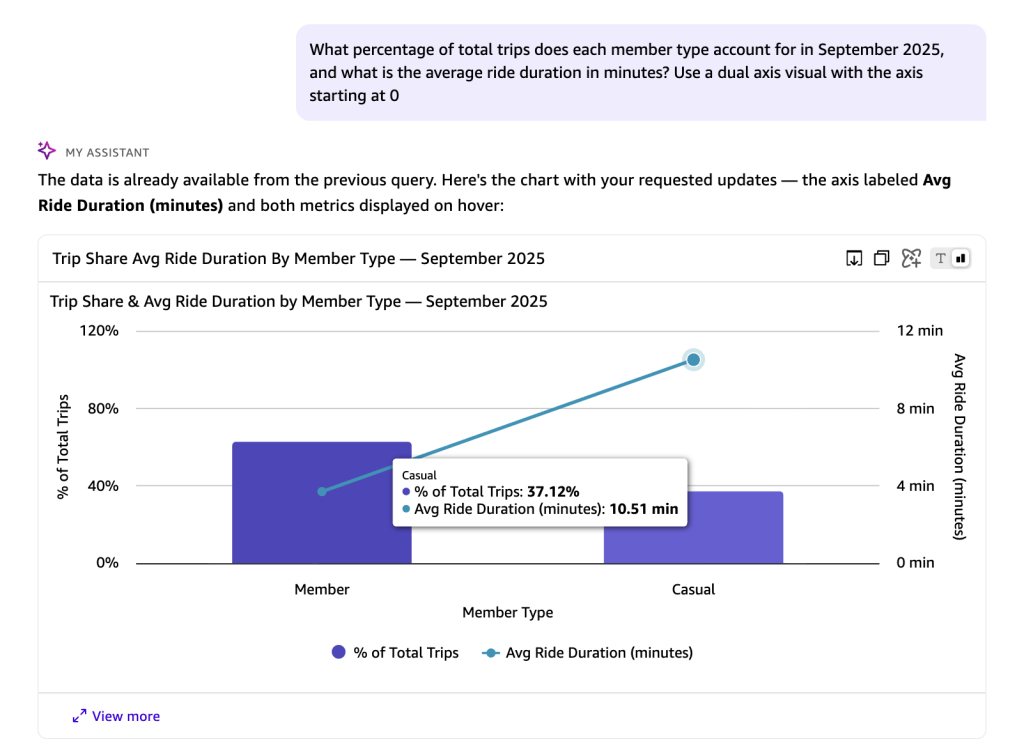
Introducing Dataset Q&A: Expanding natural language querying for structured datasets in Amazon Quick
In this post, you learn how to get started with Dataset Q&A, explore real-world use cases with hands-on examples, and discover advanced capabilities like auto-discovery across all your data assets and multi-dataset querying in a single conversation.
Create rich, custom tooltips in Amazon Quick Sight
Today, we’re announcing sheet tooltips in Amazon Quick Sight. Dashboard authors can now design custom tooltip layouts using free-form layout sheets. These layouts combine charts, key performance indicator (KPI) metrics, text, and other visuals into a single tooltip that renders dynamically when readers hover over data points.
AWS launches frontier agents for security testing and cloud operations
I’m excited to announce that AWS Security Agent on-demand penetration testing and AWS DevOps Agent are now generally available, representing a new class of AI capabilities we announced at re:Invent called frontier agents. These autonomous systems work independently to achieve goals, scale massively to tackle concurrent tasks, and run persistently for hours or days without constant human oversight. Together, these agents are changing the way we secure and operate software. In preview, customers and partners report that AWS Security Agent compresses penetration testing timelines from weeks to hours and the AWS DevOps Agent supports 3–5x faster incident resolution.