Artificial Intelligence
Category: *Post Types
Applying data loading best practices for ML training with Amazon S3 clients
In this post, we present practical techniques and recommendations for optimizing throughput in ML training workloads that read data directly from Amazon S3 general purpose buckets.
How Harmonic Security improved their data-leakage detection system with low-latency fine-tuned models using Amazon SageMaker, Amazon Bedrock, and Amazon Nova Pro
This post walks through how Harmonic Security used Amazon SageMaker AI, Amazon Bedrock, and Amazon Nova Pro to fine-tune a ModernBERT model, achieving low-latency, accurate, and scalable data leakage detection.
How Swisscom builds enterprise agentic AI for customer support and sales using Amazon Bedrock AgentCore
In this post, we’ll show how Swisscom implemented Amazon Bedrock AgentCore to build and scale their enterprise AI agents for customer support and sales operations. As an early adopter of Amazon Bedrock in the AWS Europe Region (Zurich), Swisscom leads in enterprise AI implementation with their Chatbot Builder system and various AI initiatives. Their successful deployments include Conversational AI powered by Rasa and fine-tuned LLMs on Amazon SageMaker, and the Swisscom Swisscom myAI assistant, built to meet Swiss data protection standards.
Scaling MLflow for enterprise AI: What’s New in SageMaker AI with MLflow
Today we’re announcing Amazon SageMaker AI with MLflow, now including a serverless capability that dynamically manages infrastructure provisioning, scaling, and operations for artificial intelligence and machine learning (AI/ML) development tasks. In this post, we explore how these new capabilities help you run large MLflow workloads—from generative AI agents to large language model (LLM) experimentation—with improved performance, automation, and security using SageMaker AI with MLflow.
Implement automated smoke testing using Amazon Nova Act headless mode
This post shows how to implement automated smoke testing using Amazon Nova Act headless mode in CI/CD pipelines. We use SauceDemo, a sample ecommerce application, as our target for demonstration. We demonstrate setting up Amazon Nova Act for headless browser automation in CI/CD environments and creating smoke tests that validate key user workflows. We then show how to implement parallel execution to maximize testing efficiency, configure GitLab CI/CD for automatic test execution on every deployment, and apply best practices for maintainable and scalable test automation.

Create AI-powered chat assistants for your enterprise with Amazon Quick Suite
In this post, we show how to build chat agents in Amazon Quick Suite. We walk through a three-layer framework—identity, instructions, and knowledge—that transforms Quick Suite chat agents into intelligent enterprise AI assistants. In our example, we demonstrate how our chat agent guides feature discovery, use enterprise data to inform recommendations, and tailors solutions based on potential to impact and your team’s adoption readiness.
How AWS delivers generative AI to the public sector in weeks, not years
Experts at the Generative AI Innovation Center share several strategies to help organizations excel with generative AI.

S&P Global Data integration expands Amazon Quick Research capabilities
Today, we are pleased to announce a new integration between Amazon Quick Research and S&P Global. This integration brings both S&P Global Energy news, research, and insights and S&P Global Market Intelligence data to Quick Research customers in one deep research agent. In this post, we explore S&P Global’s data sets and the solution architecture of the integration with Quick Research.
Create an intelligent insurance underwriter agent powered by Amazon Nova 2 Lite and Amazon Quick Suite
In this post, we demonstrate how to build an intelligent insurance underwriting agent that addresses three critical challenges: unifying siloed data across CRM systems and databases, providing explainable and auditable AI decisions for regulatory compliance, and enabling automated fraud detection with consistent underwriting rules. The solution combines Amazon Nova 2 Lite for transparent risk assessment, Amazon Bedrock AgentCore for managed MCP server infrastructure, and Amazon Quick Suite for natural language interactions—delivering a production-ready system that underwriters can deploy in under 30 minutes .
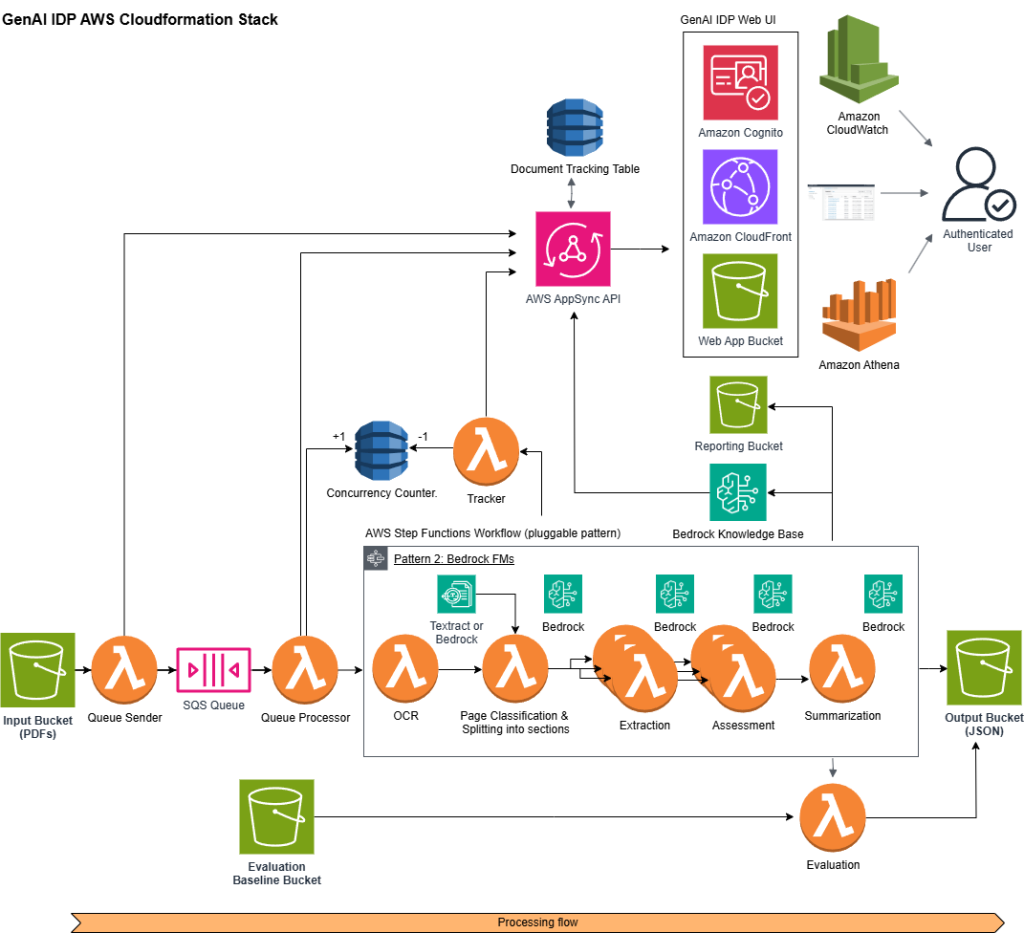
How Myriad Genetics achieved fast, accurate, and cost-efficient document processing using the AWS open-source Generative AI Intelligent Document Processing Accelerator
In this post, we explore how Myriad Genetics partnered with the AWS Generative AI Innovation Center to transform their healthcare document processing pipeline using Amazon Bedrock and Amazon Nova foundation models, achieving 98% classification accuracy while reducing costs by 77% and processing time by 80%. We detail the technical implementation using AWS’s open-source GenAI Intelligent Document Processing Accelerator, the optimization strategies for document classification and key information extraction, and the measurable business impact on Myriad’s prior authorization workflows.