AWS for M&E Blog
From flat to full immersion: The AWS path to Dolby Vision and Dolby Atmos
This blog post was co-authored by José Luis Tamez de Gyves, Client Executive Manager, Dolby.
Remember watching grainy web videos in tiny windows that constantly paused to buffer? How about those streaming videos with washed-out colors, inaccurate skin tones, and a loss of detail in both shadows and highlights? We’ll show how to implement Dolby Vision and Dolby Atmos using Amazon Web Services (AWS) Elemental services for live and video on-demand (VOD) content. We’ll transform standard video and audio into cinema-quality experiences by upgrading color ranges, adding intelligent brightness optimization, and creating immersive 3D sound.
When existing video quality was not enough
In the early 2010s, Dolby Laboratories engineers tackled a specific problem: Why video sunsets looked washed out on TVs. Dolby applied their cinema audio expertise to video quality. First, they realized that old cathode ray tube (CRT)-based standards were limiting image quality. To overcome these limitations and deliver brighter images with richer colors, they created what we now know as high dynamic range (HDR) video, based on the perceptual quantizer (PQ) curve.
A second challenge emerged: How to maintain the creative intent across different devices. Dolby’s solution: Embedding optimization instructions in the video signal so each display could adjust the image to its capabilities. Unlike traditional HDR, which uses one master image across all displays, Dolby Vision optimizes the image for each display’s specific capabilities by using dynamic metadata.
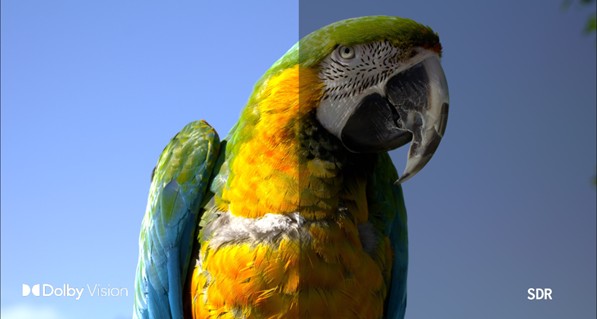
Figure 1: Dolby Vision compared with standard dynamic range.
Dynamic metadata in Dolby Vision
Dynamic metadata in Dolby Vision is shot-by-shot instructions embedded in the video signal that tell each display how to optimize the image for its specific capabilities. Each frame includes specific instructions for brightness levels, shadow detail, and color mapping. This provides frame-by-frame optimization instructions for the display.
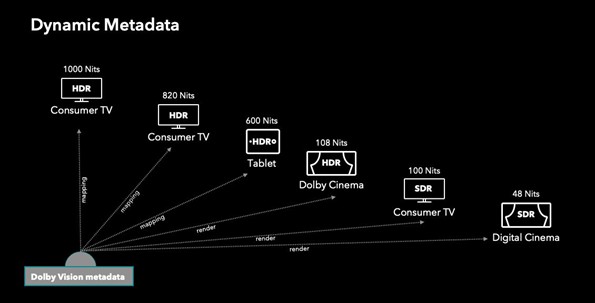
Figure 2: Chart comparing display brightness.
With an understanding of the basics of Dolby Vision, let’s move onto Dolby Atmos and what it does for sound innovations.
The audio side: Dolby Atmos audio enhancement
Sound systems 5.1 and 7.1 have a limitation: They place sound in a circle around listeners, but real sound exists in three-dimensional space. Birds chirp above. Footsteps echo below. Rain falls down.
Dolby Atmos uses object-based audio instead of channels. It says: “There’s a helicopter. It should be here in three-dimensional space.” Then the system figures out which speakers (however many there are, including ones on the ceiling) should activate to place that sound precisely where it belongs.
Ceiling speakers were a key innovation. By adding height channels, Dolby Atmos creates that third dimension. The helicopter can now fly overhead, rather than move only horizontally. Dolby Atmos is available in everything from soundbars to headphones.
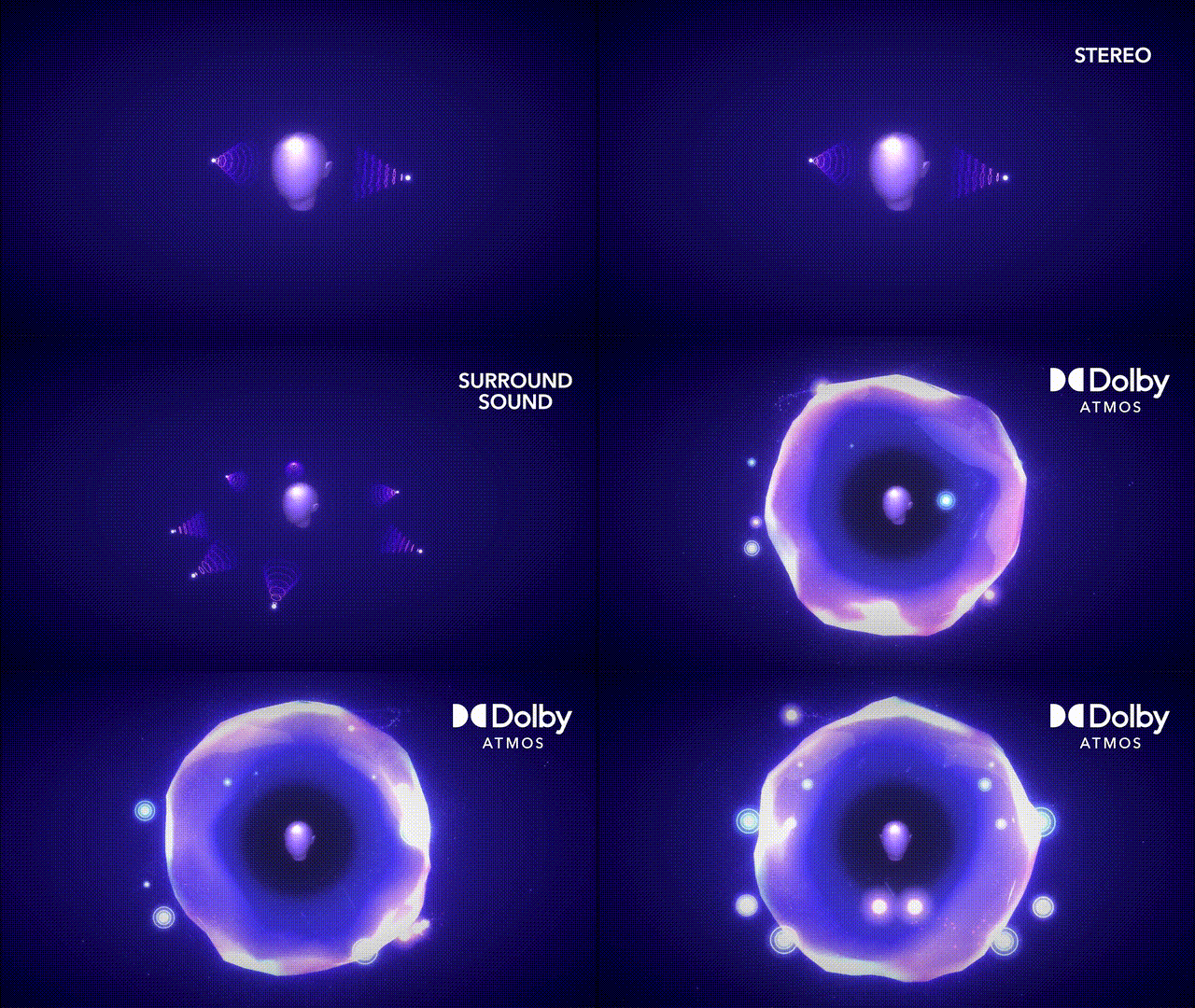
Video 1: Dolby Atmos evolution from stereo to immersive spatial audio (visual representation only, no sound included).
Now that we have an overview of Dolby Vision and Dolby Atmos, we need to highlight a color conversion tool before starting our AWS Elemental services solution.
About 3D look-up table files
A 3D look-up table (LUT) is a color conversion tool. Think of it as a translation guide that tells your video how to convert colors from one format (such as standard dynamic range (SDR)) to another (like HDR). Unlike a 1D LUT, which adjusts individual color channels independently, a 3D LUT considers the relationships between red, green, and blue channels together. It allows for complex color transformations, such as creating specific cinematic looks, matching camera profiles, or converting between different color spaces.
In our solution we use the .cube format. It can be applied in video edition or video production software and various camera monitoring systems to achieve consistent color appearance across different devices and workflows. The 3D LUT file we will use is LUT 3D File SDR to HDR (located under Prerequisites).
NOTE: Once you click on the link it will automatically download to your computer. This file is a test file generated for demonstration purposes only. You can create your own file using professional video editing software tools.
Prerequisites
With the basics of Dolby Vision, Dolby Atmos and LUTS explained, we can begin to create our cinema-quality experience with upgraded color ranges and intelligent brightness optimization, along with immersive 3D sound.
First you will need to make certain that you have:
- AWS Elemental MediaLive
- AWS Elemental MediaConvert
- AWS Elemental MediaPackage V2
- Advanced Audio Add-on for AWS Elemental MediaLive
- Dolby Audio Add-on for AWS Elemental MediaConvert
- Dolby Vision Add-on for AWS Elemental MediaConvert
- LUT 3D File SDR to HDR (test file)
Also, make certain that your equipment meets the necessary requirements:
- Input:
- Minimum input: 1080p
- Output:
- Codec: High Efficiency Video Coding (HEVC) is required or Codec: Use HEVC
- Profile: Supports Main10/Main and Main10/High profiles
- Enable the color corrector pre-processor Dolby 8.1 profile
- Dolby Vision and Dolby Atmos compatible device or player
Configuring a live event with Dolby Vision and Dolby Atmos
Step 1. AWS Elemental MediaLive configuration
AWS Elemental MediaLive and MediaConvert handle the encoding and transcoding needed for processing the Dolby Vision stream once Dolby Vision has added in the dynamic metadata. Dolby Vision combines an HEVC encoded stream with the Dolby metadata. The metadata is carried as a reference processing unit (RPU) sub-stream, which is the frame-by-frame dynamic metadata, stored in private MPEG network abstraction layer (NAL) units.
AWS Elemental MediaLive analyzes the HDR input video and generates Dolby Vision dynamic metadata. It packages that metadata into the RPU format and mixes it with the HEVC elementary stream, with the help of a LUT 3D file.
For this part of the solution we will have the configuration convert the color space from SDR (Rec. 709) to Dolby Vision (profile 8.1 is Dolby Vision with HDR10 cross-compatibility).
To use AWS Elemental MediaLive to enable Dolby Vision in your live stream use the follow steps:
- In Input attachments, specify the Color Space for the input or inputs.
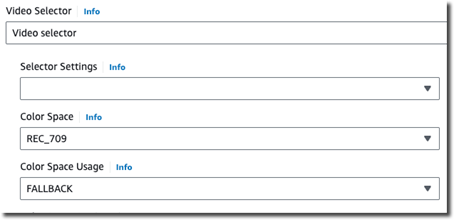
Figure 3: Input Color Space.
- In General Settings, go to the Color Correction Settings section, enable color correction and enter the path to the 3D LUT file Uri. In Input Color Space, select REC_709, and in Output Color Space, select HDR10.
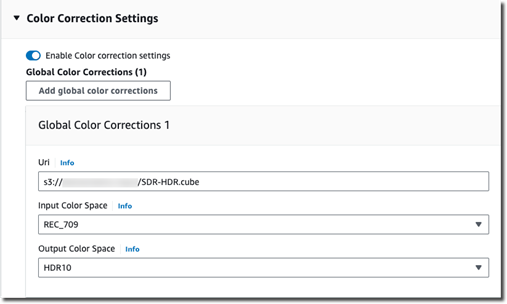
Figure 4: Color Correction settings.
- In the Output settings section of each video profile under 265 Packaging Type make sure that HVC1 is selected.
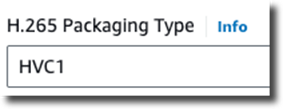
Figure 5: H.265 Packaging Type.
- In each video output profile under Codec Details, you must use the codec profile MAIN_10BIT with the codec Tier HIGH or MAIN.
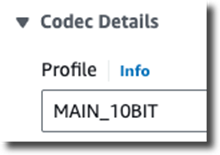
Figure 6: Codec Details profile.
- In each video output profile, you must enable Color Space transformation and select Dolby Vision 8.1.
- This process must be repeated for each video profile that will be used.
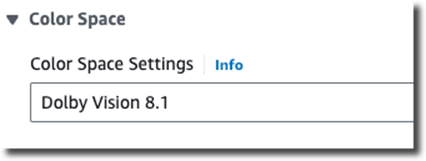
Figure 7: Color Space conversion.
- The output group type compatible with Dolby Vision is h265 in HTTP Live Streaming fragmented (HLS fmp4), UDP, secure reliable transport (SRT), or common media application format (CMAF) ingest.
- Specify the audio at the input that will be converted to Dolby Atmos.
- For Dolby Atmos it is recommended that the input has 16,12 or 10 channels to perform the conversion correctly.
- If the necessary channels are not available, an upmix conversion will be performed.
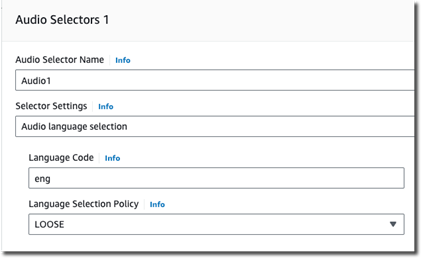
Figure 8: Audio Input configuration.
- For audio-only track outputs:
- Set the codec to Dolby ATMOS (EAC3 ATMOS).
- Select the Coding Mode depending on the number of channels in the input or whether it is stereo or another arrangement.
- AWS Elemental MediaLive will perform an upmix conversion. The Dialnorm is suggested to be 27, but this will depend on each case.
- The other values can remain at their default settings.
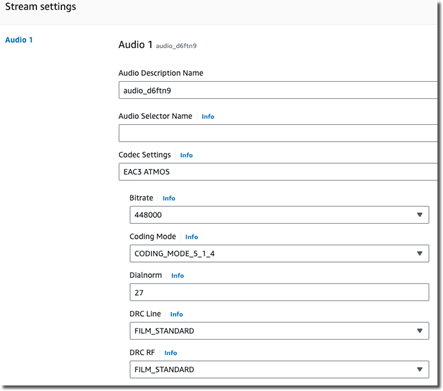
Figure 9: Audio Output configuration.
Step 2. AWS Elemental MediaPackage V2 configuration
Dolby Vision and Dolby Atmos are supported in AWS Elemental MediaPackage V2. We will be using this version in our configuration:
- Create a channel group and, within this channel group, create the channel that will be used for Dolby Vision and Dolby Atmos.
- The input type can be HLS or CMAF. In both cases, the metadata for both Dolby Vision and Dolby Atmos is sent to AWS Elemental MediaPackage V2.
- For improved performance, CMAF ingest is recommended.
- Within the channel, create an endpoint with the Container type CMAF.
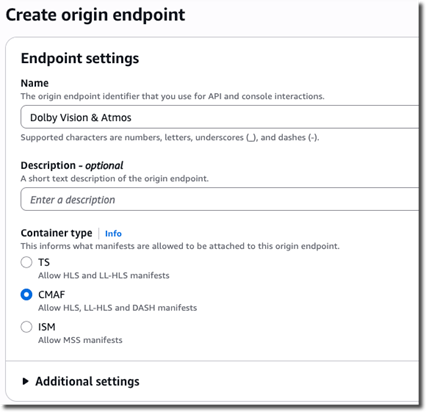
Figure 10: Origin Endpoint configuration.
- Dolby Vision and Dolby Atmos can be packaged in HLS (fmp4), low-latency HTTP Live Streaming (HLS-LL), and dynamic adaptive streaming over HTTP (DASH) within the AWS Elemental MediaPackage V2 endpoint.
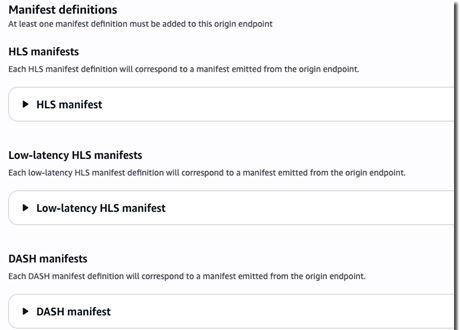
Figure 11: Manifest definition.
- Use the URL of each manifest generated as appropriate.
- Dolby Vision profile 8.1 technology will automatically fall back to HDR10 if the screen or device does not support Dolby Vision.
- To validate the correct configuration of Dolby Vision and Dolby Atmos, use the Dolby Stream Validator. Enter the HLS (fmp4) or DASH URL for validation.
Configuring a VOD asset with Dolby Vision and Dolby Atmos
Step 1. AWS Elemental MediaConvert configuration
- Select the desired input to convert within the Video selector section and specify the Color space and Sample range of the input file.
- If you do not know this information, you can leave it as AWS Elemental MediaConvert will automatically detect your input Color space and Sample Range.
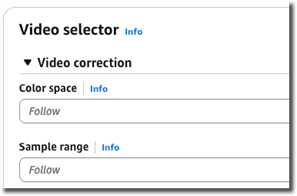
Figure 12: Video selector and Video correction.
- In the Global processing section, enable 3D LUTs.
- For Input color space, select 709.
- For Output color space, select HDR 10.
- Add the path to the 3D LUT file.
- You can use the same file we used for the live event.
- Click the Add 3D LUT
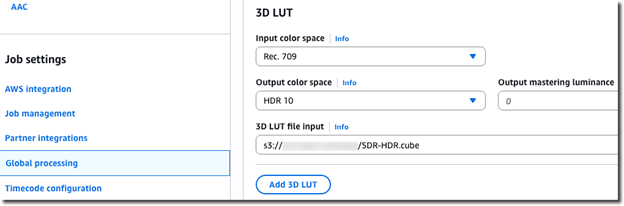
Figure 13: 3D LUT configuration.
- Create an output. Be sure to use the h265 codec with the main10/main or high codec profile and HVC1 packaging type.
- Dolby Vision is only valid with MPEG-2 transport streams, MPEG-4, DASH, CMAF and raw container outputs. In this case we used CMAF.
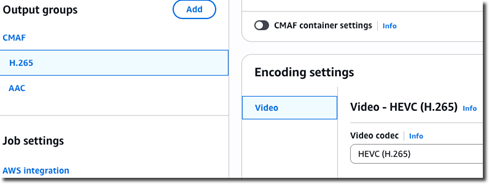
Figure 14: Output Group configuration.
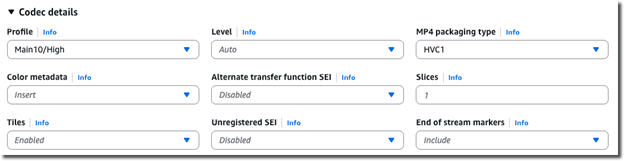
Figure 15: Codec Details configuration.
- Enable Dolby Vision pre-processing.
- Select profile 8.1.
- Leave the Level 6 metadata handling mode set to Passthrough.
- In Content mapping select HDR10 1000.
- This allows you to create an HDR10-compatible signal with a peak of 1000 nits by applying static content mapping to the source.
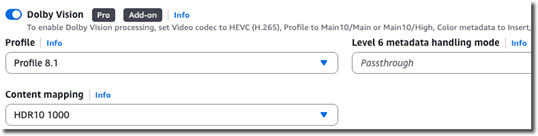
Figure 16: Dolby Vision configuration.
- For Dolby Atmos audio configuration, it is mandatory to have the number of channels for the Dolby Atmos arrangement (10, 12, or 15 channels).
- You can perform an input remix manually to create and emulate the necessary channels. Read Configuring a job that mixes audio descriptions to perform input remix in AWS Elemental MediaConvert.
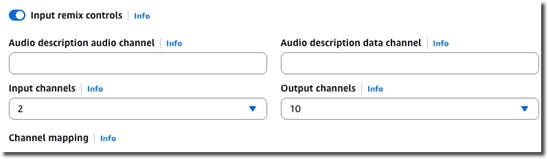
Figure 17: Audio Input remix.
- In the Encoding settings, for Audio Codec select Dolby Digital Plus JOC (Dolby Atmos) and then select the corresponding Audio source. You can leave the other audio settings at their default values or modify them for a more suitable customization.
- AWS Elemental MediaConvert will automatically select the CBI input according to the number of input channels (10, 12, or 15).
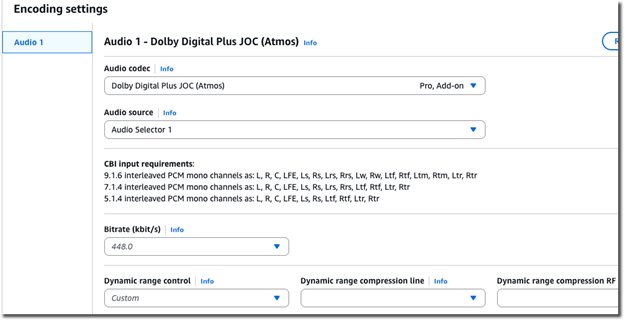
Figure 18: Dolby Atmos configuration.
- Once processing is complete, you can play your VOD content with Dolby Vision and Dolby Atmos.
- If your device is not compatible with Dolby Vision, it will fall back to HDR10.
- To validate the correct configuration of Dolby Vision and Dolby Atmos use Dolby Stream Validator. Enter the MPEG-4, CMAF or DASH URL for validation.
This solution can deliver cinema-quality experiences to millions of viewers without the need for specialized equipment. It improves colorimetry by mapping colors effectively and takes advantage of HEVC for significant bit savings, averaging around 40%.
Conclusion
Without requiring a viewer to have specialized equipment, you can deliver cinema-quality video and audio. The process involves using a LUT file to convert SDR to HDR. It then generates frame-by-frame Dolby Vision metadata to optimize the image for each display.
AWS Elemental MediaConvert handles video encoding, while AWS Elemental MediaLive manages live workflows. Both services support the full dynamic range across TVs, mobile devices, and computers. If a device doesn’t support Dolby Vision, it automatically falls back to HDR10 or SDR.
The same adaptive approach works for audio. Viewers with compatible systems receive the full Dolby Atmos experience, while others receive optimized stereo or surround sound. AWS Elemental services process your existing stereo or 5.1 audio and converts it to object-based audio. It then packages it for delivery across various platforms.
AWS Elemental MediaPackage V2 handles the encoding, packaging, and delivery. The Dolby Atmos adapts the quality based on each viewer’s device, whether it’s a high-end smart TV or a mobile phone.
Contact an AWS Representative to know how we can help accelerate your business.