AWS Public Sector Blog
Amazon Web Services Partner KBR achieves 27% savings migrating to AWS Graviton
Organizations processing satellite imagery at scale can significantly reduce infrastructure costs while improving performance by migrating to instances based in Amazon Web Services (AWS) Graviton.
In this post, you’ll learn how KBR—a global science, technology and engineering solutions organization—achieved a 33.5% cost savings and a 27.09% increase in pipeline processing speed by migrating geospatial processing workloads from an x86 Amazon Elastic Compute Cloud (Amazon EC2) M7i instance to AWS Graviton processors. This was accomplished while maintaining data accuracy within 0.002% of x86 outputs.
Rising costs for geospatial processing at scale
If you process massive volumes of satellite imagery for Earth observation and scientific analysis, you understand the computational demands of transforming raw sensor data into analysis-ready geospatial products.
KBR faced increased projected processing needs through 2040, prompting the identification of cost-effective infrastructure solutions without compromising performance or data quality.
Traditional x86-based processing infrastructure delivered reliable results, but rising computational demands meant escalating costs. KBR evaluated whether AWS Graviton instances could provide a viable alternative by reducing the total cost of ownership while maintaining or improving processing speeds.
Performance testing across multiple processor types
KBR evaluated different AWS instance types to compare AWS Graviton and x86 performance: M7i, M7a, M7g, and M8g. Each instance processed identical scenes through cold cache and warm cache trials to measure real-world performance across all processing stages.
The testing revealed that Advanced RISC Machine (ARM)-based instances consistently matched or exceeded x86 performance. The M8g instance powered by AWS Graviton4 delivered the strongest results, processing imagery 27.09% faster than the M7i baseline. The M7g instance with AWS Graviton3 achieved 12.89% better performance, and the Advanced Micro Devices (AMD) EPYC-based M7a showed 19.38% improvement over M7i powered by Intel Xeon Scalable processors. These results are illustrated in the following graphs:
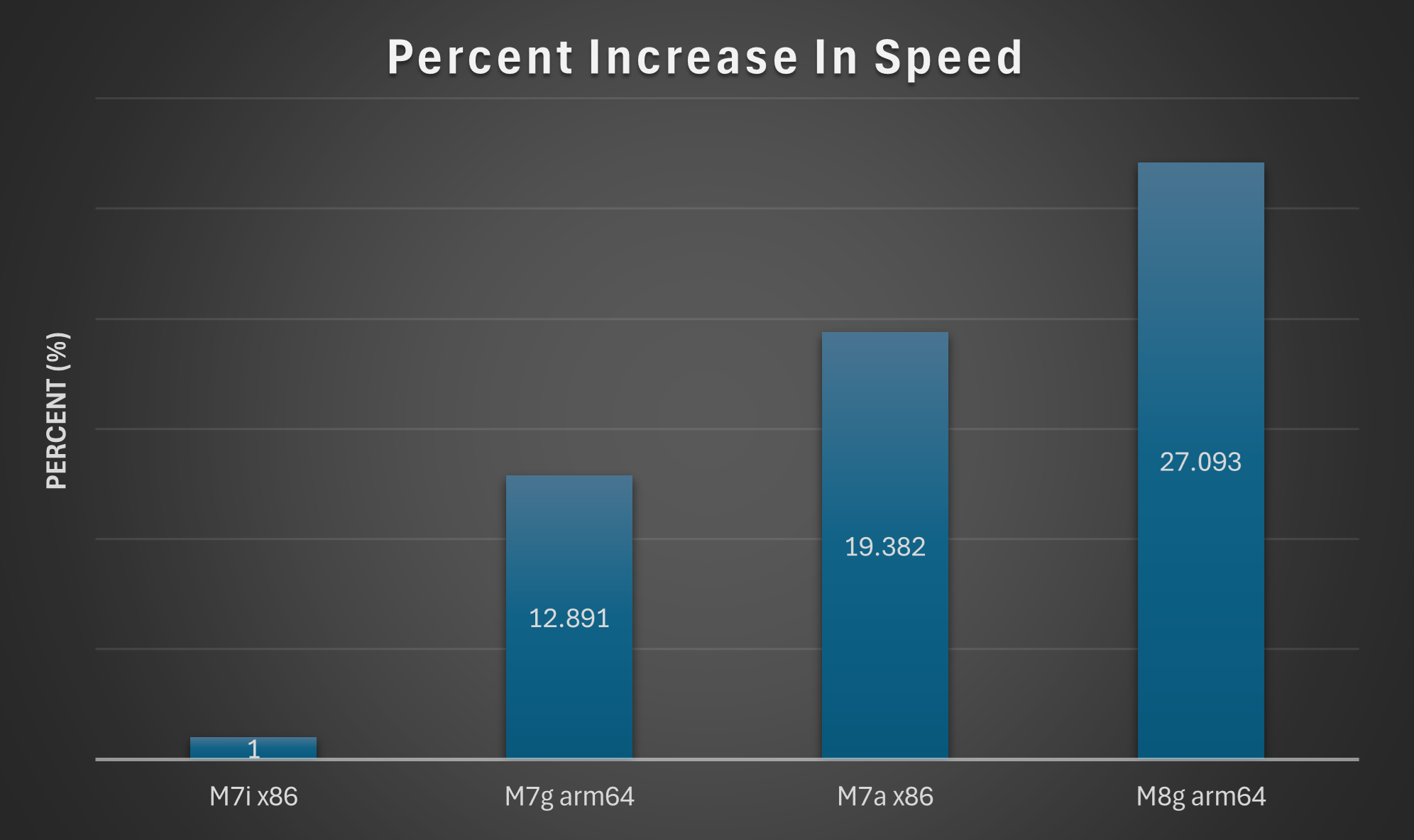
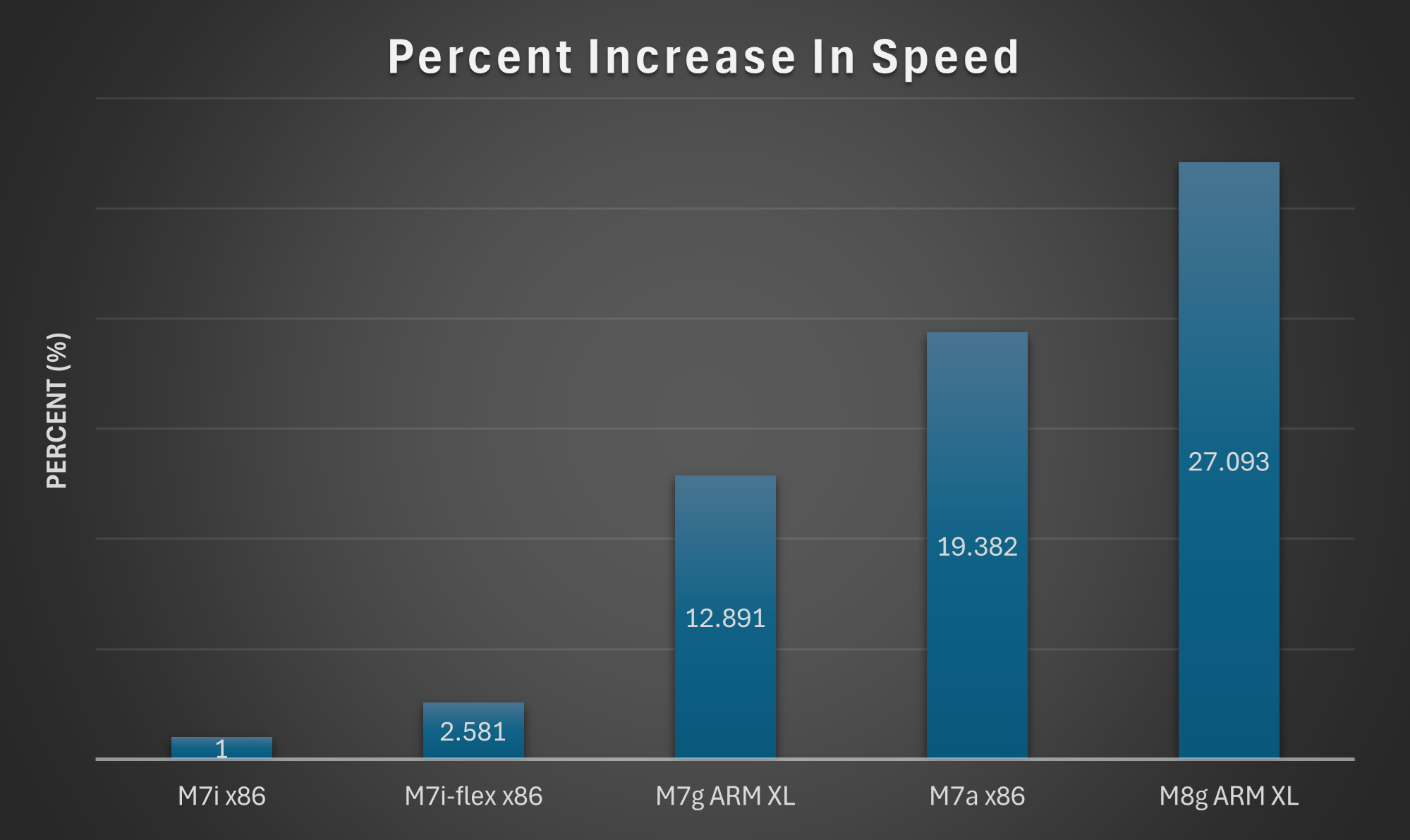
Figure 1: Performance percentages illustrated per instance
Network performance testing confirmed that M8g delivered the highest download and upload speeds among all tested instances. This advantage proved particularly valuable for workloads involving large data transfers from Amazon Simple Storage Service (Amazon S3).
AWS services power the solution
KBR’s geospatial processing pipeline uses multiple AWS services to deliver cost-effective, high-performance results:
- AWS Graviton processors are optimized for price performance
- Amazon Elastic Kubernetes Service (Amazon EKS) orchestrates containerized processing workloads
- Amazon S3 stores raw satellite imagery and processed outputs
- AWS Lambda handles event-driven processing tasks
- Amazon EC2 Spot Instances reduce costs for fault-tolerant workloads
The migration required implementing multi-architecture Docker builds supporting both AMD64 and ARM64, updating GitLab runners for ARM64 compatibility and configuring Amazon EKS node groups with ARM instance types.
Cost savings and performance gains
The financial impact of migrating to AWS Graviton proved substantial: M8g instances cost $0.1795 per hour compared to $0.2016 for M7i instances, an 11% reduction in hourly costs while delivering 27% faster processing.
When you project these savings from 2026 to 2040, switching to the M8g would reduce total processing costs by 27.4%, saving $1,907,723.11 and bringing total costs down from $6.97 million to $5.06 million. This calculation doesn’t include gains from newer versions of AWS Graviton.
Data validation confirmed the migration maintained scientific accuracy. Pixel-by-pixel comparison of AWS Graviton and x86-generated GeoTIFF outputs showed only 0.002% difference. This is well within acceptable tolerances for geospatial analysis. Both radiometric precision and geometric accuracy remained consistent across processor architectures, attesting to the robustness of the software underlying the methods. These results are illustrated in the following image:
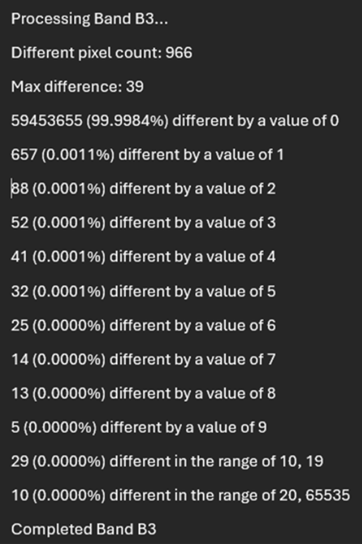
Figure 2: AWS Graviton and x86 output comparison
Dual-architecture support implementation approach
KBR’s migration strategy supports both AWS Graviton and x86 architectures to maintain flexibility. Implementing the first subsystem required an estimated 136 hours, including 56 hours for general infrastructure updates (GitLab runners, Amazon EKS Karpenter configuration, multi-architecture Docker builds, Lambda functions and continuous integration and continuous delivery pipeline enhancements) plus 80 hours for subsystem-specific work, split evenly between regression testing and Dockerfile refactoring).
The recommended deployment model uses M7g instances for persistent workloads and M8g instances for ephemeral tasks, enabling dynamic cost optimization while maintaining backward compatibility with x86 when needed.
The recommended deployment model uses M7g instances for persistent workloads and M8g instances for ephemeral tasks, enabling dynamic cost optimization while maintaining backward compatibility with x86 when needed.
Broader implications for geospatial processing
KBR’s successful proof of concept demonstrates that AWS Graviton processors deliver immediate value for compute-intensive geospatial workloads. If you process satellite imagery, LiDAR data or other large-scale geospatial datasets, you can achieve similar cost reductions and performance improvements by migrating to AWS Graviton.
The combination of lower hourly costs, faster processing speeds, enhanced security features and validated data accuracy makes AWS Graviton an attractive option for government agencies, research institutions and commercial organizations operating geospatial processing pipelines at scale.
Conclusion
KBR achieved a 27% cost savings and significant performance improvements by migrating geospatial processing workloads to AWS Graviton. If you use a similar approach—evaluating multiple instance types, implementing multi-architecture support and using Amazon EC2 Spot Instances—you can optimize your compute-intensive workloads for better price performance while maintaining data accuracy.
Ready to explore how AWS Graviton can reduce costs for your compute-intensive workloads? Visit AWS Graviton to learn more about ARM64-based processors optimized for price performance. You can also review the AWS Graviton documentation for migration best practices and architecture-specific considerations.
For geospatial processing solutions, explore the Registry of Open Data on AWS to discover how AWS services support satellite imagery analysis, remote sensing applications and location-based intelligence at scale.