AWS Public Sector Blog
Transforming tactical communications with AWS Wickr and agentic AI
In the past decade, the ability to collaborate across mission partners has undergone significant transformation. Edge communication solutions are revolutionizing how organizations collect, ingest, transport, process, retain, and secure data. Tactical commanders can use generative and agentic AI to convert data from the edge into actionable intelligence to inform and expedite the decision-making process.
Many legacy messaging and collaboration solutions are creating significant vulnerabilities in this new threat environment. Designed for legacy on-premises infrastructure, these systems suffer from fragmented encryption models, limited administrative visibility, compliance gaps, and constrained scalability.
In this post, we explore how Amazon Web Services (AWS) Wickr and AWS WickrGov allows field operators to interact with AI agents to deliver or collect crucial intelligence at the edge in a unified interface.
Modernizing more secure communications with AWS Wickr
AWS Wickr is an end-to-end encrypted messaging and collaboration application available on iOS/Mac OS, Android, Windows, Linux. AWS Wickr provides one-to-one dedicated chatrooms, group messaging, voice and video calling, file sharing, and screen sharing protected with 256-bit Advanced Encryption Standard (AES) message-level encryption indecipherable to anyone but the sender and receiver. Adoption has accelerated rapidly: For example, the U.S. Army surpassed 100,000 users in 2025.
Wickr IO is an integration platform by AWS Wickr that allows developers and administrators to build, deploy, and manage custom automated applications or “bots” within the end-to-end encrypted Wickr ecosystem. An AWS Wickr bot is a programmatic participant working with users within conversations or rooms and enables customers to integrate Wickr to other third-party platforms. The bot can process incoming data, interact with external systems, and deliver results back into encrypted conversations. For example, the Wickr bots bring together edge users, third-party applications, sensor data, and cloud-powered analytics into a single pane of glass through the Wickr platform. The figure below is an example workflow that can be deployed.
Extending AWS Wickr with custom AI bot integrations
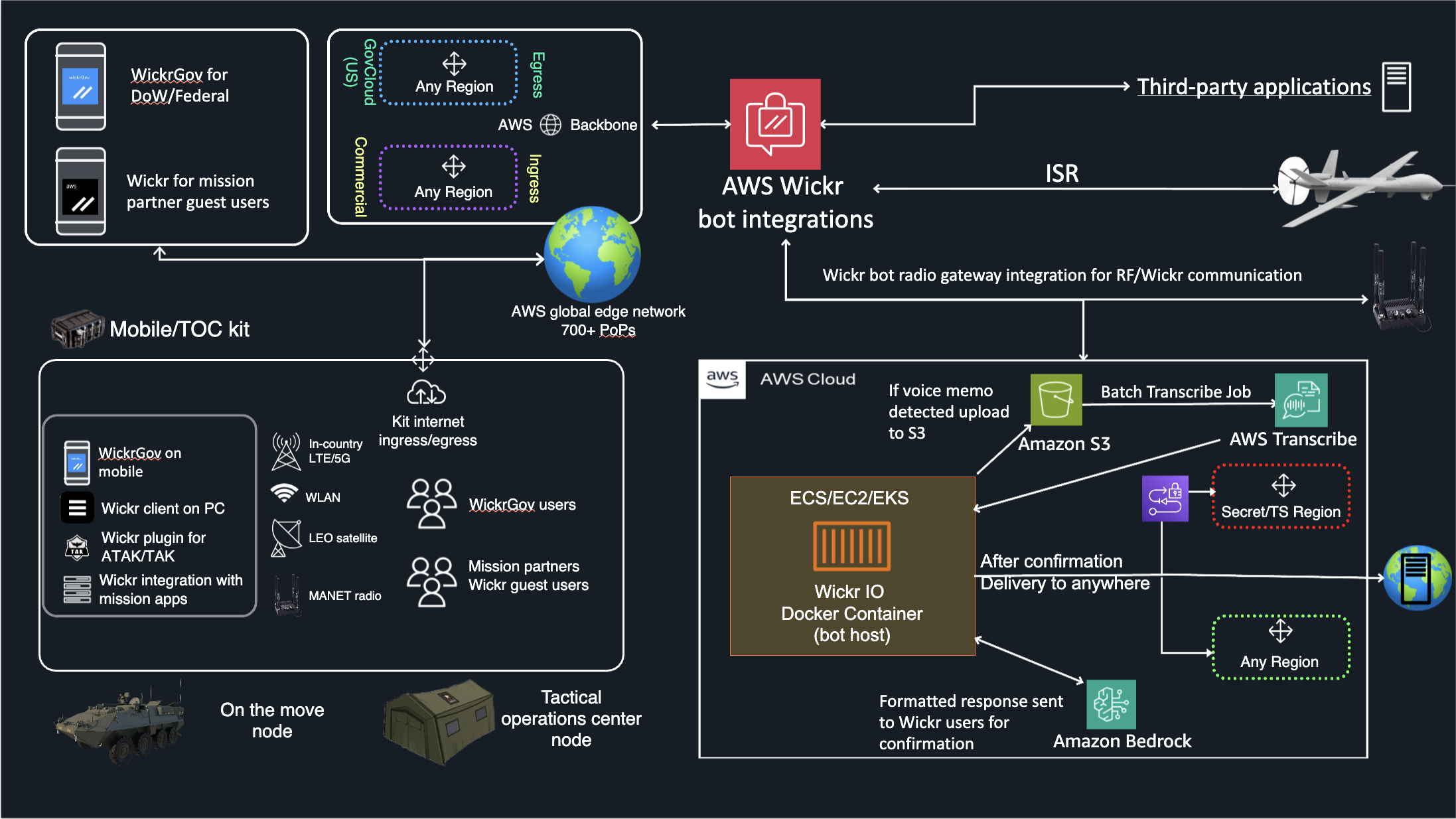
Figure 1: Tactical edge architecture showing the edge to cloud deployment model: edge operators, Tactical Operations Center, Wickr bot workload in AWS cloud.
The Wickr bot integrates with Amazon Bedrock to unlock LLM reasoning at the edge. This means a field operator can type or speak an urgent MEDEVAC request. A bot in the room interprets the request, extracts relevant details, and delivers the MEDEVAC to higher echelon command centers.
The bot runs on AWS Wickr and transcribes voice memos via Amazon Transcribe; then Amazon Bedrock interprets the operator’s natural-language requests. Extracted fields are written to Amazon DynamoDB and forwarded through open standardized APIs into the receiving command and control data layer for downstream MEDEVAC response. When the receiving command operates in a different security domain, AWS Diode, a cross-domain solution moves the structured request between classification levels in near real-time.
With the AWS Wickr bot software development kit (SDK) and agentic AI development solutions such as Kiro, teams can stand up purpose-built integrations in hours rather than weeks.
Operators at the edge
Soldiers and field operators in denied, degraded, intermittent, and limited (DDIL) environments carry portable software-defined wide area network (SD-WAN) transport kits, mesh radios, and mobile devices. These tools facilitate transport connectivity where traditional infrastructure may not exist.
AWS Wickr is transport agnostic: it opens secure, encrypted communications channels between intended recipients regardless of the underlying network, whether that is Non-Classified Internet Protocol Router (NIPR), commercial cellular, or satellite.
Using AWS Wickr clients on their phones, tablets, or Android Team Awareness Kit (ATAK)-equipped solutions, these operators maintain end-to-end encrypted communications with their chain of command, peer units, and mission partners. AWS Wickr bots serve as their direct interface to AWS Cloud services. A dismounted operator can send a message to a bot requesting the latest situation report, an AI-generated summary of overnight intelligence traffic, or the status of a logistics resupply and receive a response. A radio gateway bot extends this further, bridging Wickr conversations with tactical RF networks, so users on handheld radios and Wickr clients can communicate in a single thread.
The U.S. Army has already demonstrated anywhere-to-anywhere medical care in combat situations using AWS Wickr, connecting field medics with remote medical professionals through encrypted channels to deliver lifesaving guidance when evacuation isn’t immediately possible.
The following video illustrates an example of a bot integration using Amazon Bedrock and Amazon Transcribe that operators within a Tactical Operations Center (TOC) could develop and deploy:
Tactical Operations Center
At command posts, operations centers, and forward staging areas, analysts and commanders access AWS Wickr through desktop clients. The Web Interface Bot serves as a particularly powerful integration point by enabling external systems, dashboards, and mission applications to push data into and pull data from encrypted AWS Wickr conversations programmatically. The TOC serves as a hub for aggregating field communications, coordinating with higher headquarters, and integrating mission partner inputs through AWS Wickr network federation capabilities, enabling more secure cross-organization collaboration without compromise.
This model has already proven decisive: During Operation Recovery, local cellular networks in Afghanistan were compromised by the Taliban, making traditional communications channels untrustworthy. AWS Wickr connects warfighters on the ground with evacuation planners, enabling encrypted messaging, file sharing, and location tracking regardless of the network transport to get individuals to safety.
Critically, TOC operators and developers can rapidly build and deploy new bots to service emerging capabilities as mission requirements evolve.
A new intelligence feed comes online; a coalition partner needs a translation workflow; a commander needs automated rollup of field reports by sector: the TOC team builds a bot, deploys it into the appropriate AWS Wickr network, and the capability is live. In a contested environment, the system that adapts fastest holds the advantage. AI-powered integrated development environments (IDEs) such as Kiro mean TOC teams can design, build, and deploy custom AI-powered integrations to AWS Wickr in hours, compressing the capability delivery cycle from an acquisition timeline to an operational one.
AWS Cloud backend
For Defense and Intelligence Community missions requiring higher compliance postures, AWS WickrGov operates exclusively within AWS GovCloud (US), where it holds FedRAMP High authorization and DoW CC SRG IL4, IL5, and IL6 provisional authorization. AWS WickrGov is available in AWS Secret and Top-Secret regions. By leveraging Wickr bot integrations with AWS Diode, users can build integrations to move data between different security classification domains. Data doesn’t leave an isolated, ITAR-compliant environment operated solely by US persons on US soil. Connectivity between edge kits and the cloud backend is facilitated through Cloud Edge Global Access on AWS with managed internet ingress paths, providing more secure, resilient transport between tactical deployments and cloud-hosted services.
Conclusion
AWS Wickr offers the DoW the following advantages over legacy systems:
| Capability | Legacy approach | AWS Wickr cloud-based approach |
| Encryption model | Often server-side or partial end-to-end encryption (E2E) | Full end-to-end, per-message key rotation |
| Infrastructure | On-premises servers, manual scaling | Fully managed autoscaling AWS service |
| Administrative control | Limited visibility, manual policy enforcement | Centralized admin console with granular policies |
| Compliance and retention | Difficult to balance security with compliance | Data retention to Amazon Simple Storage Service (Amazon S3) |
| Federation | Siloed networks | Cross-organization federation and guest user support |
| Integration | Standalone systems | Native integration with AWS services and third-party applications |
| Compliance | Limited or inconsistent compliance posture | HIPAA, SEC/FINRA, DoW IL4/5/6, Secret, Top Secret, FedRAMP, ITAR compliant |
AWS Wickr brings next-generation modernization to more secure communications. The combination of modern cloud architecture, zero trust encryption, custom bot integrations, and AI systems working together builds new pathways for more secure, data-driven decision-making at the speed of relevance for the next generation of warfighters. If you have an army.mil email, you can get started on AWS WickrGov today for free. Otherwise, you can download AWS Wickr today to get started!
Learn more
- AWS Wickr – Overview and getting started
- AWS Wickr Administration Guide – Configuration, security, and bot framework
- AWS Wickr Data Retention – Compliance-ready retention architecture
- Amazon Bedrock User Guide – Get started with foundation models
- AWS GovCloud (US) – Compliance for government workloads
- Kiro IDE – Agentic AI development environment
- AWS Secret Cloud – Secure and scalable cloud for secret mission needs
- AWS Top Secret Cloud – Secure and scalable cloud for top secret mission needs