AWS Big Data Blog
Category: Amazon CloudWatch

Enable metric-based and scheduled scaling for Amazon Managed Service for Apache Flink
Thousands of developers use Apache Flink to build streaming applications to transform and analyze data in real time. Apache Flink is an open source framework and engine for processing data streams. It’s highly available and scalable, delivering high throughput and low latency for the most demanding stream-processing applications. Monitoring and scaling your applications is critical […]

Monitor Apache Spark applications on Amazon EMR with Amazon Cloudwatch
To improve a Spark application’s efficiency, it’s essential to monitor its performance and behavior. In this post, we demonstrate how to publish detailed Spark metrics from Amazon EMR to Amazon CloudWatch. This will give you the ability to identify bottlenecks while optimizing resource utilization.

Monitor data pipelines in a serverless data lake
AWS serverless services, including but not limited to AWS Lambda, AWS Glue, AWS Fargate, Amazon EventBridge, Amazon Athena, Amazon Simple Notification Service (Amazon SNS), Amazon Simple Queue Service (Amazon SQS), and Amazon Simple Storage Service (Amazon S3), have become the building blocks for any serverless data lake, providing key mechanisms to ingest and transform data […]

Centralize near-real-time governance through alerts on Amazon Redshift data warehouses for sensitive queries
Amazon Redshift is a fully managed, petabyte-scale data warehouse service in the cloud that delivers powerful and secure insights on all your data with the best price-performance. With Amazon Redshift, you can analyze your data to derive holistic insights about your business and your customers. In many organizations, one or multiple Amazon Redshift data warehouses […]

Push Amazon EMR step logs from Amazon EC2 instances to Amazon CloudWatch logs
Amazon EMR is a big data service offered by AWS to run Apache Spark and other open-source applications on AWS to build scalable data pipelines in a cost-effective manner. Monitoring the logs generated from the jobs deployed on EMR clusters is essential to help detect critical issues in real time and identify root causes quickly. […]
Monitor AWS workloads without a single line of code with Logz.io and Kinesis Firehose
February 9, 2024: Amazon Kinesis Data Firehose has been renamed to Amazon Data Firehose. Read the AWS What’s New post to learn more. Observability data provides near real-time insights into the health and performance of AWS workloads, so that engineers can quickly address production issues and troubleshoot them before widespread customer impact. As AWS workloads […]

Use AWS CloudWatch as a destination for Amazon Redshift Audit logs
Amazon Redshift is a fast, scalable, secure, and fully-managed cloud data warehouse that makes it simple and cost-effective to analyze all of your data using standard SQL. Amazon Redshift has comprehensive security capabilities to satisfy the most demanding requirements. To help you to monitor the database for security and troubleshooting purposes, Amazon Redshift logs information […]

Monitor your Amazon QuickSight deployments using the new Amazon CloudWatch integration
Amazon QuickSight is a fully-managed, cloud-native business intelligence (BI) service that makes it easy to connect to your data, create interactive dashboards, and share these with tens of thousands of users, either within the QuickSight interface or embedded in software as a service (SaaS) applications or web portals. With QuickSight providing insights to power your […]

Gain insights into your Amazon Kinesis Data Firehose delivery stream using Amazon CloudWatch
February 9, 2024: Amazon Kinesis Data Firehose has been renamed to Amazon Data Firehose. Read the AWS What’s New post to learn more. The volume of data being generated globally is growing at an ever-increasing pace. Data is generated to support an increasing number of use cases, such as IoT, advertisement, gaming, security monitoring, machine […]
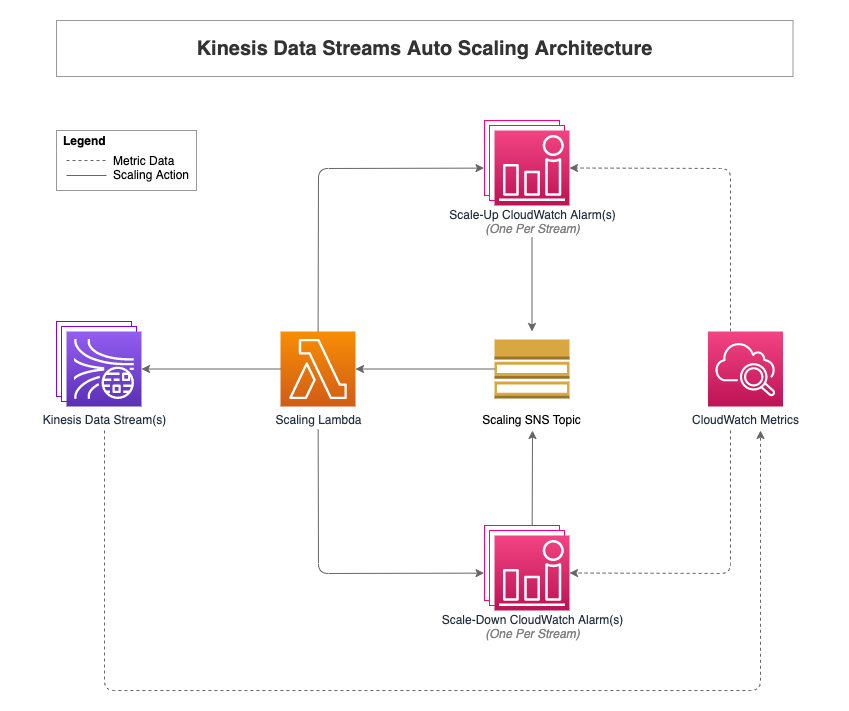
Auto scaling Amazon Kinesis Data Streams using Amazon CloudWatch and AWS Lambda
This post is co-written with Noah Mundahl, Director of Public Cloud Engineering at United Health Group. Update (03/09/2026): Amazon Kinesis Data Streams On-Demand Advantage mode is now the recommended way to natively auto scale your Amazon Kinesis Data Streams. In this post, we cover a solution to add auto scaling to Amazon Kinesis Data Streams. […]