How Zynga scaled multi-warehouse data governance with Amazon Redshift federated permissions
Zynga, a global leader in interactive entertainment operates a portfolio of mobile game studios including Socialpoint, the creators of Dragon City and Monster Legends. Zynga’s analytics platform processes telemetry and revenue data across studios using Amazon Redshift as its central data warehouse.
As Zynga expanded its analytics architecture to include individual studios with their own compute environments, the team faced a challenge: how to maintain centralized data governance while granting studios independent query capacity. Their existing approach to permission management introduced lag and required custom infrastructure if scaled to multiple warehouses.
In this post, we walk through how Zynga adopted Amazon Redshift federated permissions and AWS IAM Identity Center to enforce consistent, tiered data access across provisioned and serverless Amazon Redshift environments without building custom synchronization pipelines.
The challenge
Zynga needed to onboard Socialpoint’s current Amazon Redshift workloads and make Zynga’s central data available to them. Zynga’s existing production cluster would house the Socialpoint raw data, but the compute would come from another warehouse set up as a consumer. At the same time, Zynga’s data access control policies would need to be enforced across all warehouses. Zynga uses a tiered access control policy which would need to be synced across all consumers with no permission lag or manual grant synchronization.
During the migration, Socialpoint’s specific extract, transform, and load (ETL) processes would be included in Zynga’s central ETLs and their data ingestion pipeline would be replaced by Zynga’s latest generation of data ingestion infrastructure. Because the migration process happens in stages, Amazon Redshift sizing would also gradually need to increase.
The team evaluated two alternatives before arriving at a solution:
Manual grants on consumer clusters introduced a delay between when permissions were updated on the producer and when they took effect on the consumer. This approach would also require an external job that synced permissions and would be unlikely to scale well beyond 2–3 consumers.
Solution overview
Zynga implemented a solution using three AWS services working together:
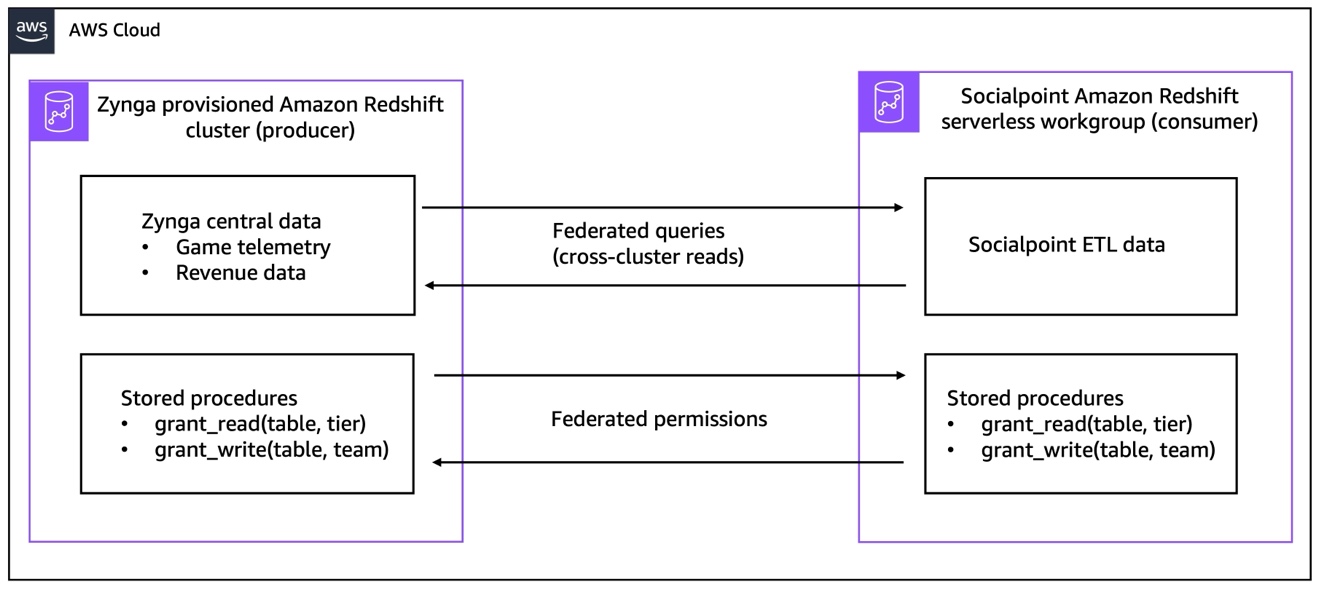
Amazon Redshift federated permissions enabled cross-cluster queries without explicit data shares. Permissions granted on the producer cluster propagate immediately to consumer workgroups through AWS Glue Data Catalog registration.
AWS IAM Identity Center provides unified authentication through federation with Okta. When users sign in, their Okta group memberships are provisioned through a System for Cross-domain Identity Management (SCIM) and automatically map to Amazon Redshift roles, removing the need for external synchronization jobs.
Amazon Redshift Serverless provides the compute layer for Socialpoint, scaling to zero when idle and avoiding the need to pre-size a provisioned cluster during the migration period.
The architecture uses a dual-grant approach where every permission is granted to both an IAM Identity Center group (for users) and a federated IAM role (for service accounts). This gives both authentication paths the same access.
How it works
Authentication with IAM Identity Center
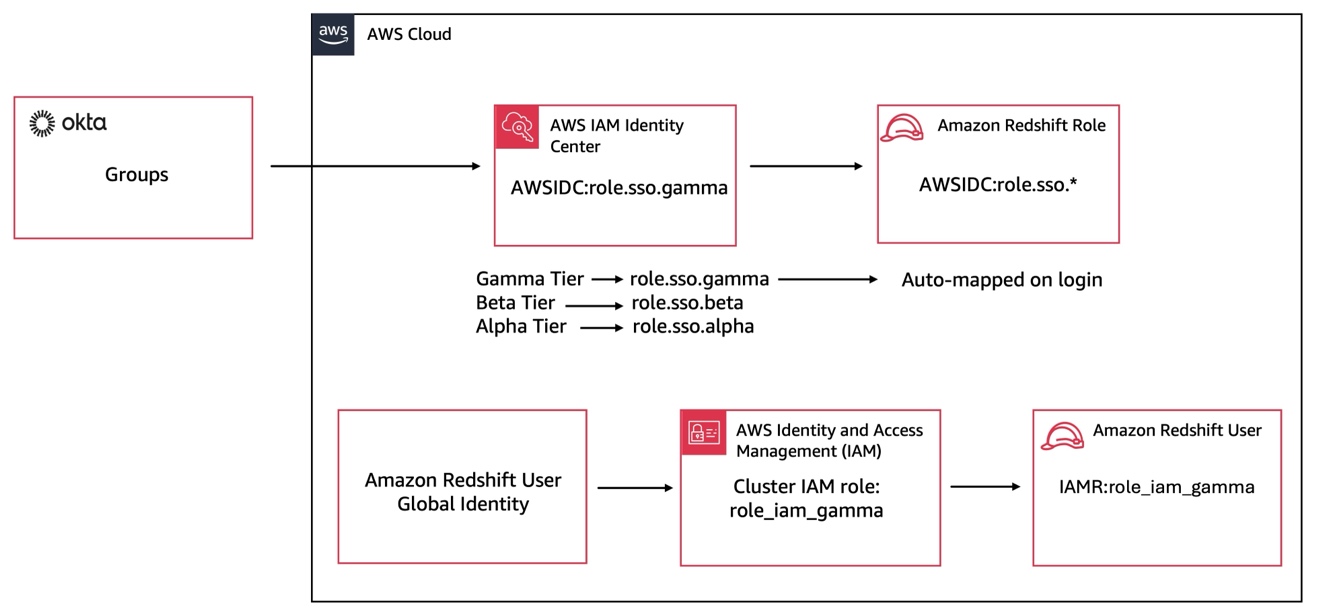
Zynga’s existing Okta directory syncs to IAM Identity Center, which is connected to the Amazon Redshift Serverless workgroup. When a user authenticates, Amazon Redshift automatically creates a user mapped to their email address and assigns them to roles based on their Okta group membership.
For example, an analyst in the Gamma Tier group signs in and is automatically assigned the AWSIDC:role.sso.gamma role in Amazon Redshift. No manual role assignment or synchronization job is required.
Service accounts, used for programmatic access, authenticate differently. Either using their IAM role and calling the get-credentials API, or by using the new federated permissions feature. Each service account assumes a federated IAM role, which creates a corresponding federated user in Amazon Redshift (for example, IAMR:role_iam_gamma).
Figure 1 – Identity layer
The dual-grant approach
To ensure that both users and service accounts can access the same data, every read permission is granted to both the IAM Identity Center group and the federated IAM role in a single statement:
GRANT SELECT ON schema.table TO
	'IAMR:role_iam_gamma',
	ROLE 'AWSIDC:role.sso.gamma';
Transitioning the producer cluster
The shared provisioned cluster already had active users with local grants. To avoid disruption, Zynga implemented a tri-grant approach on the producer during the transition period. Existing stored procedures were modified to grant permissions to three targets: the legacy local role, the IAM Identity Center group, and the federated IAM role.
GRANT SELECT ON schema.table TO
	ROLE role_rs_gamma,
	ROLE 'AWSIDC:role.sso.gamma','IAMR:role_iam_gamma';
This approach maintains backward compatibility for existing users on the producer while enabling immediate access from the new serverless workgroup. The long-term plan includes migration of all producer users to IAM Identity Center and retire the legacy local grants.
Stored procedures for consistent governance
Rather than requiring users to construct dual-grant statements manually, Zynga created stored procedures that encapsulate the grant logic:
grant_read accepts a table name and access tier, then issues the appropriate dual-grant for both the IAM Identity Center group and the federated IAM role.
grant_write grants data definition language (DDL) and data manipulation language (DML) permissions to the appropriate team-based role.
This provides a consistent interface for permission management regardless of which cluster or workgroup that the user is on.
Figure 2 – Data and compute layer
Results
The migration delivered measurable improvements:
Immediate permission propagation – Grants on the producer cluster took effect on the consumer workgroup instantly, replacing a process that previously required manual intervention and introduced lag.
Zero additional infrastructure cost – Federated permissions, federated queries, and IAM Identity Center added no incremental costs to the architecture.
Removed custom synchronization – The team removed the need for Lake Formation configurations, external AWS Lambda functions, and Airflow workflows for permission management.
Scalable pattern – The same architecture can be extended to additional studio workgroups without duplicating permission management logic.
Lessons learned
Zynga adopted federated permissions shortly after the feature launched in US West Oregon (us-west-2) in January 2026. The team shared several observations from their early adoption:
Run a proof of concept first. The team validated the full permission model in a test environment before deploying to production, including testing that existing data shares to other clusters were not disrupted.
Plan for the dual-grant requirement. Because IAM Identity Center users and federated IAM roles are distinct identity types, every read permission requires two grants. Encapsulating this in stored procedures prevents errors and reduces cognitive overhead.
Start with serverless for new workloads. With Amazon Redshift Serverless, the team can avoid sizing decisions during the migration period. If usage patterns later justify it, they can migrate to a provisioned cluster from a serverless snapshot with minimal downtime.
Engage with AWS. As an early adopter of a new feature, Zynga maintained regular contact with the Amazon Redshift team through their AWS Technical Account Manager to report issues and request enhancements.
Conclusion
Zynga’s adoption of Amazon Redshift federated permissions demonstrates how organizations with multi-cluster Amazon Redshift architectures can enforce centralized data governance without building custom synchronization infrastructure. By combining federated permissions with IAM Identity Center and Amazon Redshift Serverless, the team established a pattern that scales to additional studios while maintaining consistent access controls and reducing operational overhead.
To learn more about the services used in this post, see the following resources: