Artificial Intelligence
Automate Document Processing with Quick Automate and the IDP Accelerator
Mortgage lending runs on documents. Every loan starts with a familiar set: earnings statements, W-2s, bank statements, driver’s licenses, voided checks, and insurance applications. Every lender processes them at scale. The challenge of classifying, extracting, and validating high volumes of documents isn’t unique to mortgage lending. Organizations in banking, insurance, healthcare, and the public sector face their own versions of it, each with different but repeated document types and compliance requirements. In this post, we use mortgage lending as a concrete, well-quantified example, but the underlying architecture is scalable and adapts to document-intensive operations across industries.
At scale, the numbers add up fast. The U.S. mortgage market originates roughly 4–6 million loans per year, according to the MBA Mortgage Finance Forecast. The average mortgage takes 44 days to close, per ICE Mortgage Technology’s Origination Insight Report.
The Mortgage Bankers Association estimates the total cost to originate a single loan at over $11,000, spanning sales, fulfillment, production support, and overhead. Document intake and processing make up a significant part of that fulfillment workload. Delays here cascade into longer cycle times across the pipeline.
For a mid-size lender processing 50,000 loans annually, manual document handling consumes thousands of hours per year. What if you could automate the entire pipeline? From the moment a lending package arrives to the moment validated data flows into your downstream systems, the process is fully automated.
Overview
We walk through how a typical mid-size lender can automate their entire document intake pipeline using two AWS solutions: the AWS Generative AI Innovation Center (GAIIC) Intelligent Document Processing (IDP) Accelerator and Amazon Quick Automate. In this post, you will see the specific pain points they solve, how the solution works, and the business results you can expect. By the end, you will understand how to apply this approach to your own lending operation.
To make this concrete, we follow one lender through the transformation.
Meet Summit Mortgage
Summit Mortgage is a fictional company. The scenario reflects common patterns observed across mortgage lenders, and the metrics shown are illustrative. We believe they are indicative of real-world potential benefits and achievable in practice, though individual outcomes will vary based on document volume, process complexity, and existing systems. Summit Mortgage is a mid-size lender processing roughly 50,000 loans per year. Their loan processors spend 15–20 minutes per file manually sorting documents, verifying completeness, and keying data into the loan origination system. Across 50,000 loans, that adds up to more than 15,000 hours per year of manual document handling.
The pain compounds quickly. Manual keying introduces errors that trigger rework downstream. Incomplete packages sit in queues until someone notices what’s missing. During peak lending season, Summit’s only option was temporary staffing, which was expensive, slow to onboard, and inconsistent in quality.
Summit’s leadership set a clear goal: cut document processing time from 15–20 minutes to under 6 minutes per file. They also aimed to reduce data entry errors and handle volume spikes without scaling headcount.
The solution: GAIIC IDP Accelerator + Quick Automate
Summit deployed two AWS solutions that, together, automate the journey from raw documents to orchestrated workflow.
GAIIC IDP Accelerator
The GAIIC IDP Accelerator is an open source, serverless pipeline that handles document processing at scale. Serverless means it scales automatically and you pay only for documents processed, with no servers to manage. When Summit’s lending packages arrive, the accelerator, powered by Amazon Textract and Amazon Bedrock foundation models, takes over:
- Converts raw documents to machine-readable text and classifies each document, distinguishing an earnings statement from a W-2 from an insurance application.
- Extracts structured data such as borrower names, income figures, account balances, and employer details.
- Assesses the extracted data against expected schemas and flags anomalies, such as missing fields, inconsistent figures, and incomplete forms, for human review.
The pipeline scales automatically with volume. Summit pays per document processed, with no fixed infrastructure costs.
Quick Automate
Extracted data is only valuable if it reaches your downstream systems. While the IDP Accelerator extracts the data, you still need to route it to where it matters. Quick Automate bridges this gap. It’s an AI-powered automation service with a visual workflow builder and an AI assistant, with no custom code required. Quick Automate supports multi-step workflows that chain decisions, API calls, and system actions into end-to-end processes, scaling automatically to handle high-volume document pipelines without manual intervention.
Summit’s team configured their lending workflow in Quick Automate to:
- Route extracted borrower data to the loan origination system.
- Trigger income verification checks.
- Flag incomplete packages with specific missing-document notifications.
- Assign human review tasks for edge cases.
Quick Automate connects to downstream systems, makes contextual decisions based on the extracted data, and handles exceptions, all without requiring custom code.
The end-to-end flow: Documents arrive → IDP Accelerator classifies and extracts → Quick Automate orchestrates the downstream workflow → Loan processors focus on decisions, not data entry.
Business impact
Summit’s illustrative results after deploying the combined solution:
- Document processing time: Reduced from 15–20 minutes to under 6 minutes per file, up to 70 percent improvement.
- Seasonal scaling: Peak volume handled without temporary staffing.
- Error reduction: Automated extraction and validation significantly reduced the manual keying errors that previously triggered rework cycles.
- Cost structure: Per-document serverless pricing replaced fixed headcount costs.
These illustrative results reflect what’s achievable when you automate document sorting and data entry. Your specific outcomes will depend on your current process, document mix, and volume. Whether you process 5,000 or 500,000 loans annually, this serverless architecture scales to your volume. AWS infrastructure automatically adjusts to match your throughput.
What Summit’s team found most valuable: The pipeline extends well beyond purchase mortgages. Summit now applies it to refinancing packages, home equity lines of credit (HELOCs), and commercial lending. They configured each new document type within the accelerator without rebuilding infrastructure.
For borrowers, the impact is tangible: faster time-to-close, fewer requests to resubmit documents, and a lending experience that keeps pace with modern expectations.
Get started
The GAIIC IDP Accelerator is open source and deployable today:
- GAIIC IDP Accelerator: The serverless pipeline for document classification, extraction, and validation
- Quick Automate: Learn more about AI-powered workflow automation
- Amazon Textract
- Amazon Bedrock
To see the full automation end-to-end, from document ingestion through workflow orchestration, start with our companion workshop. For prerequisites and full technical setup, see the workshop documentation. It walks you through:
- Deploying the IDP Accelerator – One-click AWS CloudFormation deployment with pre-configured document classes for a mortgage lending package.
- Process a sample lending package – upload borrower documents and watch the accelerator classify, extract, and assess them in real time.
- Build the Quick Automate workflow – configure the downstream routing logic and connect it to the IDP Accelerator pipeline.
- Run the end-to-end pipeline — from document ingestion through validated data flowing into downstream systems.
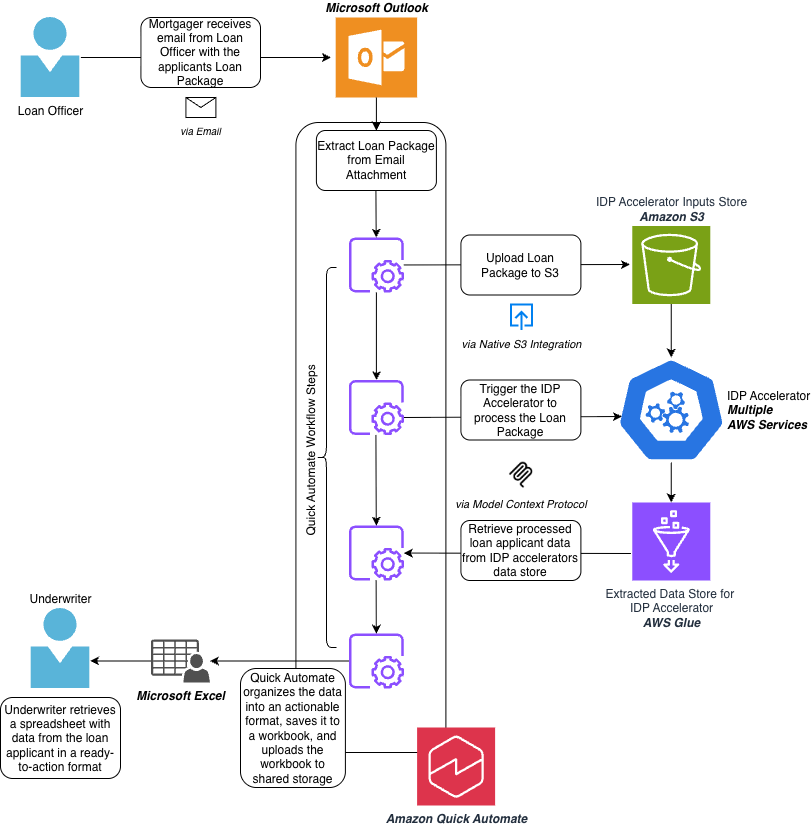
Figure 1: End-to-end architecture of the automated loan document pipeline
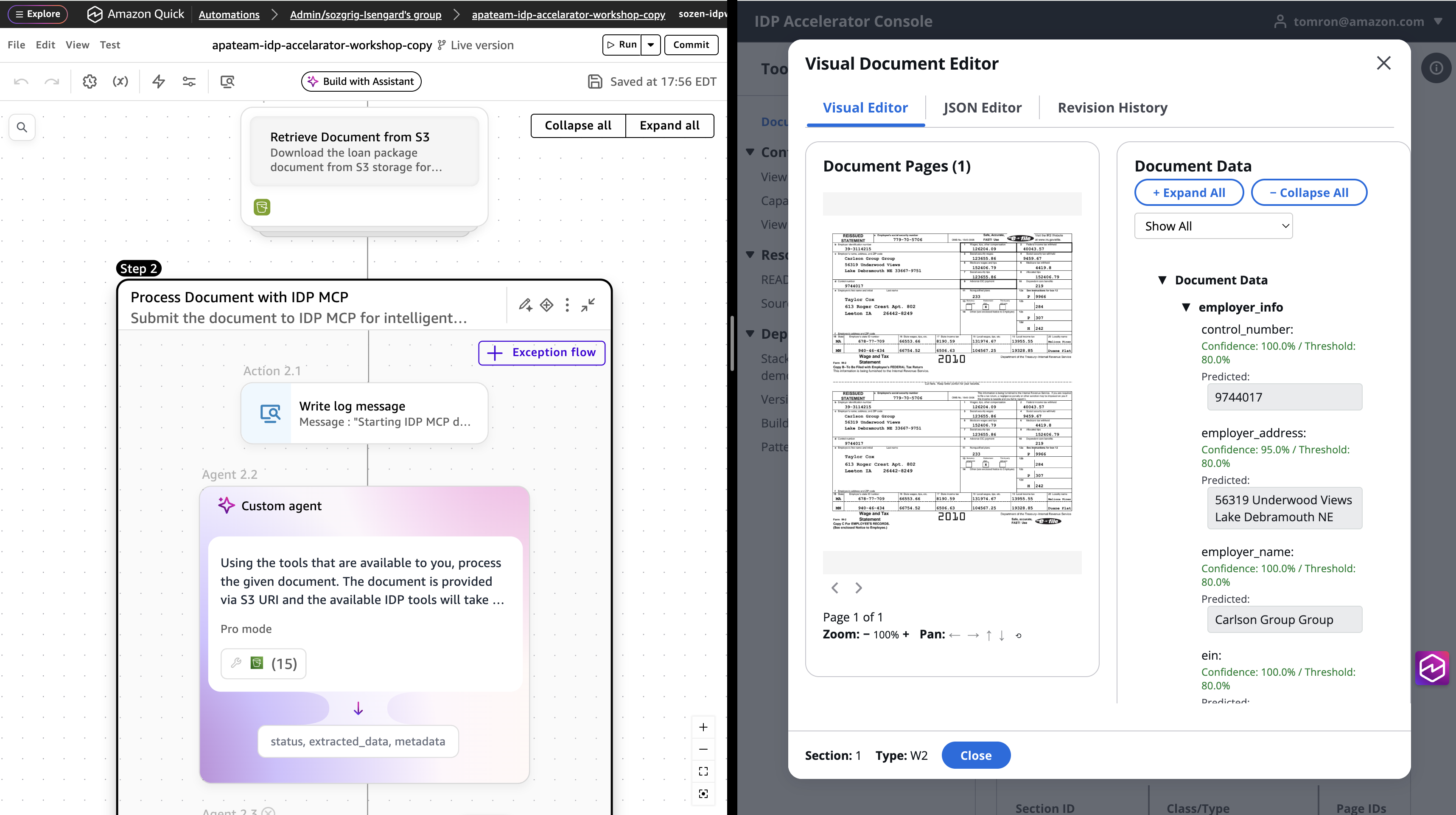
Figure 2: The Quick Automate workflow and IDP Accelerator console showing extracted W-2 data with confidence scores
Conclusion
Combining the GAIIC IDP Accelerator and Quick Automate gives document-intensive lending operations a fully automated pipeline, from raw documents to validated data flowing into downstream systems. The serverless pricing model means you pay only for what you process, with no infrastructure to manage.
Ready to automate your document intake? Start with the GAIIC IDP Accelerator repository on GitHub, or check out the companion workshop for a hands-on walkthrough. Have questions about implementing this in your lending operation? We’d love to hear how you’re tackling document processing challenges in the comments.