Artificial Intelligence
Real-time dental image verification with Amazon SageMaker AI at Henry Schein One
In dentistry, image quality determines whether a claim is paid or denied. Up to 20 percent insurance claims are initially denied, with missing or low-quality images among the leading causes. Yet quality assessment has traditionally been a manual, after-the-fact process. A clinician reviews an X-ray hours or days after capture, discovering problems only when a claim is rejected or a treatment plan can’t proceed. If the image is blurry, misaligned, or incomplete, the patient must return for a retake, adding cost, delay, and frustration for everyone involved. The fundamental gap is timing: quality feedback arrives long after the patient has left and the clinical moment has passed.
This post describes how Henry Schein One closed that gap by building Image Verify, an AI-powered quality verification system on Amazon SageMaker AI that evaluates dental X-ray quality at the point of capture, in real time, across thousands of locations. The system went from concept to over 10,000 active locations within months and has already processed over 11 million X-rays and growing at 1.5 million per week. Henry Schein One is now scaling toward 40,000 locations globally across four regions.
The challenge: Real-time image quality at scale
Henry Schein One’s previous image verification solution ran on a different cloud platform, but it couldn’t deliver the latency or cost efficiency required for a smooth clinical workflow. Rebuilding on AWS wasn’t a migration. It required designing a system that could meet five simultaneous requirements. Missing any one of them would make the solution unusable in a clinical environment where seconds matter and trust is earned incrementally.
- Latency – Clinicians won’t wait. Quality assessment must return in under three seconds to fit naturally into the clinical workflow.
- Accuracy – Multiple machine learning (ML) models must evaluate different quality dimensions, including sharpness, alignment, and completeness, without false positives that erode clinician trust.
- Scale – The system must serve tens of thousands of locations concurrently, with daily volumes in the hundreds of thousands.
- Cost efficiency – GPU inference at this scale can be prohibitively expensive if not carefully optimized.
- Global reach – Healthcare is local, but the platform must deploy across multiple regions with consistent performance.
Henry Schein One’s Image Verify
Henry Schein One serves dental practices worldwide through Dentrix and Dentrix Ascend, practice management platforms used by tens of thousands of clinicians. Their Platform Services team identified a specific and costly pain point: up to 20 percent of dental insurance claims are initially denied, with missing or low-quality images among the leading causes.
Image Verify is an AI-powered quality assessment solution built natively into the practice management workflow. When a technician captures an X-ray, Image Verify evaluates it immediately and returns a quality score on a 1-to-5 scale. If the image scores low, the technician retakes it while the patient is still present, removing the need for a return visit.
The product went from concept in fall 2025 to production in a matter of months. Within weeks of launch, it was live in 250 practices. By late April 2026, that number had grown to over 10,000, a 43-times increase, with more than 9 million X-rays processed and weekly volumes averaging 1.5 million and growing.
Image Verify is a quality solution, not a diagnostic one. It doesn’t identify pathology. It answers one question: is this image good enough for clinical use? That distinction allowed the team to iterate without the regulatory constraints associated with clinical AI.
For practices, the impact is immediate: fewer patient callbacks, higher-quality insurance claims, improved training for new technicians, and a gamification element that drives technician engagement on its own.
“Image Verify was only an idea at the end of Q3. In 6 months it was created, refined, and now deployed at scale. The design and workflow make adoption fast, intuitive, and scalable.”
— Troy Miller, VP Architecture, Henry Schein One
Architecture: How AWS and Henry Schein One built the solution
Henry Schein One built Image Verify on AWS from the start, using Amazon SageMaker AI for machine learning inference at scale. The application layer runs on Amazon Elastic Kubernetes Service (Amazon EKS), which orchestrates requests from the practice management application to the SageMaker AI inference endpoints and returns the quality score to the clinician.
Architecture diagram:
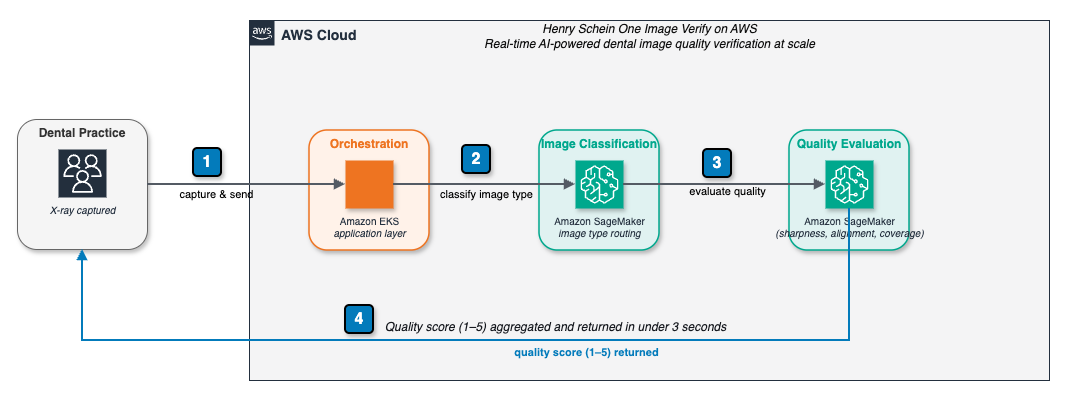
The inference pipeline
When an image is captured at a dental practice, it flows through a multi-model machine learning inference pipeline hosted on SageMaker AI. The pipeline operates in sequential stages:
- Classification – The first stage identifies the image type, such as bitewing, panoramic, or periapical, and routes it to the appropriate quality evaluation models.
- Quality evaluation – Specialized models assess sharpness, alignment, coverage, and completeness for the identified image type.
- Score aggregation – Results from the quality models are combined into a single 1-to-5 quality score returned to the practice management application.
The entire round trip, from image capture to quality score displayed on screen, takes a median of 1.4 seconds with a P90 of 2.2 seconds. The system maintains a 0.01 percent error rate across millions of inferences.
The following architecture decisions enabled the system to meet latency, cost, and scale requirements:
- SageMaker AI async inference – Handles variable request volumes without over-provisioning, with autoscaling based on queue depth rather than CPU utilization, providing a more accurate signal for GPU workloads.
- GPU instance selection – The team benchmarked across GPU instance families, ultimately migrating from ml.g6e.4xlarge to ml.g7e.4xlarge instances. The newer instance type exceeded performance expectations. Median latency dropped from 1.687 to 1.432 seconds and P90 from 2.45 to 2.196 seconds. Meanwhile, the fleet consolidated from 15 instances down to 10, a 33 percent reduction in GPU infrastructure with improved response times.
- Zero-downtime deployments – An A/B testing framework validates each change against live production traffic before full rollout, allowing daily optimization iterations without risk to the production environment.
- Multi-Region through AWS Cloud WAN – Network infrastructure provides consistent global deployment across the United States, Europe, Canada, and Asia Pacific Regions.
The AWS collaboration
When the engagement began, the AWS Solutions Architecture team reviewed Henry Schein One’s existing image verification workload, which was running on another cloud provider. The team then mapped the architecture to equivalent AWS services that could deliver the same functionality with improved latency and cost efficiency at scale. The initial focus was on establishing a working baseline on AWS, validating that the multi-model inference pipeline performed correctly in the new environment. As the team gained confidence in the functional parity, the collaboration shifted toward performance optimization and scale. The architecture progressively evolved toward a SageMaker AI inference-based solution that could support tens of thousands of locations with sub-3-second response times.
Throughout this journey, the AWS team provided ongoing architecture reviews, helped identify the right GPU instance families for the workload profile, and analyzed utilization patterns to uncover bottlenecks. The team also developed scaling strategies aligned with Henry Schein One’s global rollout target of 40,000 locations. The iterative, hands-on nature of the collaboration allowed both teams to move quickly, shipping optimizations weekly while maintaining production stability through zero-downtime deployment patterns.
Optimization: Achieving efficiency at scale
One instructive aspect of Image Verify’s journey is the optimization story: how the team identified infrastructure inefficiencies early, responded quickly, and arrived at a system that today serves tens of thousands of locations on a lean, highly efficient GPU fleet.
Identifying the bottleneck
As Image Verify scaled rapidly in its first weeks of production, the team conducted infrastructure profiling to understand utilization patterns. Analysis revealed that the preprocessing pipeline, including image decoding, normalization, and resizing, was running entirely on CPU. GPU resources were being underutilized while the overall system consumed more instances than necessary to sustain the workload.
This kind of CPU-side bottleneck on GPU instances is a common pitfall in machine learning inference at scale. The signal from CPU saturation can mask GPU headroom, leading teams to provision additional instances when the real opportunity is pipeline optimization.
The optimization approach
The team identified a prioritized set of optimization opportunities across the pipeline and began shipping them through zero-downtime A/B deployments. The first improvement, moving image preprocessing from CPU to GPU, delivered immediate and significant gains in instance efficiency, with no regression in latency or reliability.
A second optimization followed shortly after, yielding further improvements in throughput per instance. Within days, the system was serving a rapidly growing location footprint on a fraction of the previous instance count.
“Our team spent time identifying 60+ specific things that could be optimized. We just started working down the list, often deploying multiple times per day. The three highlights I want to call out: moving more model inference to the GPU directly (unlocking throughput we can’t get CPU-side); changing to an async inference pipeline; and an A/B testing framework, which lets us safely validate improvements before we push them to 10,000+ locations.”
— Troy Miller, VP Architecture, Henry Schein One
Current state
Within two weeks into the optimization journey, Image Verify has processed over 20 million dental X-rays, with weekly volumes averaging 1.5 million and growing. The system serves more than 10,000 active locations, a 43x increase from the initial 250 practices at launch. It delivers a median latency of 1.4 seconds and a P90 of 2.2 seconds with a 0.01 percent error rate across millions of inferences. The fleet runs at approximately 70 percent GPU utilization, with 60 percent of the optimization backlog already completed and improvements shipping continuously.
A key impact is where these numbers translate to patient outcomes. Up to 20 percent of dental insurance claims are initially denied because of poor image quality. Image Verify catches low-quality images at the point of capture, before the patient leaves, helping to reduce callbacks, produce cleaner claims, and accelerate reimbursement for practices. For clinicians and office staff, the feedback loop is immediate and actionable.
Equally notable is the adoption velocity. The growth from 250 to over 10,000 locations happened in weeks, not months. The gamification element, where technicians see quality scores for their captures, drives engagement without mandates and creates a natural training mechanism for newer staff.
Looking ahead, the architecture has been validated for a global target of 40,000 locations across four regions. The current 10,000 locations represent approximately 26 percent of that capacity, providing significant runway for continued growth without re-architecture. The team treats infrastructure efficiency as a product feature, not a one-time project. Shipping optimizations weekly through zero-downtime A/B deployments with no customer impact and no scheduled maintenance windows.
Lessons for machine learning inference workloads
The Image Verify optimization journey surfaces four principles applicable to machine learning inference workloads running at scale:
- Profile before scaling – The bottleneck was CPU preprocessing, not GPU compute. Adding more instances would have been expensive and ineffective. Instrument the full pipeline before scaling any component.
- Optimize the pipeline, not only the model – Inference latency often hides in preprocessing, postprocessing, and data movement rather than in model execution. Profile end-to-end, not only the model forward pass.
- Build for zero-downtime iteration – A/B testing and traffic shifting support rapid iteration without production risk, allowing a daily deployment cadence at scale.
- Use the right autoscaling signal – Queue depth and concurrent request count are more reliable scaling signals than CPU utilization when GPU instances carry mixed CPU and GPU workloads.
Looking ahead
Image Verify demonstrates a pattern applicable far beyond dental imaging: real-time machine learning inference at the point of care, scaled to thousands of locations, and optimized to run efficiently on minimal infrastructure.
The approach rests on four key ingredients that organizations can apply to similar workloads:
- Managed inference – Amazon SageMaker AI handles the operational complexity of GPU fleet management, autoscaling, and endpoint lifecycle, freeing engineering teams to focus on model and pipeline quality.
- Aggressive pipeline optimization – Profiling the full inference pipeline, not only the model, surfaces the real bottlenecks and delivers efficiency gains without additional infrastructure spend.
- Zero-downtime deployment patterns – A/B testing and traffic shifting support rapid iteration without production risk, sustaining a daily deployment cadence at scale.
- Multi-region architecture – AWS Cloud WAN and consistent infrastructure patterns across four regions provide the global reach that healthcare organizations require.
Henry Schein One’s next phase targets 40,000 locations across four regions, proving that the architecture scales not only technically, but operationally across a global healthcare footprint. The team continues to work through its optimization backlog, with each improvement shipped live through zero-downtime deployments.
For organizations building real-time image verification or similar machine learning inference workloads, the pattern is: start with managed inference, instrument everything, optimize the pipeline end-to-end, and build deployment practices that support daily iteration.
To learn more about running machine learning inference workloads on AWS, visit Amazon SageMaker AI. To learn more about Image Verify and Henry Schein One’s practice management platform, visit henryscheinone.com.