AWS for M&E Blog
Bitmovin enhances streaming intelligence with Amazon Bedrock
The streaming video industry has reached a pivotal moment, with streaming viewership now surpassing traditional broadcast and cable television combined, according to a Gauge report from Nielsen.
This unprecedented growth has created a significant challenge: managing and analyzing the massive volume of streaming session data required to deliver quality viewing experiences. When viewers face poor streaming quality, they often abandon content and cancel subscriptions, directly impacting revenue.
Engineering teams face mounting pressure to analyze this complex web of streaming health data, which flows in from multiple sources including content delivery networks (CDNs) and video player logs. Traditional approaches require technical teams to spend countless hours manually analyzing millions of viewing sessions to troubleshoot issues and optimize streaming quality, which is a time-consuming, resource-intensive process that delays root cause analysis and resolution.
To address this challenge, Amazon Web Services (AWS) Partner Bitmovin has developed the AI Session Interpreter powered by the Mistral 7B foundation model (FM) on Amazon Bedrock, a fully managed service that offers a choice of industry-leading FMs. This solution automatically monitors viewer sessions and generates actionable insights at scale, helping support teams as they analyze quality of experience (QoE) data more efficiently while reducing issue resolution times. Streaming services can detect issues faster, benchmark stream quality through AI-driven analysis, and see recommendations for how to enhance the viewer experience in real time by using FMs running on Amazon Bedrock.
In this post, we explore how streaming services can transform video experience monitoring using Bitmovin’s AI Session Interpreter within the Bitmovin Observability solution for video playback. Platforms can identify streaming problems sooner and make complex technical insights accessible to broader teams by combining generative AI FMs on Amazon Bedrock with sophisticated analytics.
The role of QoE in video streaming

Streaming viewers dread seeing the spinning buffering icon that appears when video content can’t load fast enough for seamless viewing. Buffering occurs when the video delivery pipeline encounters bottlenecks, which can stem from multiple sources: slow internet connections, CDN limitations, server response delays, or video player configuration issues. Each disruption threatens the viewer’s QoE.
Beyond buffering, streaming services must manage a complex array of potential viewing disruptions. Low bitrate video, failed image loading, advertisement playback issues, and unresponsive user interface elements all contribute to viewer frustration.
When these problems persist, viewers are more likely to watch less content or abandon the platform entirely, which poses a risk to ad and subscription revenue. According to Deloitte, new user acquisition can cost as much as $200 per subscriber. Given the significant cost of acquiring new users, maintaining high QoE is crucial for platform profitability.
To monitor and maintain QoE, streaming platforms collect vast amounts of data from multiple sources, including video player events, CDN performance, ad delivery metrics, technical statistics, platform health indicators, and user engagement signals. However, because the sheer volume of data can include 30–10 samples per play, as Bitmovin observes, analysis has historically been manual and time-consuming.
This creates a critical gap where viewing issues might affect large audiences before being detected and resolved. The Bitmovin AI Session Interpreter addresses this challenge through the scalable cloud infrastructure of AWS, specialized analytics services, and the advanced AI capabilities of FMs running on Amazon Bedrock. With these solutions, platforms can process and act on QoE data more efficiently than ever before.
How Bitmovin’s Observability addresses this challenge
Bitmovin is an AWS Partner and a leading provider of video streaming solutions. With their Observability solution, video developers and engineers can monitor and analyze real-time playback data, track viewer behavior and playback performance, configure alerts for key events or anomalies, and much more.
Observability is a valuable companion for the Bitmovin Encoding and Player products, and it can stand alone to be used with open source and commercial video players. Additionally, Bitmovin now supports Vega OS, an operating system built specifically for Amazon devices. This reinforces platform readiness across modern Fire TV environments, which means insights generated by the AI Session Interpreter are accessible on next-generation devices. An example of the user interface is shown in Figure 1:
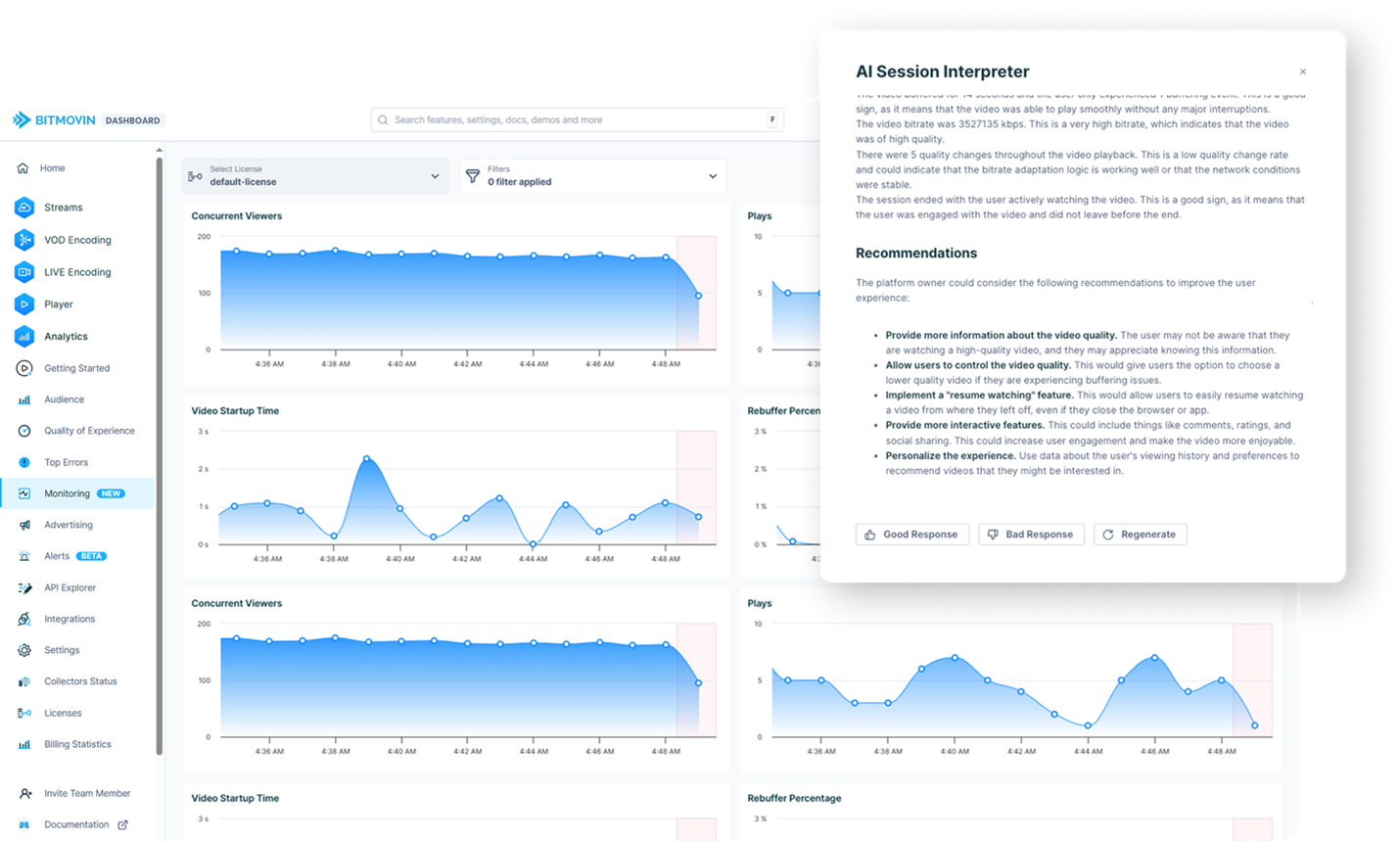
Figure 1: The Bitmovin Observability dashboard with the AI Session Interpreter panel providing session analysis and actionable recommendations
Bitmovin’s Observability includes a dedicated dashboard for visual interpretation and supports data export for use in custom dashboards, such as Amazon Managed Grafana, or for agentic processing through large language models (LLMs) using a Model Context Protocol (MCP) server. It collects extensive playback data across the streaming workflow, from basic metrics such as play and pause duration to more advanced signals such as video bitrate, digital rights management (DRM) license exchanges, adaptive bitrate switching, and detailed error logs.
To help video platforms address the challenges of data aggregation and analysis, Bitmovin’s goal was to reduce manual processing and make insights more accessible to users who don’t have deep technical expertise in video workflows. The team turned to AI to streamline analysis, surface relevant patterns more quickly, and make root cause identification seamless. Bitmovin built the AI Session Interpreter using existing cloud infrastructure to deliver automated, actionable insights from complex playback data.
When a user selects an individual viewer session in the Observability dashboard, the AI Session Interpreter sends that session’s telemetry—including startup time, buffering events, bitrate adaptation, quality switches, and error logs—to the Mistral 7B FM running on Amazon Bedrock. The model returns a structured, plain-language summary that explains what happened during the session, why it might have impacted the viewer’s experience, and what specific steps the operator can take to improve performance.
Because the analysis is specific to the selected session, different sessions surface different insights and recommendations. For broader conversational exploration of analytics data across multiple sessions, Bitmovin also offers the Observability Assistant, a chat-based interface where users can ask natural language questions such as, “Which country had the highest buffering percentage last week?” or, “I have three sessions with the same buffering-related error. I want you to analyze them and compare their user experience in terms of buffering.” Users receive real-time answers with follow-up capability.
To identify the best FM for this solution, Bitmovin used Amazon Bedrock Evaluations to compare multiple FMs and determine which best fit the requirements of the AI Session Interpreter. The team tested model behavior against structured prompts and identified the most consistent and contextually accurate output. This process led to the selection of the Mistral 7B model, which demonstrated the best ability to provide faster, more relevant summaries of playback data, making it effortless to identify performance issues and take corrective action.
Architecture: Bitmovin and Amazon Bedrock integration
In this section, we walk through how Amazon Bedrock factors into the architecture for Bitmovin, enabling real-time session analysis as shown in Figure 2:
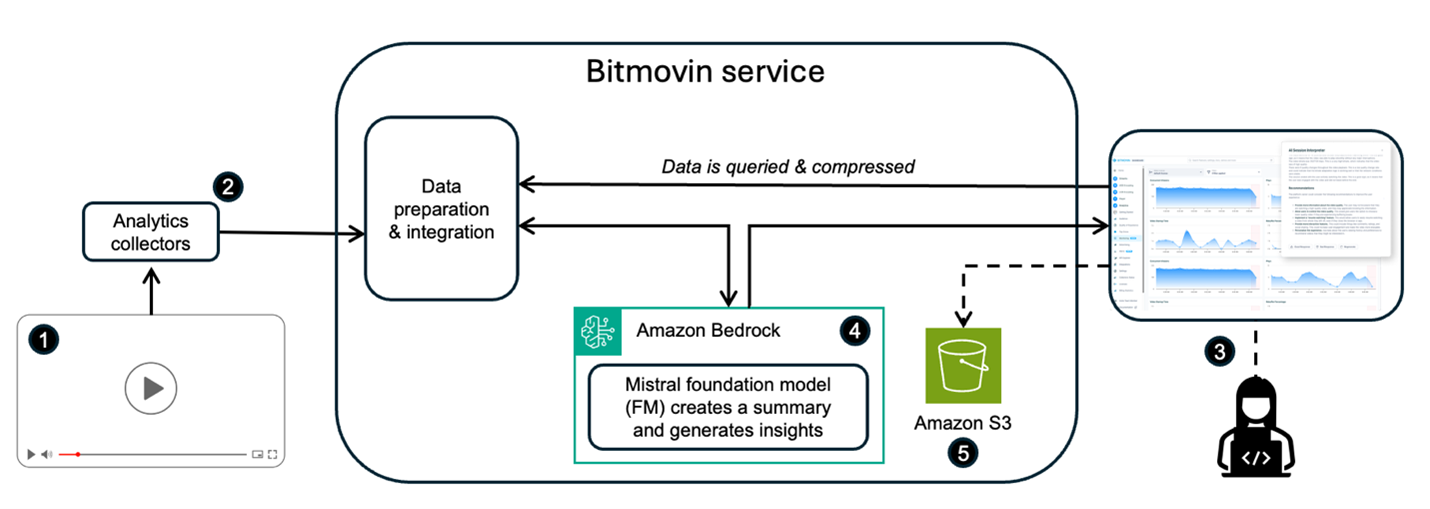
Figure 2: Architecture diagram depicting the data flow for the AI Session Interpreter, from video player telemetry through Amazon Bedrock processing to dashboard insights
The architecture data flow works as follows:
- The video player sends playback logs to the collectors about changes during playback (time, QoE metrics) and the analytics collectors pull the necessary data.
- Analytics collectors send session data packages containing demographic, geographic, and time data to the Bitmovin service for data preparation, integration, and storage access.
- A user selects a viewer session and initiates an AI interpretation request. The session’s analytics data, which covers playback events, quality metrics, and error logs, is compressed and sent to Amazon Bedrock for analysis.
- The Mistral FM on Amazon Bedrock creates a summary and generates insights. The resulting data is fed to a dashboard for the user to view.
- Data is available to export to Amazon Simple Storage Service (Amazon S3).
AI Session Interpreter results
One of the key outcomes of integrating Amazon Bedrock into the AI Session Interpreter is that complex session-level telemetry is automatically translated into structured summaries containing a session overview, root-cause analysis, and prioritized recommendations, expanding access to streaming insights across teams beyond video engineering.
In addition to video engineering, the tool supports roles such as customer success, product management, and user retention by surfacing insights that are ready to interpret and act on. The platform supports user-level tracking through customer IDs, enabling session analysis tied to individual viewers and helping identify potential churn risks.
Additional features include customizable alerts with rule-based thresholds, anomaly detection through smart alerts, and session scoring to quantify experience quality. The system also incorporates DRM-specific analytics to surface encryption-related errors and startup issues. Future roadmap items include proactive agents with email notifications and continued enhancements to observability.
Conclusion
In this post, we reviewed the challenges streaming services face when collecting, analyzing, and acting on playback performance data. Bitmovin’s Observability and AI Session Interpreter can help address these challenges using Amazon Bedrock and the Mistral FM to deliver real-time AI-powered insights that reduce manual analysis and accelerate issue resolution.
AI Session Interpreter is available in AWS Marketplace as part of Bitmovin’s Observability for video playback. You can also find more information by visiting the Bitmovin website, or contacting their sales team.
For more information on AWS media solutions, visit the AWS for Media & Entertainment page or contact an AWS representative to learn how we can help accelerate your organization.