AWS for M&E Blog
How PGA TOUR automated live profanity detection with AWS using Amazon Transcribe
For the PGA TOUR, live sports broadcasting presents unique content moderation challenges. Live broadcasts require real-time monitoring to protect brand integrity and viewer experience. For organizations like PGA TOUR, where microphones capture natural on-course sounds, including the occasional colorful commentary, profanity filtering is essential for brand protection across PGA TOUR LIVE streams that broadcast on the ESPN App and the World Feed.
Historically, the PGA TOUR relied on hardware-based solutions that required dedicated operators to manually monitor audio feeds and press a physical button when they heard objectionable language. This approach was expensive, introduced approximately 5 seconds of broadcast delay, required a team of staff members per tournament for production of the four streams to cover breaks and shift changes, and was inherently limited by human reaction time and attention span.
In this post, we share how the PGA TOUR automated their approach with an AI-powered profanity detection and filtering system built on Amazon Transcribe. The solution meant that experienced production staff could take on higher value creative and technical roles while improving detection speed and consistency.
The challenge
The PGA TOUR operates multiple simultaneous live streams for each tournament through PGA TOUR LIVE, each requiring independent audio monitoring. Their existing solution, a purpose-built hardware-based profanity delay system, requires:
- Dedicated operators – A team of staff members rotating through shifts to continuously watch and listen to each broadcast feed (up to 12 hours a day)
- Physical hardware – On-premises devices
- Additional hardware and staff – Each additional stream requires additional hardware and staff due to scaling limitations
With four simultaneous PGA TOUR LIVE streams running during tournaments, the PGA TOUR assigned staff members to profanity monitoring, rotating through shifts to allow for breaks and changeover during long tournament days. This was a significant operational expense that diverted production staff from higher-value creative and technical tasks.
Solution overview
The new system uses Amazon Transcribe streaming to perform real-time speech-to-text conversion on the live audio feed, then automatically mutes the output when profanity is detected. The key innovation is a configuration-led architecture using pipelined tasks in Amazon Elastic Container Service (Amazon ECS) on AWS Fargate:
- Ingest – The live Secure Reliable Transport (SRT) stream containing audio and video is received.
- Split – The audio track is forked from the video source and sent to Amazon Transcribe at 16 kHz for real-time speech recognition.
- Detect – Transcribed text, both partial and complete, is compared against a customizable word list using configurable matching (exact or partial match).
- Action taken – When an example of profanity is detected in the transcription path, a system in PGA TOUR Studios connects to the broadcast management system to invoke the mute action.
- Output – The profanity detection system sends a command to the broadcast system to mute (swap) the audio program. This process happens in the live production pipeline from each control room.
This architecture means the system only needs to detect profanity faster than the configured delay, a comfortable margin given Amazon Transcribe streaming quick response time.
The following diagram shows the solution architecture.
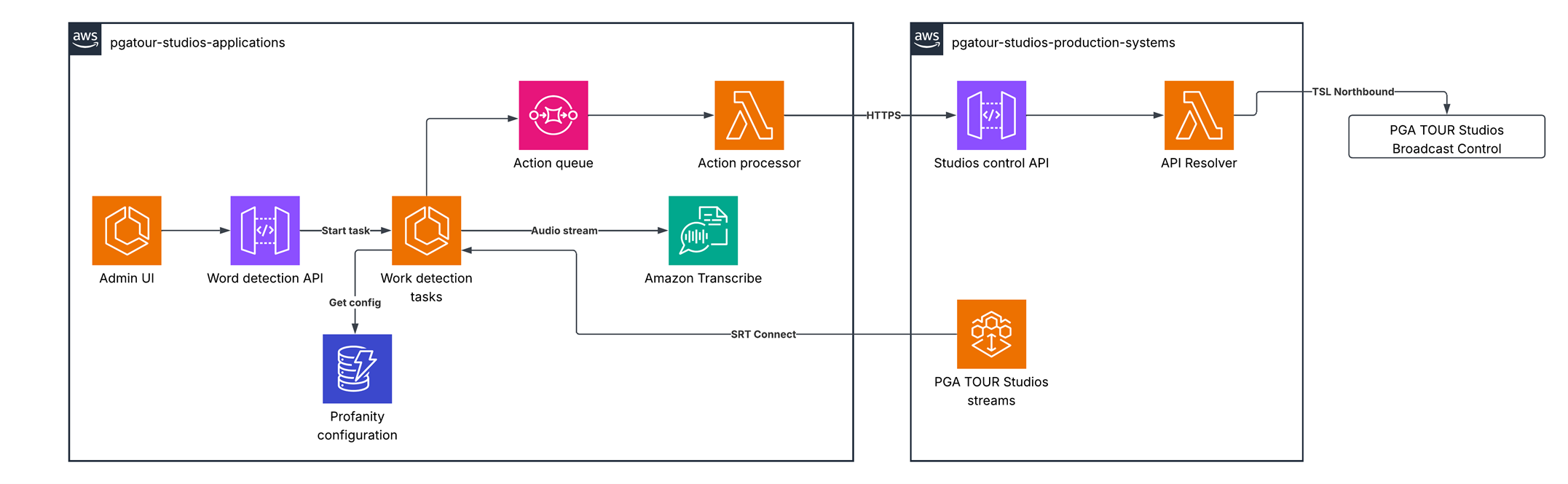
Figure 1: Live profanity detection and filtering architecture
The word detection Fargate task has the following flow:
- Start task
- Connect to SRT by establishing a connection to the SRT audio stream
- Load configuration and retrieve profanity filter settings
- Is the stream and configuration valid?
- If no, report error and end task
- If yes, continue
- Segment the audio for processing
- Connect to the AWS Transcribe stream and open a real-time transcription session
- Receive transcription back from Transcribe
- Is transcription still active?
- If no, end task
- If yes, continue
- Does it match a word in the list?
- If yes, identify the action from config, send to Amazon Simple Queue Service (Amazon SQS), and return to step 7 (receive the next transcription)
- If no, return to step 7 (receive the next transcription)
Key features
The production system includes several capabilities that make it suitable for live broadcast environments:
- Customizable word library – The PGA TOUR built a production library of over 1,500 words and phrases, tuned for the golf broadcast context.
- Flexible matching – Supports both exact-match and partial-match modes to catch variations and compound words.
- Configurable debouncing – Prevents repeated muting from sustained outbursts, with configurable cooldown periods.
- Multi-language support – Uses language capabilities in Amazon Transcribe for international broadcast events.
- Logging and auditability – Every detection is timestamped and logged for review, enabling continuous improvement of the word list.
- Configurable targets and words – The team has constructed the system to allow any set of configurable words to take an action, which provides future value for the system for items such as sponsor recognition and player name recognition. This configuration is also automatically reloaded by the word detection tasks, meaning PGA TOUR Studios can make updates and configuration changes in the middle of broadcast windows if needed.
Integration with broadcast facility control
The PGA TOUR productionalized this solution by integrating it into their centralized broadcast facility control environment, the system they’re already using to manage all production operations during tournament broadcasts. Rather than running as a standalone application, the profanity detection system operates as a component within the existing production workflow. This makes it easy for production staff to manage alongside other broadcast operations.
Accelerating development with generative AI
One of the most compelling aspects of this project was the development speed. The PGA TOUR’s engineering team used AI-assisted coding with Claude by Anthropic in Amazon Bedrock to accelerate the productionalization effort. From the proof-of-concept architecture, the team completed full production development, including the 1,500-word library, facility control system integration, operational monitoring, and production hardening, in approximately 2 weeks of development effort.
Beyond raw speed, AI-assisted development fundamentally changed how the team collaborated. The PGA TOUR’s developer and broadcast engineer worked together directly, iterating on the implementation in minutes rather than days. Each cycle incorporated enterprise broadcast best practices from the start, because the speed of iteration made it practical for a developer and a domain expert to pair in real time. There was no backlog grooming, no prioritization calls, no waiting for the next sprint. They decided to move forward, and within 2 weeks, the system was production-ready and running autonomously.
This demonstrates that AI development tools compress timelines and support a different kind of collaboration. Specialists who previously would have worked asynchronously through tickets and handoffs can now iterate together with purpose, embedding domain expertise into the solution from day one.
Business outcomes
The impact of this solution has been significant, as outlined in the following table.
| Metric | Prior solution | AWS powered solution |
|---|---|---|
| Annual cost | Significant dedicated staffing investment | ~$1.50 per hour on demand (Amazon Transcribe) |
| Staff assigned | Six staff members per event | Two passive monitors (four diverted to more creative or technical roles) |
| Scalability | Linear cost per stream | Elastic; scales with no additional staff |
| Development time | Not applicable | ~2 weeks (AI-assisted) |
By automating profanity detection, the PGA TOUR diverted four experienced staff members from profanity monitoring into higher-value creative and technical production roles while simultaneously improving broadcast latency and detection consistency. The remaining two team members now serve in an oversight capacity, spending much of their time on other production responsibilities.
Conclusion
The PGA TOUR’s live profanity detection system demonstrates how combining purpose-built AWS AI services with modern streaming architectures can solve real operational challenges in live broadcasting. With Amazon Transcribe streaming, you get a real-time speech-to-text foundation, while the pipeline architecture ensures broadcast-grade reliability and low latency.
The project also showcases how generative AI tools such as Claude by Anthropic in Amazon Bedrock can accelerate development timelines, turning a proof of concept into production-ready software in weeks rather than months.
If your organization is exploring automated content moderation for live media, you can explore how the real-time streaming capabilities of Amazon Transcribe might fit into your existing production workflows.