Migration & Modernization
Category: Technical How-to
Running parallel migration waves on AWS Transform with team isolation
Choose the right workspace and job isolation model so multiple migration teams can run concurrently without conflicts
Migrate Oracle-to-PostgreSQL Java code with AWS Transform custom
Migrating an enterprise Java application from Oracle to PostgreSQL is often described as a database project — but with tools like AWS Transform custom, most of the real work lands in the application code. A large Java or Kotlin codebase can carry thousands of Oracle-specific SQL statements, Java Database Connectivity (JDBC) type assumptions, object-relational mapping […]
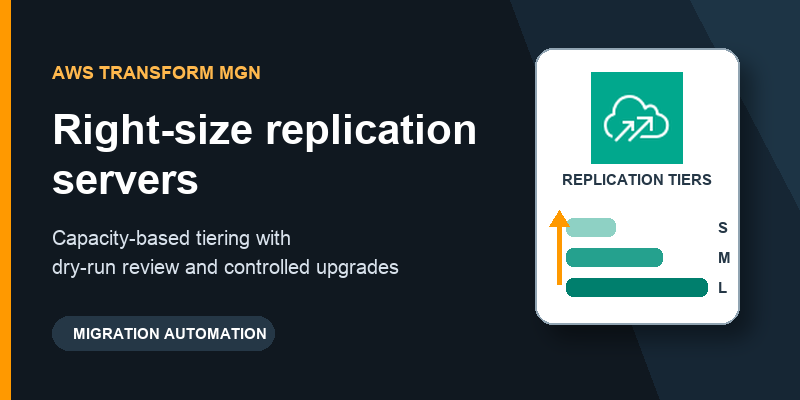
Right-Size AWS Transform MGN Replication Servers
Migration teams need a consistent way to right-size AWS Transform MGN replication servers when a wave includes many source servers. The challenge grows when source servers range from small systems to workloads with several tebibytes of provisioned disk capacity. AWS Transform MGN, formerly AWS Application Migration Service, uses lightweight Amazon Elastic Compute Cloud (Amazon EC2) […]
High-throughput enterprise-scale document migration on AWS
Migrating hundreds of millions of documents to the cloud is a defining enterprise challenge – data loss, downtime, or compliance gaps break traditional approaches. Here’s how we built a system on AWS that migrated 800 million documents with configurable parallelism, self-healing, and integrity validation. When migrating at this scale, traditional approaches quickly break down. Manual […]
How resource tagging scopes the AWS Transform connector role
AccessDenied during an AWS Transform migration is often a missing or incorrect tag. This post shows you how to diagnose and resolve it.
Centralized multi-account server migration to AWS with AWS Transform
Introduction AWS Transform for migrations lets you orchestrate a centralized, multi-account migration of your workloads to Amazon EC2 from a single location. It coordinates the migration across all your target accounts and applies AI-powered automation to dependency mapping, wave planning, and network configuration, so dependent workloads move together while landing in their intended destination accounts. […]
Migrate MuleSoft APIs to AWS serverless with AWS Transform custom
When you migrate a portfolio of MuleSoft applications to AWS serverless, each application brings its own decisions: how every connector maps to an AWS service, how DataWeave scripts translate to AWS equivalents, and how error-handling strategies carry over. Multiply those decisions across a portfolio, and each migration becomes a one-off exercise. In this post, explore […]
Migrating Your Angular Applications to React Using AWS Transform Custom
Moving an Angular application to React can require changes across components, state management, routing, build tooling, and tests. Teams may consider the migration when Angular expertise is harder to staff, third-party libraries stop supporting older versions, or maintenance costs increase. AWS Transform custom automates this migration process by analyzing the Angular codebase, creating a migration […]
Migrating Windows Server 2008 to AWS: Resolving PV Driver Issues and Boot Failures
Overview Many organizations still run Windows Server 2008 workloads that cannot be upgraded before migration due to application dependencies, vendor support constraints, or licensing limitations. When migrating these servers to AWS using AWS Transform MGN, the choice of target Amazon EC2 instance type determines which drivers the guest operating system needs to communicate with the […]
HALO by First Student: How AWS and AI-powered solutions are shaping the future of student transportation
Introduction If you’re managing student transportation for a school district, you’re navigating increasingly diverse student needs alongside rising expectations from families who want real-time visibility into their student’s journey. At the same time, you must deliver consistent, reliable service in a complex operating environment where disruptions can quickly impact safety, service reliability and community trust. […]