AWS Public Sector Blog
Building an AI-ready university campus with AWS
AI adoption is accelerating across university campuses, but most institutions approach it through disconnected pilots and departmental silos. When universities treat AI as a collection of tools rather than an institutional capability, the result is fragmented investments, duplicated efforts, inconsistent policies, and moving too slow to address student and faculty needs, which leads to missed opportunities to transform teaching, research, and operations at scale.
Universities need to figure out how to adopt AI strategically. Based on insights from the 2025 EDUCAUSE research on AI in higher education, only 23% of universities measure AI return on investment (ROI), yet those that do scale their initiatives twice as fast. The difference lies in treating AI as an institutional capability requiring coordinated strategy, not as isolated tools or IT projects.
Institutions that build coordinated AI capabilities today will accelerate discovery, personalize learning at scale, and operate more efficiently. Those that don’t risk falling behind in serving students, advancing research, and fulfilling their public mission. AI readiness needs to focus on more than technology. To be successful progressing through the stages of AI adoption, universities need to align strategy, governance, people, and culture to transform how your institution serves its mission in the age of artificial intelligence.
AI has moved from emerging technology to foundational capability in higher education. But without coordinated strategy, universities risk creating new forms of inequality while leaving transformative potential unrealized. Students in the same lecture hall have radically different AI access. Researchers waste time navigating bureaucracy instead of advancing discovery. Administrative systems remain siloed while AI could connect them. Without a clearly defined AI adoption pathway, shadow IT use of AI is almost certain.
This post outlines an AI-ready framework for use by higher education institutions worldwide. The framework takes a holistic approach to integrating AI across campuses while addressing the critical challenges of data governance, security, academic integrity, workforce readiness, and equity.
A framework for institutional AI readiness
To become AI-ready, universities need to do more than deploy a single system or run isolated pilots. AI readiness requires a coordinated framework that aligns strategy, technology, governance, people, and culture with your core mission of teaching, research, and public service.
The framework consists of six interconnected pillars that transform AI from fragmented experiments into an institutional capability:
- Data and digital foundations – Treating data as a strategic asset with scalable infrastructure
- Responsible AI governance – Establishing ethical, transparent, and compliant systems with human oversight
- People, skills, and talent enablement – Empowering your entire community through education and development
- Culture and change readiness – Fostering experimentation while addressing resistance
- Scalable use cases – Implementing high-impact applications across teaching, research, and operations
- Measurement and adaptability – Continuously measuring impact and refining strategies
Universities that approach AI as only another IT project will struggle. Those that treat it as institutional transformation—requiring executive leadership, cross-functional collaboration, and cultural change—will lead.
These pillars represent an interconnected system where progress in one area enables advancement in others rather than a checklist to complete sequentially. Instead of thinking of the process of becoming AI ready as linear, think of these six pillars as the foundation of institutional transformation.
Data and digital foundations
Start with strategy, not servers. Before investing in infrastructure, your organization needs to answer the fundamental question of how to use AI to advance your mission of teaching, research, and public service.
This clarity drives everything else. Establish an AI committee with executive sponsorship and appoint an institutional AI champion—someone who can bridge academic, administrative, and technical perspectives. Position AI as a long-term institutional capability and build the foundation AI needs to thrive. Don’t limit your efforts by making it an IT project that lives in one department.
AI depends on high-quality, accessible data. Treat your data as a strategic asset with scalable infrastructure, data quality standards for reliable model training, and sharing mechanisms while protecting privacy. Your infrastructure should grow with your ambitions. Amazon Web Services (AWS) provides the elasticity to scale from pilot projects to campus-wide deployments without massive upfront investment.
Responsible AI governance
Trust is your most valuable asset, so you must protect it. In higher education, trust isn’t optional. Students, faculty, parents, and the public expect you to use AI ethically, transparently, and in compliance with academic norms.
Create an AI governance body with diverse representation that includes academic affairs (provost’s office), faculty from multiple disciplines, legal and compliance, IT and security, and student representatives. This body should establish clear policies that answer:
- When is AI use appropriate and when isn’t it?
- How do we drive transparency in AI-assisted decisions?
- What human oversight is required for sensitive applications?
- How do we handle bias, errors, and appeals?
- What are our data privacy and security standards?
Stakeholders sometimes worry that governance efforts will slow innovation. In reality, effective governance enables it by giving your community confidence to experiment within clear guardrails. By using AWS responsible AI, you can accelerate trusted AI innovation with effective governance.
People, skills, and talent enablement
A $2 million AI infrastructure investment delivers zero ROI if faculty don’t know how to use it. AI readiness depends on empowering your entire community—faculty, researchers, staff, and students—to understand and use AI effectively.
For faculty and researchers:
- Provide hands-on AI workshops and create communities of practice
- Offer research computing and course development support for AI integration
For staff:
- Create pathways for staff to develop technical skills
- Develop AI literacy programs that demystify the technology
For students:
- Provide AI tool access to support learning and research
- Teach responsible AI use and critical evaluation of AI outputs to prepare for an AI-augmented workforce
Setting the goal to make everyone an AI expert isn’t realistic. Instead, ensure everyone can use AI appropriately in their role. The state of the art in AI is evolving rapidly and evolving your training and enablement to keep up to date with it is important.
Culture and change readiness
Address the human side of transformation. Technology adoption fails without cultural readiness. Faculty worry about academic integrity. Staff fear job displacement. Administrators struggle with risk management. Students navigate unclear expectations.
Build a culture that embraces AI by:
- Addressing concerns directly – Host open forums where community members can voice fears and ask questions. Acknowledge legitimate concerns about job impacts, bias, and academic integrity rather than dismissing them.
- Fostering experimentation – Adopt the Amazon “two-way door decision” framework—make reversible decisions quickly to test ideas. With modern AI tools, you can prove or disprove concepts in weeks, not years. Encourage rapid experimentation within your governance guardrails.
- Celebrating innovation – Recognize and reward faculty, staff, and students who pioneer responsible AI use. Share success stories across campus to build momentum.
- Enabling cross-functional collaboration – Break down silos between academic affairs, IT, research computing, and administration. AI initiatives succeed when diverse perspectives shape implementation.
- Reinforcing academic values – Frame AI as amplifying rather than replacing human judgment, creativity, and critical thinking. Position AI as a tool that frees people for higher-value work.
Cultural change takes time. Start with early adopters, demonstrate value, and let success create momentum.
Scalable use cases across teaching, research, and operations
Move from pilots to impact. AI readiness becomes tangible through high-impact use cases that scale beyond isolated experiments. Start with applications that solve real problems and demonstrate clear value.
Wharton School developed an innovative virtual teaching assistant (TA) chat assistant using generative AI on AWS, specifically using Amazon Bedrock and Claude by Anthropic in Amazon Bedrock. The assistant offered:
- Personalized learning support – AI tutors provide around-the-clock assistance, adapting to individual student needs and learning pace.
- AI-assisted course design – Faculty use AI to generate practice problems, create assessments, and develop course materials, which frees time for direct student interaction and curriculum innovation.
- Virtual labs and simulations – AI-powered simulations enable hands-on learning in disciplines where physical labs are expensive, dangerous, or impractical.
Examples in research:
Accelerated data analysis – Researchers use AI to process datasets that would take months manually, identifying patterns and insights that advance discovery.
Literature review and synthesis – AI tools help researchers stay current with exponentially growing academic literature, identifying relevant papers and synthesizing findings.
Examples in operations:
- Student success analytics – Predictive models identify students at risk of dropping out, enabling proactive intervention and support.
- Enrollment and financial forecasting – AI improves planning accuracy, helping institutions optimize resources and manage budgets effectively.
- Administrative efficiency – AI-assisted case management streamlines processes in financial aid, human resources (HR), facilities, and other administrative functions such as procurement, which reduces wait times and improves service quality. California Polytechnic State University, with total procurement spend exceeding $190 million in 2023–2024, pioneered the use of generative AI to revolutionize its procurement process by using Amazon Bedrock and Claude AI models to generate more efficient and accurate scopes of work (SOWs).
The key to scaling is to start with use cases that have clear success metrics, engaged stakeholders, and potential for campus-wide adoption. Learn from each implementation and apply lessons to the next.
Measurement and adaptability
Because AI readiness is an ongoing journey of learning and adaptation, measuring progress is essential. Without measurement, you can’t demonstrate value, justify investment, or guide future decisions.
Define success criteria tied to outcomes:
- Teaching – Student learning gains, engagement metrics, completion rates
- Research – Time to discovery, publication output, grant success rates
- Operations – Cost savings, service quality improvements, staff productivity
Establish feedback loops:
- Regularly survey faculty, staff, and students about AI tool effectiveness
- Monitor AI system performance and accuracy
- Track adoption rates and identify barriers to use
- Assess whether AI initiatives advance your strategic priorities
- Share AI successes broadly to inspire others
Adapt as you learn:
- Refine policies based on real-world experience
- Adjust investments toward highest-impact applications
- Update governance as technologies and regulations evolve
- Reassess your AI strategy annually as capabilities mature
The universities that lead in AI won’t be those with the most advanced technology—they’ll be those that learn fastest and adapt most effectively.
The following graphic illustrates these six pillars.
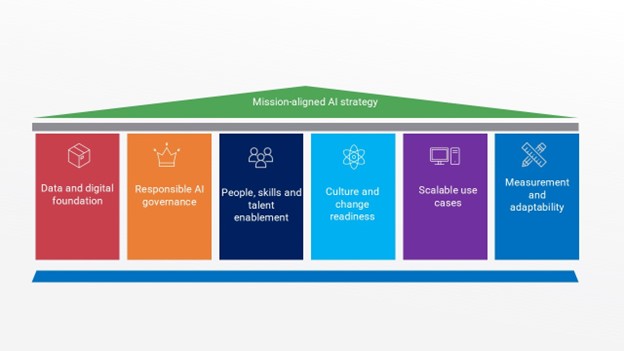
Figure 1: AI-readiness framework for a university
AI-readiness maturity model
Understanding the six pillars is one thing but knowing where your institution stands is another. The AI-readiness maturity model provides a practical framework to evaluate your current capabilities and chart your path forward.
Most universities fall into one of five maturity stages, from experimental (isolated pilots) to transformational (AI as core institutional capability). Success in AI adoption requires executive commitment, cross-functional collaboration, investment in people alongside technology, and governance that enables rather than blocks innovation.
Importantly, you might be at different levels across different pillars—advanced in research computing but early-stage in teaching applications, for example. This is normal and helps you prioritize investments strategically while enabling a shared communication model across all stakeholders on AI maturity.
Experimental
The experimental stage is marked by the following characteristics:
- Individual faculty and researchers experiment with AI tools in isolation
- No coordinated strategy or institutional policies
- Data exists in departmental silos with no integration or governance
- Ad-hoc technology purchases without central oversight
What this looks like in practice: A computer science professor uses a chatbot for course prep. A biology lab runs machine learning (ML) models on local servers. The admissions office pilots a chatbot. None of these groups know about the others’ work, and there’s no institutional guidance on appropriate use.
Key challenge: Fragmentation leads to duplicated efforts, inconsistent policies, and missed opportunities for collaboration.
Opportunistic
The opportunistic stage is marked by the following characteristics:
- Departmental AI initiatives emerge, often grant-funded
- Basic coordination within departments but silos remain between them
- Partial data integration within specific domains
- Departmental-level governance and policies
- Growing awareness of AI potential but no campus-wide strategy
What this looks like in practice: The college of engineering establishes an AI research center. The medical school launches a health analytics initiative. IT provides GPU resources for research. Each operates independently with its own policies and priorities.
Key challenge: Departments compete for resources and duplicate investments. Inconsistent policies create confusion about acceptable AI use.
Progression pathway: Establish an executive-sponsored AI committee with cross-functional representation to begin coordinating efforts.
Coordinated
The coordinated stage is marked by the following characteristics:
- University-wide AI strategy defined and communicated
- Formal AI governance committee with diverse representation
- Executive AI champion appointed (often at vice president or provost level)
- Institutional AI policies, governance standards, and guidelines published
- Systematic skill-building programs launched
What this looks like in practice: The university publishes AI principles and acceptable use policies, and an AI steering committee meets monthly to coordinate initiatives across departments.
Key challenge: Moving from coordination to actual integration requires sustained investment and cultural change.
Progression pathway: Pilot high-impact use cases that demonstrate value across teaching, research, and operations. Use success stories to build momentum and justify expanded investment.
Integrated
The integrated stage is marked by the following characteristics:
- AI embedded across teaching, research, and operations
- Mature governance processes with clear escalation paths
- Centralized AI tools, shared data repositories, and continuous improvement processes
- AI literacy among faculty, staff, and students
- Cross-functional teams routinely collaborate on AI initiatives
- Measurement systems track impact and ROI
What this looks like in practice: Personalized learning platforms serve thousands of students. Research teams routinely use AI for data analysis and discovery. Administrative systems use AI for forecasting and decision support. The institution measures AI impact on learning outcomes, research productivity, and operational efficiency. New faculty receive AI training during onboarding.
Key challenge: Maintaining momentum and avoiding complacency. Ensuring equity of access across all student populations.
Progression pathway: Expand successful use cases. Invest in advanced capabilities like custom model development. Share learnings externally to establish thought leadership.
Transformational
The transformational stage is marked by the following characteristics:
- AI as core institutional capability, not merely a tool
- AI informs strategic decision-making and institutional governance
- Continuous innovation cycles with rapid experimentation
- Global leadership in AI-enabled teaching, research, or operations
- AI capabilities attract top faculty, researchers, and students
- Institution shapes broader higher education AI practices
- Sophisticated measurement of AI’s mission impact
What this looks like in practice: The university is recognized nationally for AI innovation. Research breakthroughs are accelerated by AI capabilities. Graduates are sought after for their AI literacy. The institution contributes to AI policy discussions and shares frameworks with peers. AI enables new models of education and discovery that weren’t previously possible.
Key challenge: Staying ahead while technology evolves rapidly. Balancing innovation with responsible governance.
The following graphic illustrates the maturity model.
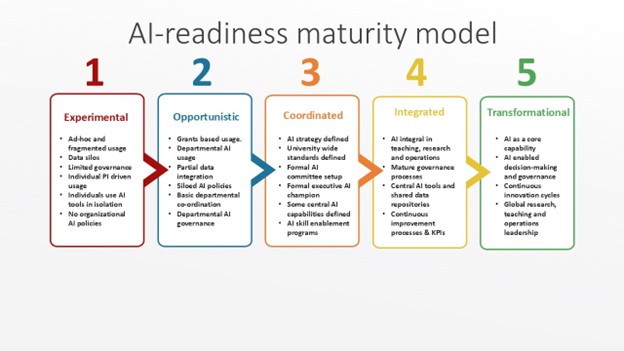
Figure 2: AI-readiness maturity model for a university
Key insights from the maturity model
You don’t need to be at stage 5 to create value. Even at stages 2 and 3, institutions can achieve significant impact through coordinated efforts.
Progress isn’t linear. You might advance quickly in some pillars while others lag. This is normal—use it to inform investment priorities.
Culture matters as much as technology. Institutions that invest only in infrastructure without addressing governance, skills, and culture struggle to advance beyond stage 2.
Leadership commitment is essential. Universities that progress to stage 4 and beyond have sustained executive sponsorship and dedicated resources.
Learn from others. Connect with peer institutions at similar maturity levels to share lessons learned and avoid common pitfalls.
The maturity model is a guide to intentional progress aligned with your mission and resources. Start where you are, be honest about gaps, and advance systematically.
Take your next step
Begin by assessing your readiness. Use the maturity model to evaluate your institution. EDUCAUSE offers a complimentary Higher Education AI Readiness Assessment, created with AWS, that is designed specifically for higher education institutions to benchmark capabilities and identify priority areas for investment.
You also need to learn from peers. Explore how universities worldwide are building AI capabilities through AWS customer stories and see real-world implementations across teaching, research, and operations.
Finally, build capabilities. AWS education programs provide resources for every stage of your AI readiness journey:
- AWS Academy – Ready-to-teach cloud computing and AI/ML curriculum for faculty
- AWS Educate – No-cost cloud learning resources for students and educators
- AWS research credits – Support for AI-intensive research projects and computational workloads
- AWS Training and Certification – Professional development pathways for IT staff and administrators
Connect with the AWS Education team to discuss your specific challenges and explore how we can support your AI readiness journey. Our higher education specialists work with institutions at every maturity level—from establishing initial strategy to scaling campus-wide implementations.
Join the community by attending AWS re:Invent and AWS Public Sector Summit events to connect with peers, learn from customer presentations, and discover the latest AI innovations for higher education.
The institutions that invest in AI readiness today—building foundations, empowering their people, and learning as they scale—will define the future of higher education. Your students, faculty, and researchers are counting on you to lead.
Ready to begin? Start with an honest assessment, identify your highest-impact opportunities, and take the first step toward transforming your campus for the AI era.