AWS Partner Network (APN) Blog
A Data-First Approach to Mainframe Modernization with AWS Transform and Qlik
By: Giacomo Brioschi, Principal Solution Architect Technology Alliances — Qlik
By: Sean Williams, Senior Manager Partner Solution Architect — Qlik
By: Chris Poole, Senior Mainframe Partner Solution Architect — AWS
By: Sathisan Vannadil, Senior Partner Solution Architect — AWS
 |
| Qlik |
 |
AI agents are making mainframe migration programmable
With AWS and Qlik, AI agents are making mainframe modernization programmable – analyzing mainframe codebases, mapping data dependencies, and orchestrating incremental data replication. This turns mainframe modernization from a multi-year, all-or-nothing program into a data-first, wave-by-wave migration. At the core is Change Data Capture (CDC), which streams mainframe data to cloud targets in near-real-time. Combined with this capability, organizations gain a repeatable pattern for modernizing without disrupting production.
“Big bang” migrations, rewriting or replatforming entire portfolios in a single pass, carry significant risk: overrun timelines and budgets, plus data loss, transactional failures, and downtime when systems of record are disrupted. The strangler fig pattern for incremental migration, combined with blue/green deployment for safe cutovers offers a lower-risk, data-first alternative.
Four drivers are contributing to this shift:
- Rising mainframe costs: Hardware leasing, licensing, and maintenance rise year-over-year, while cloud is elastic and consumption-based.
- COBOL and PL/I skill shortage: The talent pool shrinks as experienced developers retire.
- Batch processing limits: Nightly batch windows can’t meet real-time business and customer needs.
- Constrained innovation: Monolithic architectures make it hard to adopt cloud-native services, ML, and generative AI.
This post describes a data-first approach that combines Qlik’s CDC with AWS agentic AI services for an incremental mainframe-to-AWS migration path.
Qlik and AWS Transform: a data-first modernization approach
This approach pairs data modernization with application modernization, using the strangler-fig pattern to progressively replace mainframe functions with cloud-native equivalents while existing systems keep running. Rather than a single cutover, new and legacy applications coexist, with data flowing between them until migration completes.
AWS Transform orchestrates the application modernization work. As an agentic AI service, it deploys AI agents to analyze mainframe codebases (COBOL, PL/I, JCL), generate technical documentation, map dependencies, and Kiro then reimagines legacy applications into cloud-native microservices.
With Qlik Data Integration, you can perform CDC of Db2 tables and dependencies that AWS Transform identifies. This maintains a synchronized copy of mainframe data on AWS that modernized applications can consume before migration is complete. Qlik Replicate and Qlik Enterprise Manager are components of Qlik Data Integration.
With these capabilities, you can follow a blue/green migration model. The mainframe remains the system of record while modernized applications are built, tested, and validated against live AWS data. Traffic shifts module by module until the mainframe is decommissioned.
Blue/green cutover. Each wave follows a blue/green pattern at the module level. The mainframe (blue) stays the system of record while the modernized service (green) runs in parallel on live AWS data kept current by CDC. Once green passes validation (data-parity, functional, and performance checks,) traffic shifts to green incrementally. If a signal regresses, traffic reverts to blue and reverse CDC resyncs any green-side changes, helping to minimize the risk of data loss. The mainframe is decommissioned only after all in-scope modules cut over and clear a defined bake-in period.
Qlik capabilities for mainframe modernization
- CDC from transaction logs: loads historical data, then captures real-time changes from transaction logs without querying the mainframe minimizing MIPS impact.
- Bi-directional sync (reverse CDC): The support of IBM Db2 for z/OS as a target reduces cutover risk during coexistence.
- Composability: APIs and flexible deployment enable programmatic orchestration of replication within the broader pipeline, pairing cleanly with AWS Transform.
- Target compatibility (1:1 or 1:N fan-out replication): Replicates a single source table to multiple AWS targets at once – Amazon Relational Database Service (Amazon RDS), Amazon Aurora, Amazon Redshift, Amazon Simple Storage Service (Amazon S3), Qlik Open Lakehouse. Each target receives automated schema creation and datatype mapping, column selections, row-level filter conditions and in-table transformations to mask sensitive data or standardize format types.
- Data Quality and Trust: Qlik Trust Score aggregates multiple metrics into a single, intuitive score, and governed Data Products deliver lineage-tracked datasets with defined quality checks.
- Analytics and AI: Migration data flows into Qlik Cloud Analytics through the Qlik Analytics Engine, powering live dashboards for data exploration. Users query this data in natural language via both Qlik Answers, Qlik’s agentic AI assistant, and through the Qlik MCP Server’s integration with Amazon Quick.
Architecture overview
The reference architecture is modular and composable, allowing organizations to adopt its components independently based on their modernization priorities, and includes the following components:
- AWS Transform: Analyzes the mainframe codebases (COBOL, PL/I, JCL), generates technical documentation, maps module-to-table dependencies, and refactors applications into cloud-native services.
- Qlik Replicate: Streams mainframe data (Db2, IMS DB) to Amazon RDS and other AWS targets using CDC from transaction logs.
- Qlik Enterprise Manager: Configures, runs, and monitors replication tasks across the migration landscape, and provides APIs for programmatic task management.
- Kiro: AI-powered IDE for forward engineering that translates the microservice specifications generated by AWS Transform into deployable code.
- AWS Lambda and Amazon Bedrock: Orchestrate the replication lifecycle using generative AI, and convert AWS Transform dependency reports into Qlik API payloads.
- Qlik Cloud Analytics: Gives program managers a real-time, trusted view of migration progress and data quality and trust metrics across the migration data.
- Amazon Quick (optional): AI assistant, powered by Amazon Bedrock, that queries migration data through the Qlik MCP Server to return natural-language answers.
Each component integrates through defined APIs and event-driven patterns, so teams can start with data replication and add application modernization, analytics, and AI capabilities as the program progresses.
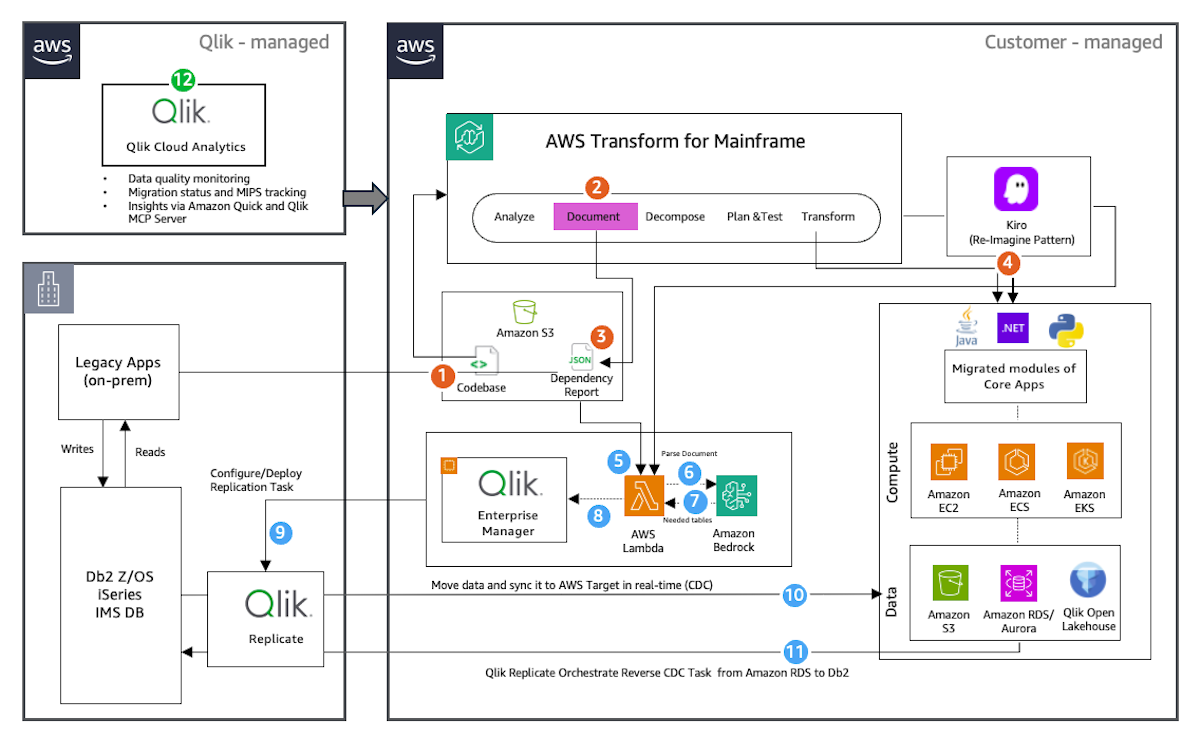
Figure 1: shows the numbered path that traces the migration wave end to end, from mainframe code analysis through data replication to analytics.
Architectural deep dive
Application modernization with AWS Transform and Kiro
The process follows two phases; numbers in parentheses map to the reference architecture diagram’s steps.
Reverse engineering (understand the application): Mainframe source code (COBOL, PL/I, JCL, copybooks) is uploaded to Amazon S3 (1), where AWS Transform agents analyze the codebase to identify program structures, business logic, data flows, and inter-module dependencies (2). The output includes a JSON dependency report, data lineage showing which programs read from and write to each Db2 table, and PDF technical documentation (3).
Forward engineering (build the services): AWS Transform generates microservice specifications based on the decomposition analysis, and Kiro turns these into deployable cloud-native code (4). Developers then review, refine, and deploy the generated services iteratively.
The integration point for data modernization is the Db2 dependency report, a structured output that identifies which tables must be replicated to support each modernized module. This report feeds into the data modernization pipeline to support module-aligned data replication.
Data modernization with Qlik Data Integration
Using the technical documentation of AWS Transform and dependency mapping, teams orchestrate replication programmatically, so it aligns with application migration waves.
Orchestration (AWS Lambda and Amazon Bedrock): An AWS Lambda function reads the Db2 dependency report and triggers the workflow (5). The mappings then pass to Amazon Bedrock (6), which converts them into Qlik Enterprise Manager API payloads, provisioning each wave’s data requirements without manual configuration (7).
Replication (Qlik Enterprise Manager and Qlik Replicate): AWS Lambda invokes Qlik Enterprise Manager APIs (8) to clone a template replication task (9), targeting the Db2 tables from the dependency report. Qlik Replicate then runs a full load from Db2 to Amazon RDS (10), then uses CDC to keep the target synchronized at low latency, applying in-table transformations, column selection, row filtering, and data masking without affecting the source. During coexistence, reverse CDC syncs Amazon RDS changes back to Db2 (11).
Analytics and AI with Qlik Cloud Analytics and Amazon Quick
Monitoring modernization progress
Tracking a modernization program’s health and progress supports risk management, resource allocation, and stakeholder communication. Qlik Cloud Analytics and Amazon Quick report on the state of the migration.
Qlik Trust Score and Data Products
Qlik Data Products are governed data packages that combine replicated mainframe data with quality metrics, lineage tracking, and access controls. Each Data Product carries a Trust Score, a single metric combining completeness, accuracy, validity, and diversity into a trustworthy score. Stakeholders can track data quality at each step of the migration journey.
Qlik Cloud Analytics
Qlik Cloud Analytics combines telemetry from Qlik Enterprise Manager, AWS Transform, and the application layer into a single view (12):
- Migration progress: Modules migrated versus forecast and wave completion status.
- Velocity: Tables replicated per sprint and CDC latency trends.
- Wave breakdown: Current wave composition, dependencies, and risk distribution.
- Data quality: Trust Scores across replicated datasets and anomaly detection.
Qlik Answers / Qlik MCP Server with Amazon Quick
These insights can also be consumed through an agentic experience using either Qlik Answers, Qlik’s integrated agentic assistant, or Amazon Quick. Amazon Quick connects to the Qlik MCP Server to run natural-language queries against live migration data. Stakeholders can ask questions such as “How many modules are left in Wave 3?” or “What is the current CDC latency for the customer accounts table?” These queries return live answers and insights powered by the Qlik Analytics Engine.
Representative scenario: a global asset management profile
This illustrative scenario describes a global asset management firm running core record-keeping and transaction processing on IBM Db2 z/OS. Taking a data-first approach, the firm uses Qlik Replicate’s log-based CDC to stream mainframe changes into AWS ahead of any application rewrite. Qlik Replicate runs securely within the customer’s AWS environment, connecting to the on-premises mainframe over a private, encrypted network link with centrally managed credentials. ‘
Representative outcomes after standing up the initial data layer:
- Improved cost efficiency by offloading reporting and downstream extract workloads that previously ran as nightly batch jobs against Db2.
- Sustained throughput in the millions of rows/hour range, feeding operational data stores and the analytics data lake for near-real-time visibility without querying the mainframe.
- No data loss during coexistence.
- Near-real-time visibility through live dashboards tracking replication health and data quality, replacing manual, point-in-time status reporting.
Conclusion
Mainframe modernization does not have to be all-or-nothing. Organizations can combine data modernization through log-based CDC with an agentic approach to application modernization. This lets them modernize incrementally, migrating related functionality in dependency-ordered stages while maintaining operational continuity.
Next Steps:
- Explore Qlik Data Integration on AWS Marketplace
- Explore Qlik MCP Server on AWS Marketplace
- Learn more about AWS Transform for mainframe
- Learn more about mainframe modernization through the self-paced demo

Partner Spotlight: Qlik
Qlik is an AWS Technology Partner with Agentic AI, Generative AI, Data, and Migration & Modernization Competencies. With Qlik, you can bring proven, real-time data movement to modernization programs – from mainframes, databases, and applications to AWS. Serving more than 30,000 customers worldwide, Qlik delivers trusted data and analytics so organizations can move from data to insight to action.