AWS Partner Network (APN) Blog
How OceanBase unifies transactions analytics and AI on AWS
By: Ye Dai, Ecosystem Solutions Architect – OceanBase
By: Haibo Huang, Senior Partner Solutions Architect – AWS
 |
| OceanBase |
 |
Modern data architectures often rely on separate databases for transactions, analytics, and AI, leading to extract, transform, and load (ETL) latency; data inconsistency; and rising costs. OceanBase addresses these challenges with a unified multimodel architecture that converges online transaction processing (OLTP), online analytical processing (OLAP), and vector retrieval within a single engine on Amazon Web Services (AWS).
By eliminating data movement between systems, enterprises can reduce operational complexity, lower total cost of ownership (TCO), and provide real-time data fresh for AI applications. Integrated with AWS services such as Amazon Elastic Compute Cloud (Amazon EC2), Amazon Bedrock, and AWS Key Management Service (AWS KMS), OceanBase delivers a streamlined, more secure, high-performance data foundation for intelligent workloads.
Modern data architectures such as OceanBase are redefining how organizations handle the tension between real-time transactions and analytics. Traditional ETL-dependent systems require data teams to wait hours for ETL pipelines to complete before AI applications can access transactional data from minutes ago, undermining your intelligence transformation progress.
At the time of writing, many enterprises use MySQL for transactions, a data warehouse for analytics, and a separate vector database for AI retrieval, which is regarded as a type of federated architecture. This federated architecture addresses individual use cases, but it also introduces challenges, such as difficulties in maintaining data consistency, high operational complexity, significant ETL latency, and rising TCO.
This post explains how to use the built-in capabilities of OceanBase on AWS to build a unified data foundation by converging online transaction processing (OLTP), real-time analytics (OLAP), and multimodal retrieval within a single system. This approach supports enterprises in streamlining their cloud architecture, alleviating cumbersome ETL processes, and providing a consistent real-time data foundation for AI applications.
Industry pain points: Why traditional heterogeneous architectures struggle in the AI era
Enterprises typically adopt a dedicated database per workload strategy in early stages, using separate databases for transactional, analytical, and AI workloads. However, as digitalization advances and intelligence requirements deepen, organizations encounter new challenges, such as:
Operational complexity and technology stack redundancy
Managing multiple database technology stacks in the cloud requires enterprises to master diverse technologies. This can cause increasing operational costs and architectural adaptation challenges.
Data consistency and latency issues
Relying on ETL/ELT tools to transform data among services not only creates storage redundancy, but also inevitably introduces synchronization delays. Such a data gap can significantly impact real-time risk control and personalized recommendation scenarios, which require millisecond-level responses.
High overall TCO
Multiple database license fees, storage overhead fees, network traffic expenses from data migration, and ongoing development and maintenance expenses combine to continuously drive up total costs.
Lack of a real-time data foundation for AI
AI scenarios such as large language models (LLMs) and intelligent recommendations require low-latency, high-quality unified data sources. The real-time context retrieval required by agent applications is extremely difficult to achieve. In heterogeneous architectures, data is scattered across different systems, making processing pipelines lengthy and complex.
The solution: OceanBase’s unified multimodel architecture on AWS
OceanBase takes a different approach with its built-in unified multimodel architecture. Rather than stitching together multiple databases through middleware integration, the approach provided by OceanBase fuses transaction processing, analytical processing, and intelligent processing capabilities into a single system at the kernel level. Through a unified storage engine, query optimizer, and execution framework, it achieves efficient coordination of different workload types.
-
- A single engine for multi-workload collaboration – A single database engine simultaneously supports transaction processing, real-time analytics, and AI real-time workloads. After business data is written, it immediately enters the analysis and AI retrieval pipeline, meeting the stringent data freshness requirements of agent and real-time decision-making scenarios.
- Built-in multimodal engine – OceanBase supports unified storage of structured, semi-structured, and vector data, and allows direct invocation of built-in model capabilities such as embedding generation, reranking, and text summarization within SQL. This means developers can perform AI computation preprocessing without moving data out of the database. By integrating with the foundation model (FM) capabilities of Amazon Bedrock, OceanBase can directly provide high-quality context retrieval for generative AI applications, building an end-to-end closed loop from data to inference.
- AI-based hybrid search – OceanBase implements Hybrid Search, supporting combined queries of vector similarity, full-text relevance, and structured filtering conditions. It supports transactional consistency while delivering millisecond-level recall for large-scale vector data. This capability complements Amazon OpenSearch Serverless. OceanBase serves as the core data engine, handling both transactional consistency and vector retrieval, while Amazon OpenSearch Serverless can take on larger-scale unstructured log analytics scenarios, giving enterprises flexible data stack choices.
The following figure compares a traditional federated database architecture with OceanBase’s unified approach, showing how consolidating multiple database engines into a single solution reduces complexity and cost:
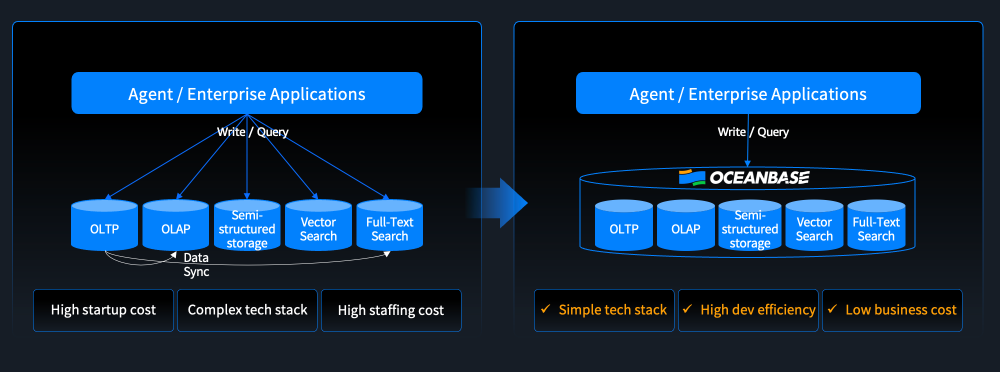
Figure 1: Traditional federated architecture compared to OceanBase unified multimodel architecture
Deeply integrated with AWS Cloud infrastructure, this solution builds a high-performance, highly elastic, more secure unified data foundation.
- High performance – Deploy OceanBase on Amazon EC2 memory-optimized instances, fully using OceanBase’s optimizations for in-memory computing and massive parallel processing to achieve high-throughput, low-latency handling of transactional and analytical workloads.
- Data security – OceanBase uses AWS PrivateLink to establish dedicated connections and integrates with AWS KMS to facilitate more secure control and management of key lifecycles and permissions to safeguard customer data.
The following figure shows the deployment architecture of OceanBase on AWS, illustrating how customer applications connect to OceanBase clusters through AWS PrivateLink, with multi-Availability Zone (AZ) distribution for high availability and integration with AWS services for security, storage, and AI capabilities:
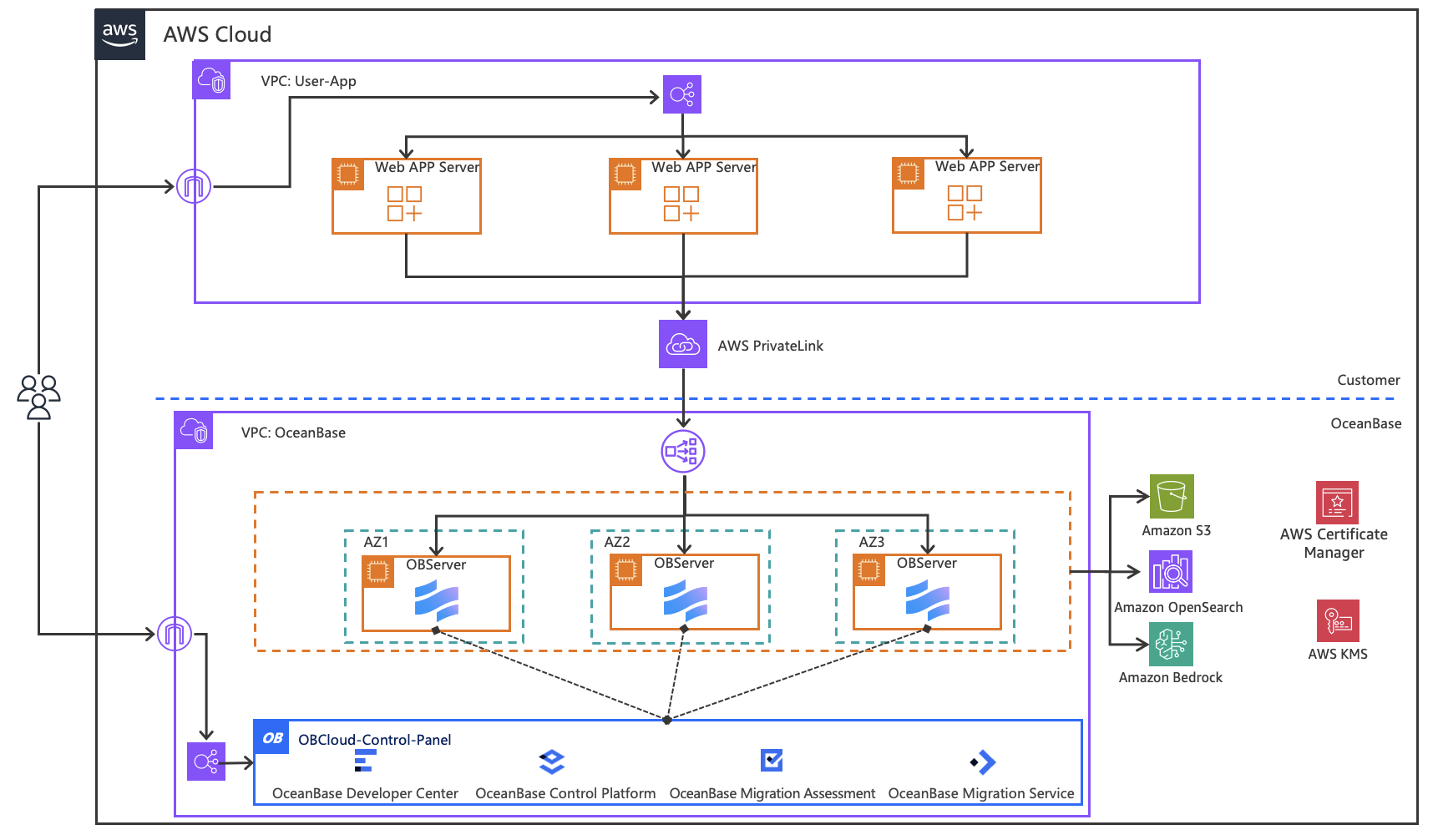
Figure 2: OceanBase multi-AZ deployment architecture on AWS with integrated cloud services
Customer value: From architecture streamlining to business acceleration
By avoiding data silos through unification, OceanBase enables transactional data to be instantly transformed into analytical insights, which in turn drive business value through AI applications. If customers adopt OceanBase’s unified multimodel architecture on AWS, they could realize the following benefits:
- Cost reduction and efficiency gains – Consolidating multiple databases into a single system reduces operational complexity, infrastructure costs, and maintenance overhead. Organizations typically see improvements in resource utilization and IT team productivity after architecture streamlining.
- Accelerated AI innovation – By avoiding data movement, the latency from data generation to AI-ready inference drops from hours to seconds. One retail customer significantly shortened the development cycle for its real-time recommendation feature by 30% after adopting OceanBase’s unified architecture.
- Enhanced decision agility – The fusion of real-time analytics and intelligent decision-making means businesses can make accurate judgments based on the latest data rather than relying on outdated reports.
Conclusion
Facing an AI-driven future, the streamlined and real-time nature of data architecture becomes a core competitive advantage. A deeply integrated unified data architecture is one of the most optimal technological paths to tackle multimodal data processing challenges and adapt to business intelligence upgrades.
As a member of the AWS Partner Network (APN), OceanBase provides unified capabilities on AWS that converge OLTP, OLAP, vector retrieval, and full-text search so enterprises can support both mission-critical business transactions and advanced intelligent applications with a single system.
If you’re evaluating a database architecture upgrade on the cloud and seeking to build a unified real-time data foundation for your AI applications, you can get started by visiting OceanBase in AWS Marketplace to experience the streamlined efficiency of the unified architecture approach. You can also contact the OceanBase technical team to obtain reference architecture design consultations tailored to your business scenarios.

OceanBase – AWS Partner Spotlight
OceanBase is an AWS Advanced Technology Partner with the AWS Data Analytics Competency. As a unified distributed database built for the AI era, it powers demanding workloads across financial services, ecommerce, and telecommunications, delivering the real-time consistency and scale required by mission-critical applications. With OceanBase, organizations can build a resilient, scalable data foundation that unifies OLTP, OLAP, and AI workloads, avoiding data silos while maintaining consistency and performance as demands grow.