AWS Architecture Blog
AI-powered clinical trial eligibility and safety using Amazon Bedrock AgentCore
AI agents built on Amazon Bedrock AgentCore let clinical trial teams make fast, accurate enrollment decisions while keeping clinicians in control through human-in-the-loop oversight. According to the Tufts Center for the Study of Drug Development, 80 percent of clinical trials miss their enrollment timelines, and each day of delay costs an estimated $500,000.
Today, eligibility decisions rely on manual chart review across fragmented sources — EHR notes, lab results, imaging reports, and medication histories. Study teams spend hours reconstructing each candidate’s history and mapping it to protocol criteria. As protocols grow more complex, this doesn’t scale: screen failure rates stay high and enrollment targets slip.
We show how to architect a Clinical Trial Eligibility and Safety Agent on AWS that assembles patient evidence, evaluates it against protocol criteria, and presents screening recommendations with citations, while clinicians retain final authority and full audit trails. It combines AWS HealthLake for FHIR-native data access, Amazon Bedrock AgentCore for multi-step reasoning, and Amazon Bedrock AgentCore Evaluations for scoring each decision via LLM-as-a-judge and human-in-the-loop. This post is for solution architects, engineering teams, and technology leaders applying AI to clinical trial operations on AWS.
AI agents for clinical trial screening
AI agents with Human-in-the-Loop (HIL) are well-suited for clinical trial eligibility and safety decisions because they address information fragmentation while preserving human clinical judgment. The core problem isn’t a lack of data, but that eligibility and safety signals are scattered across EHR notes, lab portals, imaging reports, and medication histories, forcing study teams to reconstruct each participant’s clinical picture. A knowledge graph addresses this by storing clinical data as entities and the relationships between them, representing each patient, molecule, endpoint, and market as a node with relationships stored as edges. To answer an eligibility or safety question, the agent traverses these edges, going from a diagnosis to its associated labs or a medication to its known interactions, rather than re-querying and joining disconnected sources each time. This structure supports the agent’s preparatory work:
- Organizing evidence from fragmented sources into a knowledge graph, linking patients, molecules, endpoints, and markets as interconnected nodes.
- Mapping patient information against protocol criteria.
- Surfacing relevant passages with citations for clinician review.
- Highlighting uncertainties that require human judgment.
Critically, the clinician remains the decision-maker. The agent organizes the supporting information. These systems augment rather than replace clinical reasoning — proposing preliminary assessments, flagging edge cases, providing confidence scores, and learning from feedback.
As protocols grow more complex with precision oncology and biomarker-driven eligibility, agents manage multi-step logic and maintain consistency across sites, while deferring final judgment to clinical staff.
Architecture overview
This proposed architecture illustrates how core AWS services can be combined to create an end-to-end clinical trial screening pipeline. AWS HealthLake serves as the FHIR-native clinical data foundation, ingesting and normalizing patient records from disparate EHR systems, lab portals, and imaging archives into a unified, queryable data store. Amazon Bedrock AgentCore orchestrates the multi-step workflow assembling patient profiles, matching them against trial protocols, detecting safety signals, and generating evidence-backed screening recommendations. An Amazon Bedrock Knowledge Bases stores trial protocols, inclusion/exclusion criteria, and safety guidelines. The entire pipeline feeds into a clinician review dashboard where investigators examine agent reasoning, verify citations, and render final decisions. Actions are captured in an immutable audit trail for regulatory compliance.
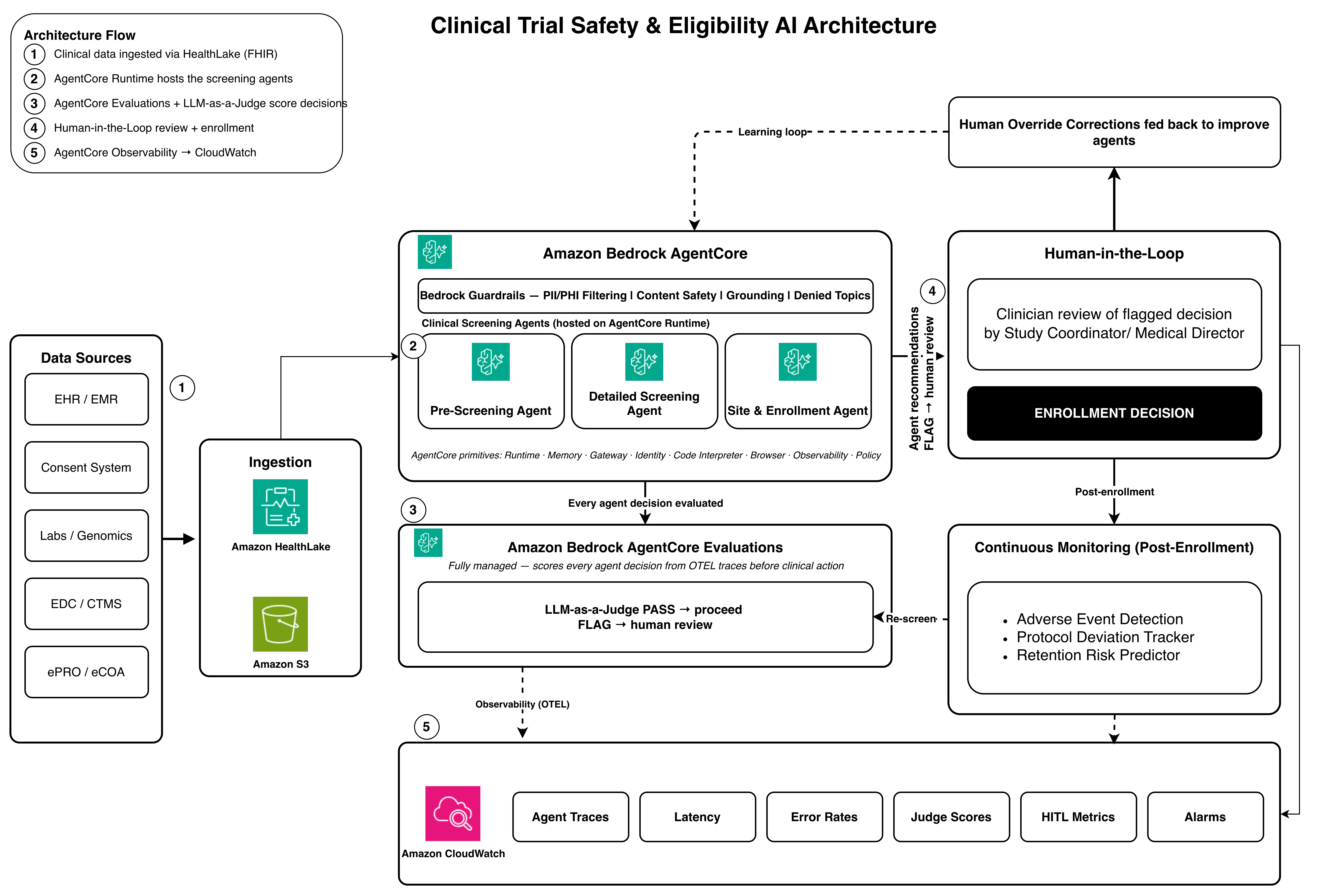
Architecture workflow
The screening pipeline operates in the following steps. Each step maps to a distinct phase of the eligibility and safety assessment, from data ingestion through clinician review and continuous monitoring.
Step 1: Clinical data ingestion
AWS HealthLake ingests patient records from EHR systems, lab portals, imaging reports, and medication histories, then normalizes them into FHIR R4 resources for standardized, queryable access.
Step 2: Agent orchestration
Amazon Bedrock AgentCore orchestrates three specialized agents, each scoped to a distinct phase of the screening pipeline. They operate within the Amazon Bedrock AgentCore Runtime, which connects to tools through MCP Gateway, maintains session memory so agents reference earlier findings without re-querying, and enforces identity-based access control for least-privilege data access. A built-in code interpreter handles dynamic calculations such as eGFR or BMI derivation.
Pre-screening agent: The first gate. It resolves three threshold questions: Is the patient’s informed consent valid and current? Does their high-level profile (age, diagnosis category, geography) align with basic enrollment parameters? Have they completed any required washout period? Patients who clear all three advance. Those who don’t receive a documented rejection citing the failing criterion.
Detailed screening agent: The core clinical reasoning engine. It walks through all inclusion and exclusion criteria, retrieving the relevant FHIR resources — Observation for labs, Condition for diagnoses, MedicationStatement for medications — and evaluating each against the protocol threshold. It also reviews organ function, adverse drug reactions, and contraindicated conditions, cross-references medications against the investigational product for interactions, and assesses the overall comorbidity profile for risk combinations no single criterion would catch. The output is a structured determination (Eligible, Ineligible, or Requires Review) with a per-criterion evidence matrix, confidence scores, and a reasoning summary citing source records.
Site & enrollment agent: Once a patient clears screening, it handles operational logistics — matching the patient to the most appropriate site by proximity, capabilities, and investigator availability, then confirming open enrollment capacity. If the preferred site is full, it identifies alternatives and flags the study coordinator.
All three agents operate behind Amazon Bedrock Guardrails, which enforce:
- PII/PHI filtering to protect patient health information.
- Content safety controls to help prevent clinically inappropriate outputs.
- Grounding checks to keep responses anchored in retrieved evidence rather than model parametric knowledge.
- Denied topic boundaries to keep agents within their screening scope.
Step 3: LLM-as-judge evaluation
Amazon Bedrock AgentCore Evaluations scores every screening decision using a combination of built-in and custom evaluators across three dimensions:
- Clinical accuracy: Correctness of the eligibility determination against patient data, faithfulness to source evidence (not hallucinated justifications), logical coherence across reasoning steps, and context relevance confirming the right protocol and patient records were retrieved.
- Operational effectiveness: Response completeness and clarity for coordinators reviewing dozens of patients daily, appropriate use of FHIR queries and knowledge base tools, and end-to-end goal success (did the agent complete the full screening workflow?).
- Safety compliance: Custom evaluators verify that safety-critical criteria (lab thresholds, restricted medications, contraindicated conditions) were never skipped, that uncertainties are explicitly acknowledged rather than resolved with false confidence, and that all safety flags route to the appropriate review tier.
Decisions that pass evaluation with high confidence proceed to the clinician dashboard. The system flags those that fall below quality thresholds and routes them to human review with the specific evaluation concern highlighted.
Step 4: Human-in-the-loop review and enrollment
Flagged cases and agent recommendations flow into a tiered clinical review structure:
- PI review queue: Principal Investigators review flagged decisions from the LLM Judge, examining the agent’s reasoning chain, verifying citations against source records, and rendering a final determination.
- Study coordinator dashboard: Coordinators manage trial logistics, scheduling, and the day-to-day enrollment pipeline, using the agent’s structured outputs to accelerate their workflow.
- Patient communication: Outreach and consent updates are coordinated through the dashboard, keeping patients informed of their screening status.
- Escalation to medical director: Complex or high-risk cases that exceed the PI’s comfort level are escalated to the Medical Director for final adjudication.
Clinicians retain complete override capability at every stage. When a clinician overrides an agent recommendation, approving a patient the agent flagged or rejecting one it cleared, the system captures the corrected decision and the clinician’s reasoning. These corrections expand the ground truth dataset used by Amazon Bedrock AgentCore Evaluations and surface patterns that inform prompt and retrieval tuning, creating a continuous learning loop where human judgment directly improves agent performance over time.
Step 5: Observability and continuous monitoring
Amazon CloudWatch provides end-to-end observability across all agents, surfacing agent traces (step-by-step execution logs), latency metrics, error rates (failed tool calls, guardrail blocks), judge scores (pass/flag rates per agent), HITL metrics (override rates, review latency), and alarm-based escalation when safety thresholds are breached.
Although the current implementation focuses on screening and enrollment, the same agent orchestration framework, evaluation pipeline, and compliance infrastructure support future post-enrollment monitoring agents such as adverse event detection from lab results and clinical notes, protocol deviation tracking, retention risk prediction, and re-screening triggers when clinical changes affect ongoing eligibility. Each inherits the existing scoring, logging, and auditability without requiring a separate governance framework.
Evaluating agent performance in clinical trial screening with human oversight
The screening pipeline’s credibility rests on two layers: an automated evaluation layer that scores every decision, and a human-in-the-loop (HITL) layer that gives clinicians final authority. LLM-as-Judge (Step 3) decides which cases clinicians see and how they’re prioritized. The HITL workflow (Step 4) decides how clinicians act. Together they form a continuous loop where human judgment both safeguards and improves agent performance. Using Amazon Bedrock AgentCore Evaluations, you build a framework spanning three dimensions: clinical accuracy, operational effectiveness, and safety compliance with built-in and custom evaluators that run continuously.
Clinical accuracy and reasoning
Built-in evaluators check whether the agent gets the determination right and whether its reasoning holds up: Correctness (accurate against the patient’s labs, diagnoses, and medications), Faithfulness (reasoning stays grounded in patient data and protocol, not plausible-sounding invention), Coherence (no logical contradictions across steps), Context relevance (the right protocol and records were retrieved), and Goal success rate (the full workflow ran end to end). Custom LLM-as-Judge evaluators add clinical specifics: Eligibility accuracy (each inclusion/exclusion criterion evaluated correctly) and Criteria coverage (no criteria skipped, especially safety-critical lab thresholds and restricted medications).
Operational effectiveness
Accuracy alone is insufficient, output must fit workflows where coordinators review dozens of patients daily. Helpfulness, conciseness, and relevance confirm a clear, scannable, on-topic determination. Instruction following verifies the expected structured format (patient summary, criteria checklist, determination, justification, safety flags, next steps). Tool selection and parameter accuracy check the agent invoked the right tools with correct inputs.
Safety and responsible behavior
Safety carries the strictest thresholds. Harmfulness detection flags clinically dangerous content; Stereotyping detection makes sure decisions aren’t influenced by demographics beyond protocol requirements. Both trigger immediate review. Custom evaluators target the highest-risk failures: Safety flag detection confirms every significant concern surfaced (contraindicated medications, out-of-range labs, disqualifying conditions, drug interactions), with a single miss treated as critical; Uncertainty acknowledgment makes sure the agent recommends human review on missing or ambiguous data rather than making an overconfident call.
The human-in-the-loop safeguard
When a wrong eligibility call can affect patient safety, human judgment is the final safeguard. A score below threshold routes the case to the HITL workflow.
The three agents together produce an eligibility determination with a confidence score. At trial onset, the clinician sets a confidence threshold. Cases below it or flagged by evaluation reach the clinician dashboard with the specific concern highlighted. Clinicians review the full reasoning and approve, reject, or request more information from the same interface. Their corrections are stored alongside machine-approved records, feeding back into future determinations and continuously improving accuracy.
Review and approval workflow
Review is tiered by complexity: automated pre-screening filters clearly ineligible candidates. Low-complexity cases get expedited review, medium-complexity follow standard protocols, and high-complexity edge cases escalate to senior clinicians. Cases unreviewed beyond set timeframes escalate automatically. Final enrollment decisions, low-confidence cases, experimental therapies, and complex histories require human approval. Routine high-confidence checks proceed automatically.
Audit trails
The system generates immutable audit records in Amazon DynamoDB for every decision, capturing clinician ID, timestamp, patient and trial IDs, outcomes, AI recommendations, and complete workflow execution history. These records are designed to support FDA 21 CFR Part 11 requirements for electronic records and signatures, providing documentation for regulatory inspections and quality assurance. Readers should consult their compliance team and conduct their own assessment. See the AWS compliance resources for further guidance.
Security and compliance
Clinical trial data is among the most sensitive in healthcare. HIPAA, FDA 21 CFR Part 11, GxP, and GDPR require strict controls over how patient data is stored, accessed, and processed, and AI agents reasoning over that data introduce new security considerations. This solution protects data at every layer while maintaining the audit trails and privacy standards regulators require.
AWS HealthLake is HIPAA-eligible with encryption at rest and in transit, access controls, and SMART on FHIR authorization. Amazon Bedrock is HIPAA-eligible, SOC 2 attested, ISO and CSA STAR Level 2 certified, and never shares customer data with model providers. AWS PrivateLink keeps traffic off the public internet.
Amazon Bedrock AgentCore enforces agent boundaries at runtime through declarative authorization policies — readable, deterministic rules, outside application code, defining what the agent can access, invoke, and retrieve. AgentCore runs within your Amazon Virtual Private Cloud (Amazon VPC) for network isolation, and AWS CloudTrail records API calls for an immutable audit trail that can support FDA compliance requirements.
Amazon Bedrock AgentCore Evaluations scores each decision using built-in and custom evaluators with an LLM-as-a-Judge approach. Continuous sampling detects drift, and Amazon CloudWatch alerts teams when quality drops below thresholds — ongoing evidence the agent performs within validated parameters, supporting GxP with minimal manual testing.
Conclusion
In this post, we showed how combining the FHIR-native data foundation of AWS HealthLake
with the multi-step reasoning capabilities of Amazon Bedrock AgentCore turns manual,
fragmented clinical trial screening into an AI-assisted workflow that reduces patient matching
time from days to minutes. Clinical trial enrollment remains one of drug development’s most
resource-intensive bottlenecks, and delayed starts carry heavy financial consequences from lost
patent-protected sell time and operational burn. Clinicians receive organized evidence,
transparent reasoning, and actionable recommendations while retaining full decision authority
and audit traceability.
The impact extends beyond speed: more consistent criteria interpretation across sites, earlier
detection of safety contraindications, and lower screen failure rates. As oncology trial eligibility
criteria grow in complexity — with fewer than 5% of cancer patients enrolling under strict
requirements — this human-in-the-loop approach offers a scalable, compliance-aligned path to
faster, higher-quality recruitment.
Call to action
Ready to accelerate your clinical trial operations? Take the next step:
- Schedule a 30-minute architecture review with our Healthcare and Life Sciences Applied
AI specialists to see how Amazon Bedrock AgentCore fits your trial portfolio. - Join other life sciences organizations already transforming enrollment workflows with
AWS. Contact us today to begin your journey toward faster, safer, and more efficient
clinical trials. - To dive deeper and start building your own solution, explore the following resources:
- Improving patient pre-screening for clinical trials with generative AI on AWS.
- Use generative AI on AWS for efficient clinical document analysis.
- Orchestrating clinical generative AI workflows using AWS Step Functions.
- Accelerating life sciences innovation with agentic AI on AWS.
- Clinical development solutions on AWS