AWS for Industries
Accelerating Autonomous Network Optimization : Agentic rApp as a Service Powered by AWS and Ericsson Intelligent Automation Platform
Ericsson rApp as a Service – Redefining Network Optimization with Agentic AI
The future of telecom networks is autonomous, intelligent, and cloud driven. Ericsson and AWS are taking a significant leap forward by introducing Ericsson rApp as a Service (rApp aaS), a pioneering solution designed to accelerate the journey towards autonomous networks for Communication Service Providers (CSPs). A Software as a Service (SaaS) solution, hosted on AWS and available via AWS Marketplace, rApp aaS leverages advanced Agentic AI to deliver seamless RAN automation, network operations, and optimization at scale.
Despite rapid technological advancements, Communication Service Providers (CSPs) continue to face significant pain points as they strive to modernize and optimize their networks. Key challenges include the growing complexity of managing multi-technology (5G and striving towards 6G) and multi-service (Mobile Broadband, Voice, Fixed Wireless Access, Ultra-Reliable Low-Latency Communication, Network slicing and more) environments, increasing operational costs due to manual interventions, and the difficulty of scaling network operations to meet surging data demands. CSPs are also under pressure to accelerate time-to-market for new services while ensuring high reliability, security, and quality of experience for subscribers. Additionally, legacy systems, such as Self-Organizing Network (SON), often hinder the adoption of AI-driven automation and cloud-native architectures, making it difficult to realize the full potential of digital transformation. These pain points underscore the urgent need for innovative, automated solutions like rApp as a Service, which are designed to alleviate operational burdens and empower CSPs to deliver agile, future-ready networks.
Open RAN has introduced the idea of Radio Access Network (RAN) automation applications, called rApps. These are software tools designed to run on the Non-Real Time RAN Intelligent Controller (Non-RT RIC), allowing automated management and optimization of RAN scenarios with control loops that operate on time scales of one second or longer. Ericsson broadens the definition of rApps by including purpose-built RAN, beyond what ORAN specifies.
Ericsson implements the Non-Real Time RIC with its Ericsson Intelligent Automation Platform (EIAP). The EIAP offers a Software Development Kit (SDK) that allows third-party Independent Software Vendors (ISVs), CSPs, and Ericsson’s own rApps and rApp as a Service developers create centralized RAN automation solutions. It uses the ORAN O1 interface to simplify Fault, Configuration, Accounting, Performance, and Security (FCAPS) management for the RAN, while the R1 interface provides access to RAN data for rApps.
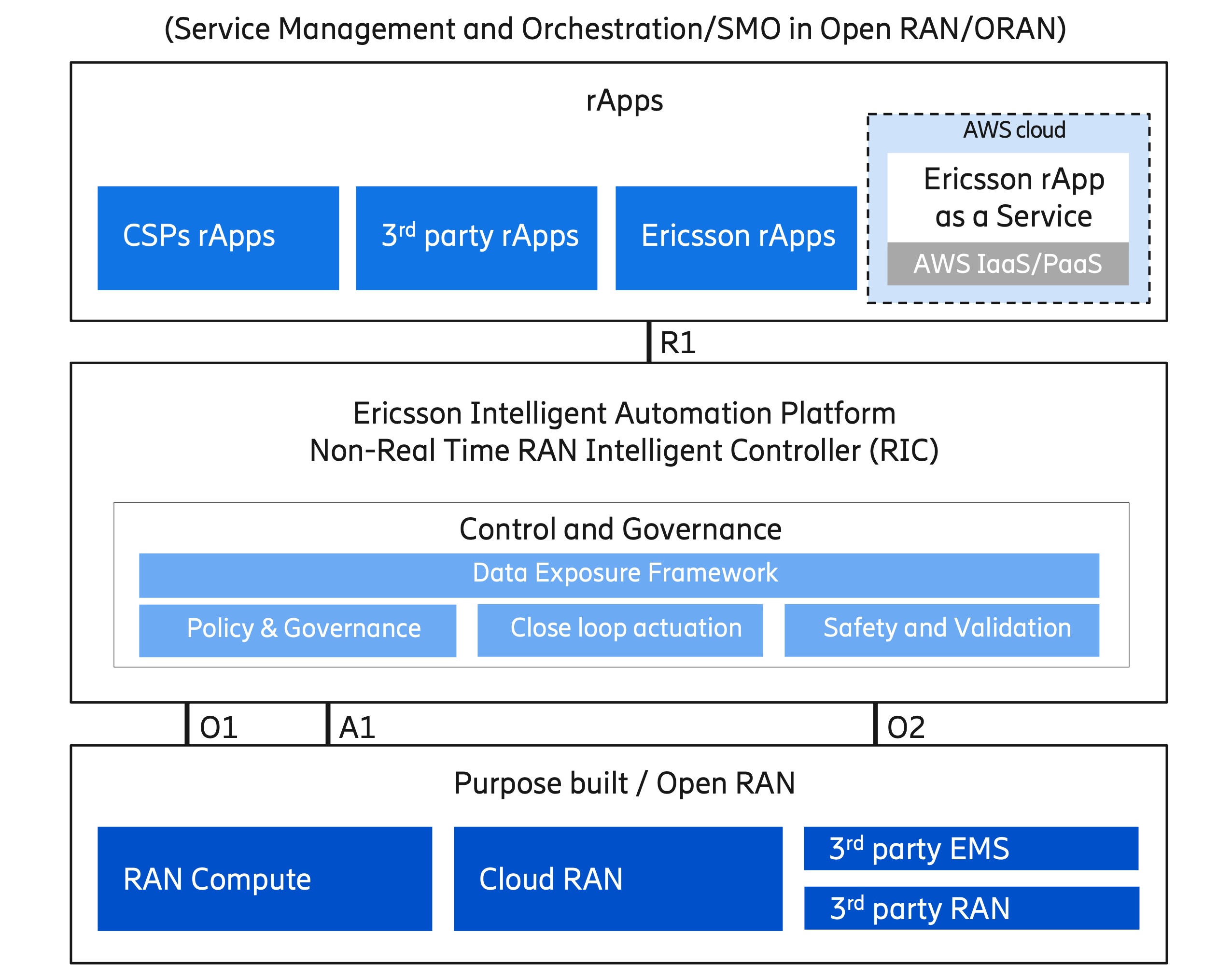
Figure 1. Leading towards open network management with EIAP and rApps
Ericsson’s proven expertise and cognitive software experience, now enhanced through AWS’s scalable services with network optimization for more than 13 million sites globally, serving over 2 billion subscribers and generating over 100 million daily AI inferences. It delivers through rApp aaS, which includes AI-powered network optimization capabilities such as Cell and Uplink Anomaly Detection, root-cause analysis, cell shaping, and interference optimization, all orchestrated to deliver rapid issue resolution based on 98% field validated accuracy with 54% faster cell issue resolution and 75% time and effort reduction during network optimization, 43% improved downlink throughput in cells with issues, and enhanced network efficiency through 4% spectral efficiencies gains. Explore more in Ericsson Cognitive Technology and Ericsson Intelligent automation with rApps.
With rApp aaS, CSPs benefit from on-demand scalability, rapid deployment, and operational efficiency. The agentic AI system brings a new level of automation: natural language interactions and intent-based workflows make complex optimization accessible to engineering teams. This means faster time-to-market, reduced operational overhead, and the ability to focus on strategic improvements, all supported by continuous software updates and professional services managed by Ericsson. The result is a future-ready network that is more agile, reliable, and capable of supporting new use cases as 5G and 6G evolve.
What sets rApp aaS apart is its agent-based architecture, where AI-powered rApp as a Service act as specialized AI agents coordinated by a supervisor agent and integrated to Ericsson Intelligent Automation Platform (EIAP), ORAN based SMO (Service Management Orchestrator) through R1 standardized interface. This framework enables the system to measure, assure, propose, evaluate and actuate to for network optimization, generating insights, making decisions and recommending actions without human intervention.
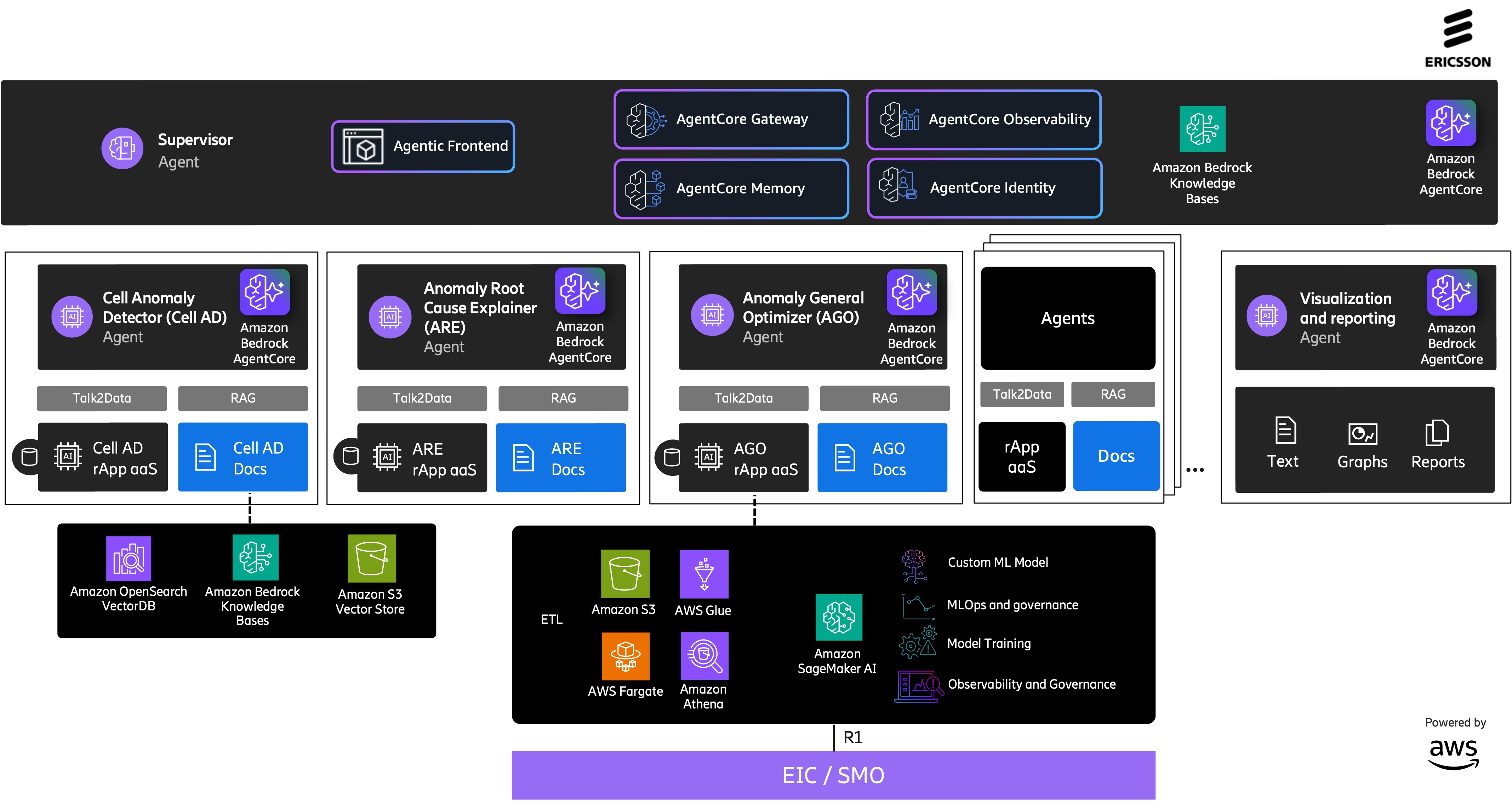
Figure 2. Agentic rApp aaS
rApp aaS leverages a comprehensive suite of AWS services to deliver scalable, secure, and cost-effective network optimization. At its core, the platform utilizes serverless compute services including Amazon ECS on AWS Fargate for containerized workload orchestration, AWS Glue for data integration and ETL processing, Amazon Athena for interactive analytics on network telemetry data, and AWS Lambda for event-driven automation. The ML lifecycle is supported end-to-end through Amazon SageMaker AI, enabling model training, deployment, and inference at scale to power the AI-driven network optimization capabilities. The agentic AI layer, which enables natural language interactions and intent-based workflows relies on Amazon Bedrock’s agent capabilities, allowing specialized AI agents to coordinate for autonomous network operations. The solution is architected as a multi-tenant SaaS platform, delivering robust tenant isolation and streamlined operations that enable Ericsson to efficiently serve multiple CSPs while maintaining security, compliance, and operational excellence at scale.
rApp aaS is available through AWS Marketplace as a SaaS offering, enabling CSPs to discover, subscribe, and deploy the solution with simplified procurement and billing. Deployment is streamlined, triggering the provisioning process of the application plane infrastructure, with tenant isolation and security boundaries.
Ericsson – AWS: AI-Powered Transformation for Data-Driven Architecture with EIAP and rApp aaS
CSPs’ data and AI strategy is often integrated within overarching horizontal programs that span multiple CSP domains, such as BSS and Networks. Consequently, these strategies are typically addressed not only within AIOps for Networks use cases but also across various organizational functions. Fundamentally, CSPs’ data and AI strategies tend to exhibit characteristics of being multi-layered, multi-domain, multi-vendor, and multi-cloud.
Beyond the launch of Ericsson rApp aaS, the strategic collaboration between AWS and Ericsson enables CSPs to realize the full potential of their data and AI investments. The joint proposition centers on integrating Ericsson rApp aaS with CSPs’ existing or planned AWS-based data architectures, while ensuring seamless and agile interoperability with ORAN SMO, ingesting RAN data with core network and transport data in the future.
With the solution blueprint, CSPs with existing AI and data strategies on AWS or other cloud could integrate EIAP. Integrating market-leading rApps optimization workflows into existing AI strategy becomes much simpler with rApp aaS on AWS.
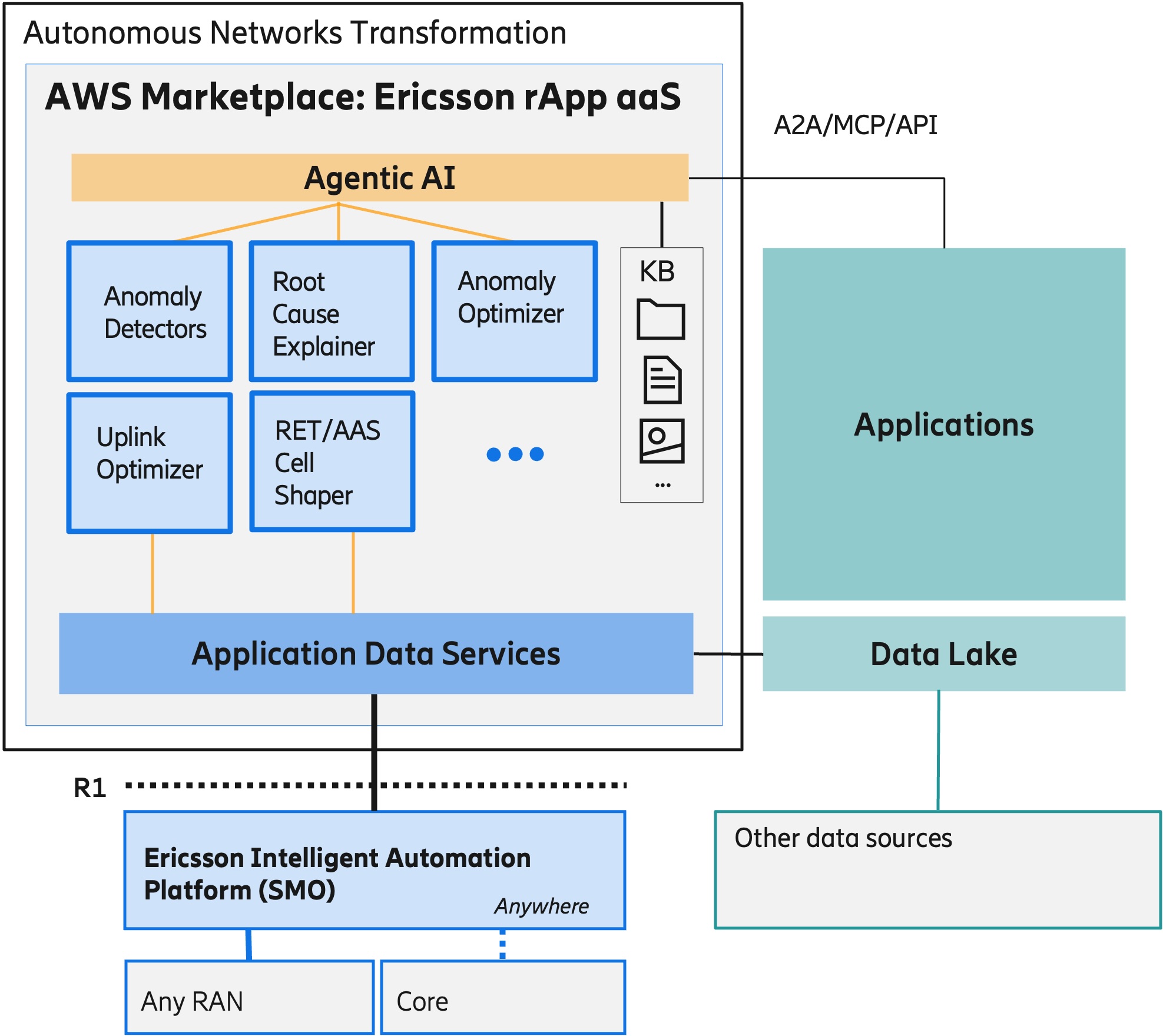
Figure 3. Solution Blueprint Ericsson and AWS – Leading CSPs’ Data/AI transformation on Network Operation and Optimization
CSPs are given flexibilities to adapt their strategies depending on the actual business needs. There are three potential scenarios:
- Integrate ORAN O1 and R1 interfaces into CSPs’ Data and AI solutions to automate networks at scale using diverse data sources, while leveraging Ericsson rApp as a Service for optimized RAN operations with Ericsson’s expertise. rApp aaS and CSPs use cases might be empowered to actuate actions to RAN through EIAP, with or without human supervision with reliance of R1 and O1 standardized interface.
- Shift RAN automation to EIAP and rApp aaS, enabling CSPs to simplify their data pipelines and directly receive insights, proposals, and network intents via Application Programmable Interfaces (APIs) or supervisor agent’s API, Model Context Protocol (MCP), Agent2Agent Protocol (A2A) from Ericsson rApp as a Service enriched with domain expertise and experience of network optimization. CSPs can streamline their own RAN data ingestion and processing pipelines to reduce computational and operational load, lowering TCO. It also includes simplifying of development and maintenance of data services as network data evolves.
- Enrich EIAP by ingesting new data sources for advanced rApp, supporting further innovation and allowing CSPs to build rApp atop EIAP, consolidating network automation and data strategies.
These integrations empower CSPs to combine the specialized intelligence of Ericsson rApps aaS—such as anomaly detection, optimization, and actionable insights—with their broader AI and analytics initiatives on AWS. It delivers scalable, secure, and cost-effective automation. For CSPs, this means no compromise: they can protect and maximize their Data and AI investments while gaining access to Ericsson’s proven telecom AI expertise. The synergy translates into reduced operational expenditure, accelerated innovation, and the ability to scale network optimization and management solutions without the complexity of bespoke development or integration challenges. By bridging telecom automation and cloud-native data strategies, AWS and Ericsson Cognitive Network Solutions (CNS) are setting the foundation for truly autonomous, intelligent networks.
As CSPs consume rApp aaS high quality predictions through standardized inbound and outbound interfaces, they are not required to run their AI strategy on AWS. CSPs stream RAN data from EIAP’s standard R1 interface to rApp aaS, and integrate their outcome through API or MCP standard interfaces, achieving the business benefits outlined above.
Value proposition with joint Ericsson and AWS blueprint
Control and Governance with Ericsson Intelligent Automation Platform (EIAP)
With EIAP, Communications Service Providers (CSPs) maintain complete authority over the data shared with rApp aaS and any other rApp providers. This ensures that only applicable and authorized data is accessed, and all proposed actuations from rApp toward the network are subject to CSP governance. EIAP also manages and resolves any potential conflicts in configuration write requests that may arise from multiple rApps operating simultaneously, protecting network integrity and policy compliance.
Ericsson rApp aaS is seamlessly integrated with the EIAP, regardless of whether EIAP is deployed on customer premises or within the AWS cloud. EIAP serves as the central point for control and governance over network data exposure and actuation, providing a robust interface between the network—via the southbound O1 interface—and centralized network automation applications (rApps) through the R1 interface.
Furthermore, EIAP delivers a secure, policy-driven execution framework. It safely coordinates changes and automation tasks across multi-domain networks, while exposing standardized R1 interfaces. This ensures interoperable and compliant operations, supporting CSPs’ requirements for secure, efficient, and flexible automation in complex network environments.
Agility and simplification journey towards Autonomous network
Communications Service Providers (CSPs) often encounter significant pain points related to long deployment lead times, which can hinder their ability to swiftly adapt to market and customer demand changes towards Autonomous Network. According to the TM Forum 2025 survey, most CSPs are on Autonomous network level 1 or 2 and most respondents want to achieve level 4 in 2030. These extended deployment cycles result in delayed realization of network automation benefits, increased operational costs, and missed opportunities for early innovation. These challenges are further compounded by the need to coordinate across multiple teams and vendors, manage complex integrations, and ensure compliance with evolving standards—all of which can slow down the rollout of new solutions and limit competitive advantage.
This blueprint accelerates the autonomous network implementation with
- Automated Deployment on AWS. Communications Service Providers (CSPs) benefit from automated deployment capabilities on AWS through rApp aaS Control Plane, leveraging AWS on-demand and scalable resources. This approach accelerates the testing of RAN automation use cases and expedites the transition from development to production. CSPs can try the solution and move forward without the burden of managing complex AI infrastructure or facing lengthy lead times, enabling more agile network innovation.
- Intent-Driven Network Automation. The solution supports intent-driven network automation tailored to specific network use cases. Integration with the Intent Management Function (IMF) allows CSPs to meet high-level optimization requirements expressed as intents. Furthermore, cross-domain intent integration is facilitated, connecting service, business, and other domain resource management intent functions for holistic and streamlined network operations.
- AI-Powered Agentic Solution. By utilizing an AI-powered, agentic-based solution, CSPs can extend automation and intelligence across existing multi-layer and multi-domain AI architectures. This extensibility ensures that network automation seamlessly adapts and scales within diverse operational environments, empowering CSPs to harness advanced AI capabilities throughout their infrastructure.
How does rApp aaS differ to in-house or System Integrator solution?
Communications Service Providers (CSPs) are increasingly developing comprehensive AI strategies alongside AWS, deciding whether to create solutions internally or partner with System Integrators rather than relying only on traditional vendors like Ericsson. By building their own AI tools or working with integrators, CSPs can design solutions that fit their unique operational requirements. This approach often leads to lower capital expenditures and increased flexibility by reducing dependence on single vendors. However, it also introduces challenges, including managing complex software, ensuring security, and securing specialized expertise for ongoing support. Developing reliable AI models tailored to customer needs demands significant effort—models must be trained, maintained, updated, and scaled across various technologies and vendors, making this a resource-intensive task. Internal teams may sometimes find it difficult to keep up with rapid changes or the scope of necessary updates.
This blueprint and collaboration can ease the pain points by
- Bridging Custom Development, Vendor Reliability and standardization. The Ericsson and AWS collaboration blueprint, along with rApp as a Service (aaS), provides an ideal middle ground for Communications Service Providers (CSPs) by combining the flexibility of custom-developed solutions with the proven reliability of vendor products. CSPs can leverage pre-built, managed applications that are designed to integrate with SMO ORAN based R1 interface This approach helps CSPs avoid the resource-intensive challenges of building solutions from scratch, extensible towards SMO ORAN based solution while still gaining the confidence that comes with established vendor support.
- Pre-Built, Managed Applications – With rApp aaS, CSPs receive ready-made applications that are continuously managed and updated by Ericsson and AWS. These applications are built to industry standards and validated for interoperability, ensuring smooth operation within existing network infrastructures. This means CSPs can quickly deploy new capabilities without lengthy development cycles, reducing time-to-market for innovative services and features.
- Reduced Complexity in Software Lifecycle Management – The service relieves CSPs of much of the burden involved in managing the software lifecycle, including updates, patches, and ongoing maintenance. Ericsson and AWS handle the heavy lifting, so CSPs can focus on strategic business initiatives instead of day-to-day software management. This reduces operational risk and frees up internal resources for higher-value tasks.
- Proven Accuracy and Industry Validation – Ericsson’s rApp as a Service comes with a field-validated accuracy rate of 98%, a testament to its robust performance in real-world scenarios. With successful deployments across more than 60 CSPs, the solution has been thoroughly tested and optimized. This high level of accuracy and industry validation gives CSPs the assurance that the applications will deliver reliable results in their own networks.
- API Exposure and Seamless Ecosystem Integration – rApp aaS offers open API exposure, enabling CSPs to integrate these solutions easily with their existing AI Agent ecosystems. This flexibility allows for the rapid incorporation of rApps capabilities into broader automation strategies, facilitating end-to-end coordination and enabling CSPs to maximize the value of their AI investments. The seamless integration ensures that CSPs can innovate and scale their operations with minimal disruption.
Data and AI security at scale in AWS
When CSPs adopt Ericsson rApp as a Service, their RAN data is processed within Ericsson’s AWS-hosted environment. AWS provides the security architecture enabling Ericsson to protect CSP data at scale, addressing data sovereignty, privacy, and AI-driven network optimization security concerns.
- Comprehensive Encryption: All CSP data is encrypted at rest and in transit. For example, Amazon S3 uses AES-256 encryption with AWS Key Management System (KMS), while TLS 1.2+ protects data in transit. Amazon SageMaker AI training and inference endpoints operate within encrypted environments with KMS-managed keys.
- AI Model Data Privacy and Isolation from Model Providers: Amazon Bedrock provides foundation model access with complete data isolation. CSP prompts, completions, and training data remain within Ericsson’s AWS environment, never shared with model providers. Customer data is never used to train or improve foundation models.
- Agentic AI Security: Amazon Bedrock Guardrails enable policy-based approval workflows for high-risk operations like network configuration changes. Agent observability through Amazon CloudWatch and AWS CloudTrail captures all autonomous decisions, tool invocations, and data access patterns, creating comprehensive audit trails for monitoring and accountability.
- Multi-Tenant Isolation, Data Residency, and Private Connectivity: AWS enables strict tenant separation through dedicated resources (silo), isolated schemas (bridge), or row-level security (pool). Each CSP’s data remains isolated regardless of model chosen. AWS regional deployment ensures CSP data never leaves designated regions, meeting regulatory and sovereignty requirements. AWS Direct Connect and AWS PrivateLink provide secure connectivity bypassing public internet, keeping RAN data transmission within AWS’s private network backbone.
- Service-Level Security, Identity Management, Auditability, and Incident Response: Ericsson leverages AWS services with enterprise-grade security. Amazon Bedrock AgentCore provides centralized agent identity management as a single source of truth for all agent identities across environments. AWS IAM implements granular, least-privilege access controls with Service Control Policies preventing privilege escalation. AWS maintains compliance with 140+ security standards globally. AWS CloudTrail captures all API calls and data access, Amazon GuardDuty provides continuous threat detection, and AWS Security Hub centralizes findings. CloudWatch enables real-time observability, with automated remediation through AWS Systems Manager and AWS Lambda reducing incident response time. CSPs can integrate security monitoring with their SOCs through standard APIs.
Conclusion
Ericsson rApp as a Service, powered by AWS and integrated with the Ericsson Intelligent Automation Platform (EIAP), represents a transformative approach to autonomous network optimization for Communication Service Providers. By leveraging an agentic AI architecture where specialized AI agents coordinate through a supervisor agent, rApp aaS delivers RAN automation through the Ericsson Intelligent Automation Platform (EIAP) via standardized O-RAN R1 and O1 interfaces. With proven field validation across more than 60 CSPs managing over 13 million sites and serving 2 billion subscribers, the solution demonstrates 98% accuracy in anomaly detection while delivering tangible business outcomes: 54% faster cell issue resolution, 75% reduction in network optimization time and effort, 43% improved downlink throughput in problematic cells, and 4% spectral efficiency gains. This SaaS model on AWS provides CSPs with on-demand scalability, rapid deployment capabilities, and operational efficiency while maintaining continuous software updates and professional services support from Ericsson.
The strategic collaboration between AWS and Ericsson extends beyond rApp aaS to deliver a comprehensive solution blueprint that integrates seamlessly with CSPs’ existing or planned AWS-based data architectures. This blueprint offers CSPs flexible integration scenarios: ingesting ORAN data through standardized R1/O1 interfaces into existing AI workflows, shifting RAN automation entirely to rApp aaS to simplify data pipelines and reduce TCO, or enriching EIAP with additional data sources for advanced innovation. Key value propositions include CSPs with EIAP can centrally govern over what network data rApp can access, and ensures all proposed network changes are authorized, conflict-resolved, and policy-compliant, accelerated autonomous network implementation through automated AWS deployment, intent-driven network automation via integration with Intent Management Functions (IMF), and AI-powered agentic solutions that extend across multi-layer and multi-domain architectures. The solution bridges the gap between custom development flexibility and vendor reliability, providing pre-built managed applications with 98% field-validated accuracy, reduced software lifecycle complexity, and seamless ecosystem integration through open APIs and standard interfaces (MCP, A2A). Built on AWS’s enterprise-grade security infrastructure with comprehensive encryption, multi-tenant isolation, and compliance with 140+ global security standards, this blueprint enables CSPs to achieve operational excellence, reduce time-to-market, and confidently advance toward autonomous network levels 4 and 5—all while protecting existing cloud and AI investments.
To learn more on Agentic AI for RAN Optimization, visit the Agentic AI for RAN optimization: Pathway to autonomous network level 5 blog post part of this series.