Artificial Intelligence

Author: Ebbey Thomas
Ebbey Thomas is a Senior Cloud Architect at AWS, with a strong focus on leveraging generative AI to enhance cloud infrastructure automation and accelerate migrations. In his role at AWS Professional Services, Ebbey designs and implements solutions that improve cloud adoption speed and efficiency while ensuring secure and scalable operations for AWS users. He is known for solving complex cloud challenges and driving tangible results for clients. Ebbey holds a BS in Computer Engineering and an MS in Information Systems from Syracuse University.
Build specialized agent workflows for your business with Amazon Quick and NVIDIA NeMo Agent Toolkit
In this post, we show how Amazon Quick can serve as the business-user front door for specialized agent workflows. We use the NVIDIA NeMo Agent Toolkit to build a supply-chain risk example that helps a planner move from an Amazon Quick dashboard and knowledge context to a guided mitigation recommendation.
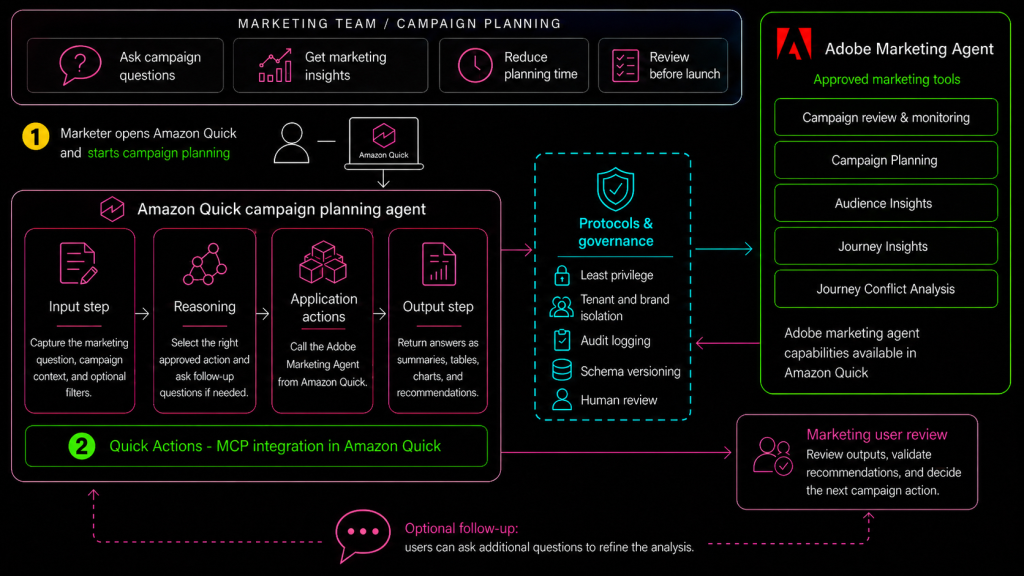
Accelerate campaign workflow with insights from Adobe Marketing Agent for Amazon Quick
This post shows how to enable Adobe Marketing Agent for Amazon Quick using a Model Context Protocol (MCP). We walk you through how to configure the integration, authenticate using your Adobe credentials, and get the latest insights in Amazon Quick. The sample workflow returns audience rankings, loyalty segment summaries, journey usage, and conflict recommendations.
Build a meeting prep and follow-up assistant with Amazon Quick and Cisco Webex MCP servers
This post shows how to build a custom meeting prep and follow-up assistant using Amazon Quick and Cisco Webex MCP servers. From a single prompt, the agent finds an upcoming Webex meeting, reviews prior meeting summaries and transcripts, and pulls related Vidcast highlights and transcript context. It then searches Webex message threads for unresolved follow-ups and creates a concise prep brief. After the meeting, the same assistant can summarize the discussion and identify action items. It can also find related Vidcast updates and draft a follow-up message for the right Webex space.
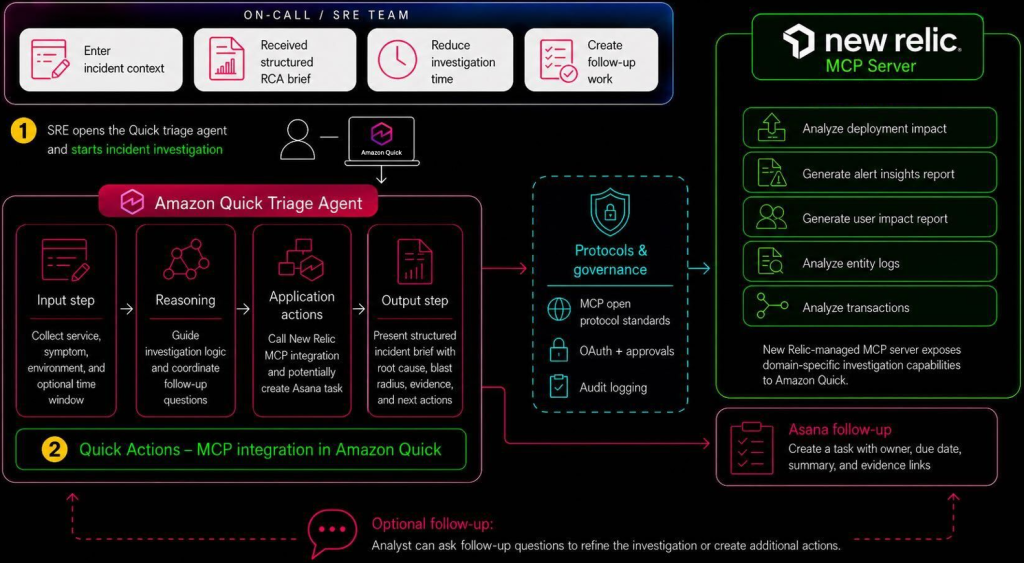
Build an agentic incident triage assistant with Amazon Quick and New Relic
This post shows engineering teams how to apply that principle to one of the most time-sensitive workflows in engineering: incident triage. You will build a custom incident triage assistant agent using Amazon Quick that orchestrates a response with the New Relic Model Context Protocol (MCP) Server and Asana through native integrations. From a single prompt, the Amazon Quick agent investigates the incident, assembles a root cause analysis (RCA) brief with evidence links, and creates a tracked Asana task ready for handoff.
Integrate external tools with Amazon Quick Agents using Model Context Protocol (MCP)
In this post, you’ll use a six-step checklist to build a new MCP server or validate and adjust an existing MCP server for Amazon Quick integration. The Amazon Quick User Guide describes the MCP client behavior and constraints. This is a “How to” guide for detailed implementation required by 3P partners to integrate with Amazon Quick with MCP.
Enhance generative AI solutions using Amazon Q index with Model Context Protocol – Part 1
In this post, we explore best practices and integration patterns for combining Amazon Q index and MCP, enabling enterprises to build secure, scalable, and actionable AI search-and-retrieval architectures.

Accelerate migration portfolio assessment using Amazon Bedrock
In this blog post, we will harness the power of generative AI and Amazon Bedrock to help organizations simplify, accelerate, and scale migration assessments.

Generate customized, compliant application IaC scripts for AWS Landing Zone using Amazon Bedrock
As you navigate the complexities of cloud migration, the need for a structured, secure, and compliant environment is paramount. AWS Landing Zone addresses this need by offering a standardized approach to deploying AWS resources. This makes sure your cloud foundation is built according to AWS best practices from the start. With AWS Landing Zone, you eliminate the guesswork in security configurations, resource provisioning, and account management. It’s particularly beneficial for organizations looking to scale without compromising on governance or control, providing a clear path to a robust and efficient cloud setup. In this post, we show you how to generate customized, compliant IaC scripts for AWS Landing Zone using Amazon Bedrock.