Artificial Intelligence
Category: Learning Levels

Unlock AWS Cost and Usage insights with generative AI powered by Amazon Bedrock
In this post, we explore a solution that uses generative artificial intelligence (AI) to generate a SQL query from a user’s question in natural language. This solution can simplify the process of querying CUR data stored in an Amazon Athena database using SQL query generation, running the query on Athena, and representing it on a web portal for ease of understanding.

Streamline workflow orchestration of a system of enterprise APIs using chaining with Amazon Bedrock Agents
In this post, we explore how chaining domain-specific agents using Amazon Bedrock Agents can transform a system of complex API interactions into streamlined, adaptive workflows, empowering your business to operate with agility and precision.

Build a RAG-based QnA application using Llama3 models from SageMaker JumpStart
In this post, we provide a step-by-step guide for creating an enterprise ready RAG application such as a question answering bot. We use the Llama3-8B FM for text generation and the BGE Large EN v1.5 text embedding model for generating embeddings from Amazon SageMaker JumpStart.

Best prompting practices for using Meta Llama 3 with Amazon SageMaker JumpStart
In this post, we dive into the best practices and techniques for prompting Meta Llama 3 using Amazon SageMaker JumpStart to generate high-quality, relevant outputs. We discuss how to use system prompts and few-shot examples, and how to optimize inference parameters, so you can get the most out of Meta Llama 3.

How healthcare payers and plans can empower members with generative AI
In this post, we discuss how generative artificial intelligence (AI) can help health insurance plan members get the information they need. The solution presented in this post not only enhances the member experience by providing a more intuitive and user-friendly interface, but also has the potential to reduce call volumes and operational costs for healthcare payers and plans.

Enabling production-grade generative AI: New capabilities lower costs, streamline production, and boost security
As generative AI moves from proofs of concept (POCs) to production, we’re seeing a massive shift in how businesses and consumers interact with data, information—and each other. In what we consider “Act 1” of the generative AI story, we saw previously unimaginable amounts of data and compute create models that showcase the power of generative […]

Introducing Amazon EKS support in Amazon SageMaker HyperPod
This post is designed for Kubernetes cluster administrators and ML scientists, providing an overview of the key features that SageMaker HyperPod introduces to facilitate large-scale model training on an EKS cluster.

A review of purpose-built accelerators for financial services
In this post, we aim to provide business leaders with a non-technical overview of purpose-built accelerators (PBAs) and their role within the financial services industry (FSI).

Genomics England uses Amazon SageMaker to predict cancer subtypes and patient survival from multi-modal data
In this post, we detail our collaboration in creating two proof of concept (PoC) exercises around multi-modal machine learning for survival analysis and cancer sub-typing, using genomic (gene expression, mutation and copy number variant data) and imaging (histopathology slides) data. We provide insights on interpretability, robustness, and best practices of architecting complex ML workflows on AWS with Amazon SageMaker. These multi-modal pipelines are being used on the Genomics England cancer cohort to enhance our understanding of cancer biomarkers and biology.
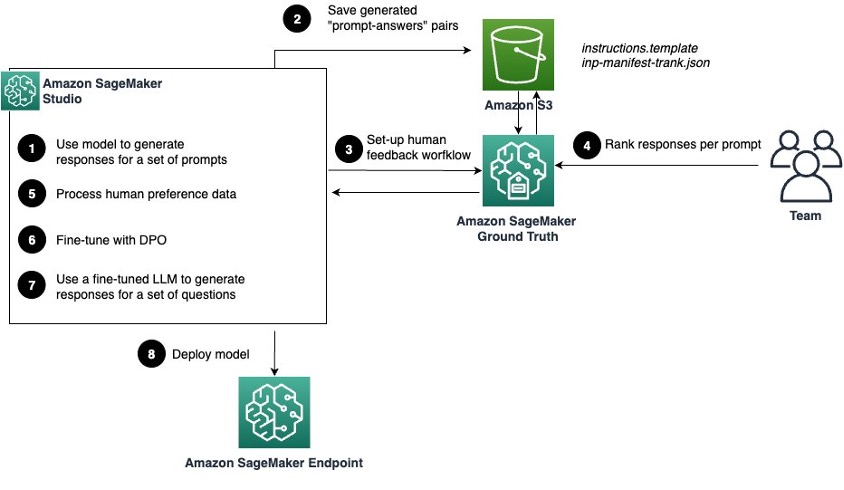
Align Meta Llama 3 to human preferences with DPO, Amazon SageMaker Studio, and Amazon SageMaker Ground Truth
In this post, we show you how to enhance the performance of Meta Llama 3 8B Instruct by fine-tuning it using direct preference optimization (DPO) on data collected with SageMaker Ground Truth.