Artificial Intelligence
How AWS Finance teams reclaimed hundreds of hours with Amazon Quick
Every finance professional knows the drill. Monday morning arrives, and your Financial Planning and Analysis (FP&A) team disappears into data compilation. They pull numbers from multiple systems, reconcile sources, build charts, and write commentary. All to answer a question that should be straightforward: what happened with revenue last week, and why?
Across AWS Finance, teams were spending hundreds of hours a month on exactly this kind of work. Not analysis. Not strategy. Getting the data ready so the real work could begin.
Amazon Quick is a generative AI assistant that connects across all your enterprise data and applications, so business users can search, analyze, and take action through natural language. It handles the complexity of querying millions of rows, running advanced analytics, and automating recurring workflows so your team doesn’t need to.
In this post, we show how AWS Finance used chat agents and Flows in Quick to transform two of their most time-consuming workflows.
Use case 1: Scenario modeling and risk analysis across the strategic portfolio
Setting financial targets for strategic customers requires reconciling bottom-up forecasts from business teams with top-down projections from leadership. It also demands enough depth to catch the risks hiding beneath historical data.
The team built an Amazon Quick chat agent that connects directly to enterprise data sources and delivers sophisticated insights through natural language conversation. The agent queries millions of rows across Amazon Redshift data tables instantly while also searching external data signals.
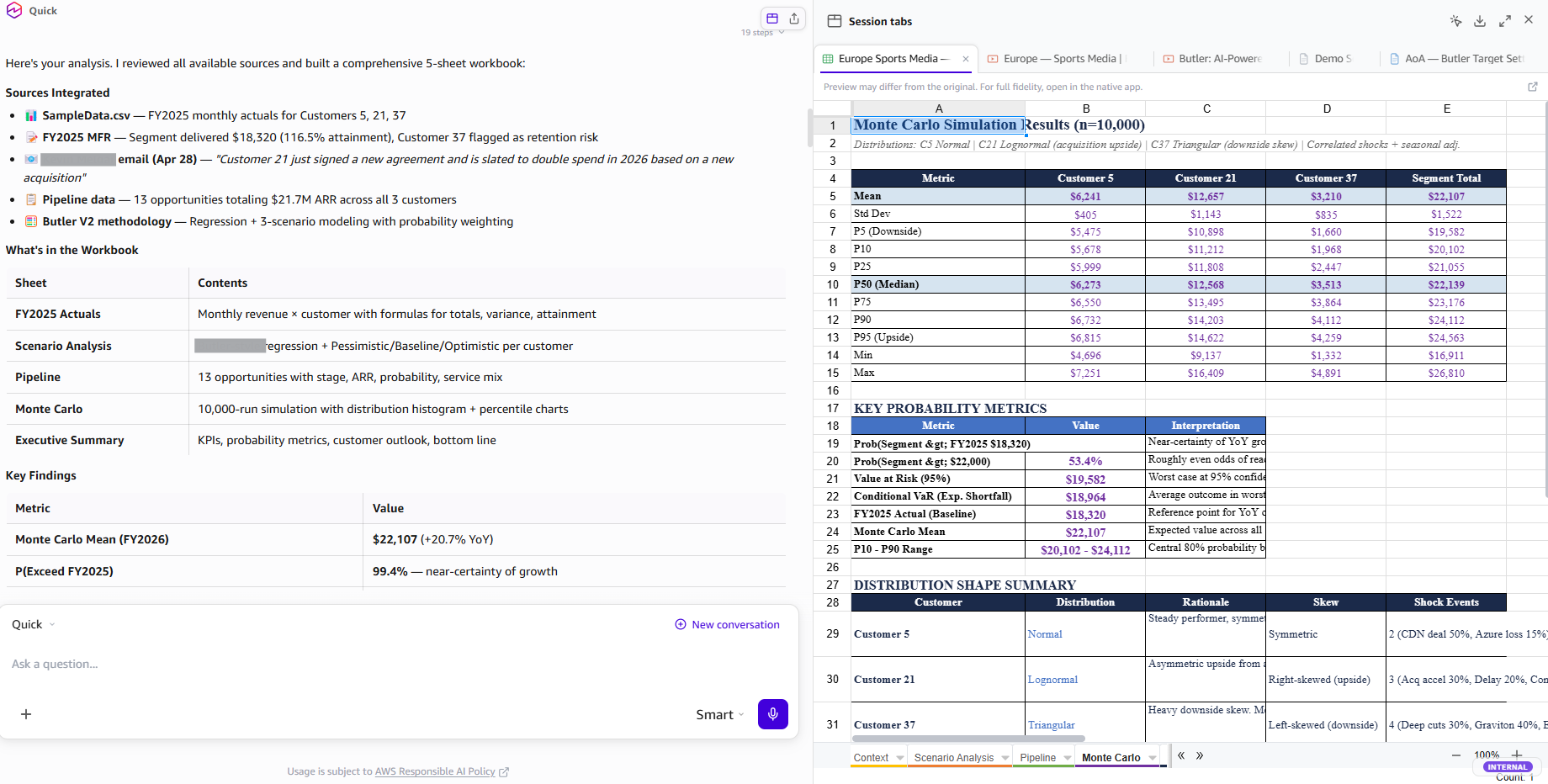
Screenshot showing Quick presenting a scenario analysis and creating a 5-sheet Microsoft Excel worksheet.
Here’s what changed:
Before: Analysts could deep-dive roughly a third of strategic customers in the time available between bottoms-up inputs and when top-level targets are due. The rest got surface-level coverage. A single customer analysis consumed up to 6 hours of manual work, including extracting data, running models, and documenting findings.
After: The Quick agent evaluates statistical forecasts, runs regression analysis, Monte Carlo simulations, and performs scenario modeling across multiple factors in approximately 10 minutes per customer. It surfaces risks and opportunities that manual analysis missed. The team now covers their entire customer portfolio with even greater depth than before.
“We have expanded from deep-diving a third of our strategic customers to covering our entire portfolio. Our finance team now spends time on what matters: partnering with the business to drive revenue, not compiling data or writing complex queries.”
— Geoff Winkler
What makes this work: An analyst asks a question in natural language: “Run an opportunity and risk assessment for our top strategic accounts.” Quick then queries millions of rows, runs advanced analytics, and synthesizes structured data with unstructured insights from field reports and pipeline data. The agent does bull versus bear analysis by reviewing accounts with upside potential based on contract renewal timing and pipeline strength, and flags accounts with risk exposure. These are insights that traditional models missed.
Because there’s no coding barrier, every finance professional on the team becomes a data analyst. Teams customize agents for different regions or business units, and the insights refresh automatically.
Use case 2: Weekly business reviews from 6 hours to 10 minutes
If target setting is a periodic deep dive, regular business reviews are the recurring ritual that occupies FP&A teams everywhere. At AWS, every week, insights on revenue performance need to be compiled, analyzed, and packaged for leadership. And every week, that preparation consumes an entire Monday.
The same AWS Finance team solved this by deploying Amazon Quick chat agents specific to each geographic region, connected through Flows to automate workflows that run on a set cadence without manual intervention.
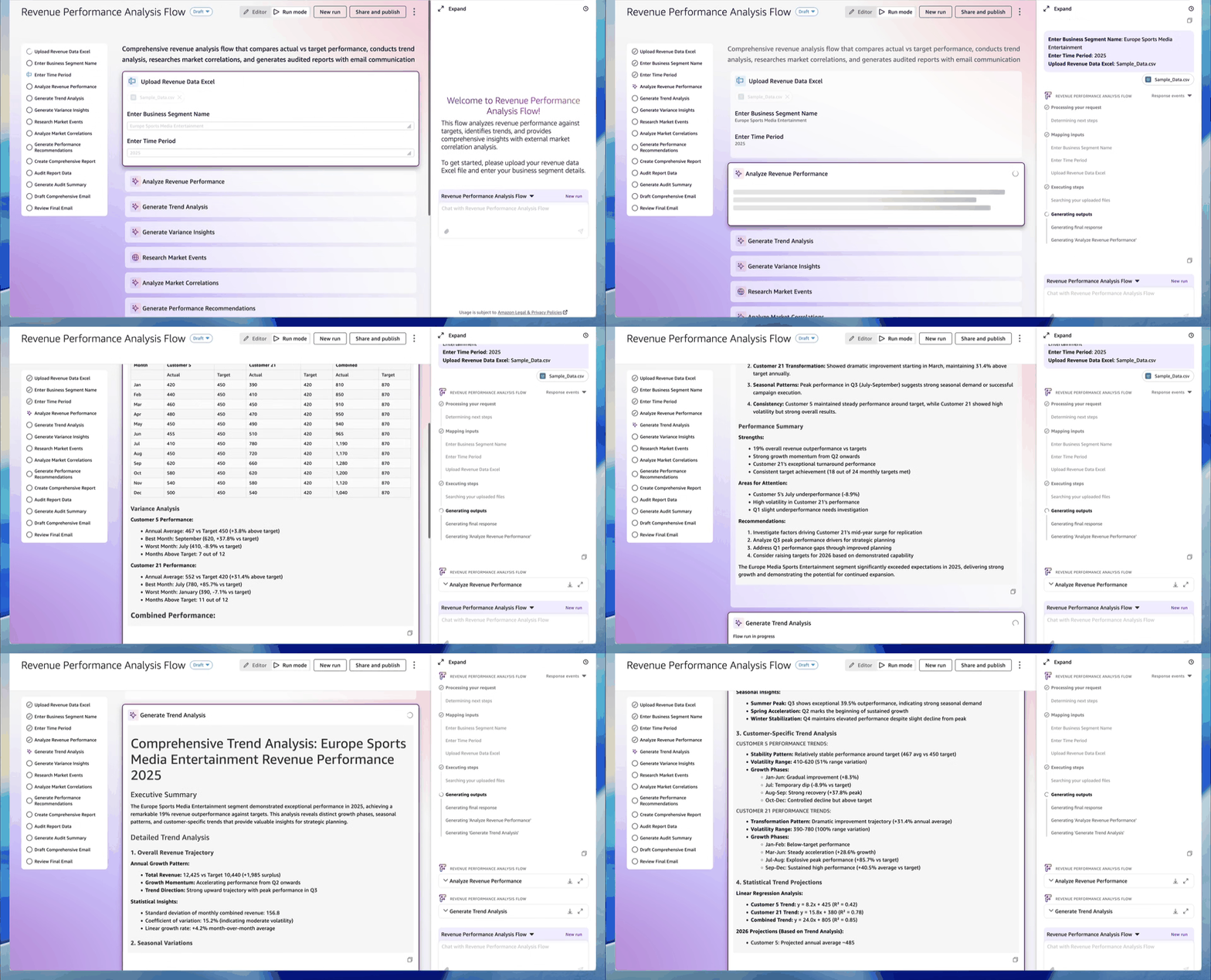
Video showing a blank Revenue Performance Analysis Flow that helps automate weekly business review workflows.
Here’s what changed:
Before: Every Monday, FP&A analysts spent a full morning compiling data from multiple systems, analyzing trends, manually reaching out to sales leads for customer anecdotes, and preparing talk tracks so leaders could understand what happened with revenue and why. The process was manual, repetitive, and left little time for strategic work.
After: Quick runs the Flow automatically each Monday morning. Region-specific chat agents analyze revenue performance across multiple dimensions: by charge type, by customer segment, and by growth contribution. They prepare comprehensive insights with ready-to-use talk tracks for leadership. Fresh analysis is waiting before the workday begins.
Quick doesn’t only report numbers. It connects structured data from financial systems with unstructured insights from field reports to get to the why behind the trends. It examines customers across over a dozen dimensions, identifies patterns, and flags anomalies with context.
“These insights are prepared automatically every Monday morning. Our team now spends time on strategic priorities instead of compiling disparate data. We spend more time on the why and on driving business outcomes.”
— Geoff Winkler
The pattern: from data compilation to strategic partnership
These two use cases share a common thread. In both, the bottleneck wasn’t analytical skill, it was data compilation. Data was scattered across systems. Getting a complete picture required hours of manual extraction before any real analysis could begin.
Amazon Quick removes that bottleneck by connecting directly to enterprise data sources and letting finance professionals interact with their data through natural language. The result isn’t incremental efficiency. It changes how finance teams spend their time:
| Workflow | Before Amazon Quick | With Amazon Quick |
| Target setting | Approximately 6 hours per customer; one-third of portfolio covered | Approximately 10 minutes per customer; entire portfolio covered with greater depth |
| Weekly Business Review preparation | Full Monday morning of manual compilation and analysis | Automated weekly; insights ready before the workday begins |
| Team focus | Data compilation and query writing | Strategic analysis and business partnership |
Across these use cases, the AWS Sales and Marketing Finance team reduced target-setting time from 6 hours to approximately 10 minutes per customer deep dive. They also removed the manual Monday routine for weekly business review preparation entirely. The time reclaimed went directly back into strategic work: risk analysis, customer anecdote synthesis, and identifying opportunities for growth.
What this means for your finance team
You don’t need to face Amazon-scale complexity to benefit. Every finance team deals with fragmented data, recurring reporting cycles, and the tension between compiling numbers and actually using them.
Amazon Quick is designed for business users. Finance professionals set up chat agents and automated workflows themselves, without engineering support. They customize agents for their specific needs, refine them through iteration, and expand them across the organization as results prove out.
If your team is spending more time preparing insights than delivering them, that’s the gap Quick is built to close.
Learn more about Amazon Quick for Finance.
In the next post in this series, we will explore how AWS Finance teams are using Quick to automate cost optimization and streamline approval workflows, turning hours of manual analysis into minutes.