Artificial Intelligence
How Totogi automated change request processing with Totogi BSS Magic and Amazon Bedrock
This post is cowritten by Nikhil Mathugar, Marc Breslow and Sudhanshu Sinha from Totogi.
This blog post describes how Totogi automates change request processing. Totogi is an AI company focused on helping helping telecom (telco) companies innovate, accelerate growth and adopt AI at scale. BSS Magic, Totogi’s flagship product, connects and models telco business operations, overlaying legacy systems with an AI layer. With BSS Magic, telcos can extend, customize, and modernize their systems without vendor dependencies or lengthy implementations. By partnering with the AWS Generative AI Innovation Center and using the rapid innovation capabilities of Amazon Bedrock, we accelerated the development of BSS Magic, helping Totogi’s customers innovate faster and gain more control over their tech stack.
In this post, we explore the challenges associated with the traditional business support system (BSS), and the innovative solutions provided by Totogi BSS Magic. We introduce intricacies of telco ontologies and the multi-agent framework that powers automated change request processing. Additionally, the post will outline the orchestration of AI agents and the benefits of this approach for telecom operators and beyond.
Challenges with BSS
BSS are notoriously difficult to manage. A typical BSS stack consists of hundreds of different applications from various vendors. But those BSS applications are difficult to integrate, either restricting telcos to the vendor’s ecosystem or requiring them to invest in costly customizations. Such customizations are slow and resource-intensive because of their reliance on specialized engineering talent.
Each change request necessitates a thorough analysis of potential impacts across interconnected modules, consuming significant time and effort. Even small updates can involve multiple rounds of coding, testing, and reconfiguration to achieve stability. For telecom operators, where system reliability is critical, these safeguards are non-negotiable, but they come at a steep price. This process is further complicated by the scarcity of engineers with the necessary expertise, driving up costs and elongating timelines. As a result, development cycles for new features or services often take months to complete, leaving operators struggling to meet the demands of a fast-moving market.
Initiatives like TM Forum’s Open Digital Architecture (ODA) aim to solve this, yet most vendors are slow to adopt such open standards. This dynamic amplifies technical debt and inflates operational expenses.
BSS Magic solution overview
Totogi BSS Magic reduces the complexity using AI-generated interoperability, which helps simplify integrations, customizations, and application development. BSS Magic has two key aspects:
- A telco ontology that understands the semantic meanings of data structures and the relationships between them, linking disparate data into a coherent network of knowledge.
- Multi-agent framework for fully automated change requests (CR), which reduces CR processing time from 7 days to a few hours.
Telco ontology: The key to interoperability
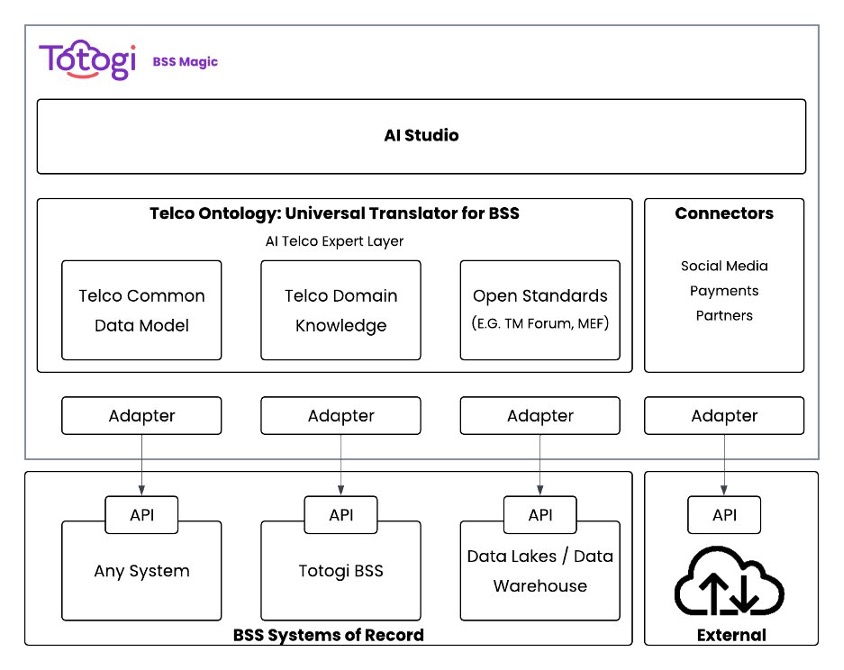
Ontologies serve as semantic blueprints that detail concepts, relationships, and domain knowledge. In telecom, this means translating the BSS landscape into a clear, reusable, and interoperable ecosystem. Totogi’s telco ontology facilitates a deep understanding of data interaction and seamless integration across any vendor or system.
By adopting FAIR principles (Findability, Accessibility, Interoperability, and Reusability), the ontology-driven architecture turns static, siloed data into dynamic, interconnected knowledge assets—unlocking trapped data and accelerating innovation. An overview diagram of the ontology is provided in the following figure.
Multi-agent framework for automated change request processing
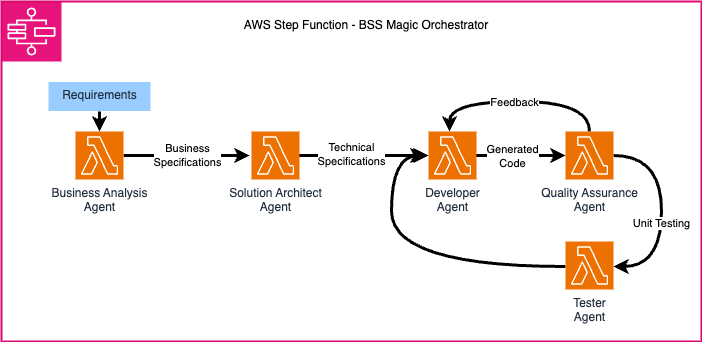
AI agents are advanced software applications trained to perform specific tasks autonomously. Totogi’s BSS Magic AI agents have extensive domain knowledge and use this understanding to manage complex data interactions across multiple vendor systems. These agents automatically generate and test telco-grade code, replacing traditional integrations and customizations with intelligent, AI generated applications. At its core, BSS Magic uses a multi-agent AI approach with feedback loops to automate the entire software development pipeline. Each agent is designed to fulfill a specific role in the development pipeline:
- Business analysis agent translates unstructured requirements into formal business specifications.
- Technical architect agent takes these business specs and defines technical architectures, APIs, and dependencies.
- Developer agent generates high-quality, deployable code, complete with modular designs and optimizations.
- QA agent validates the code for adherence to best practices, improving quality and security. It provides feedback which is used by the developer agent to update the code.
- Tester agent generates robust unit test cases, streamlining validation and deployment. The result of the test cases is used by the developer agent to improve the code.
An overview of the system is provided in the following figure.
This integrated pipeline reduces the time to complete a change request from 7 days to a few hours, with minimal human intervention. The prerequisites for implementing the system include an AWS account with access to Amazon Bedrock, AWS Step Functions, AWS Lambda, and configured Amazon credentials. The AI agents are implemented using Anthropic Claude large language models (LLMs) through Amazon Bedrock. State management and workflow coordination are handled by Step Functions for reliable progression through each stage. The AWS infrastructure provides the enterprise-grade reliability, security, and scalability essential for telco-grade solutions.
To build the framework, Totogi collaborated with the AWS Generative AI Innovation Center (GenAIIC). GenAIIC offered access to AI expertise, industry-leading talent, and a rigorous iterative process to optimize the AI agents and code-generation workflows. It also provided guidance on prompt engineering, Retrieval Augmented Generation (RAG), model selection, automated code review, feedback loops, robust performance metrics for evaluating AI-generated outputs, and so on. The collaboration helped establish methods for maintaining reliability while scaling automation across the platform. The solution orchestrates multiple specialized AI agents to handle the complete software development lifecycle, from requirements analysis to test execution. The details of the AI agents are given in the following sections.
Multi-agent orchestration layer
The orchestration layer coordinates specialized AI agents through a combination of Step Functions and Lambda functions. Each agent maintains context through RAG and few-shot prompting techniques to generate accurate domain-specific outputs. The system manages agent communication and state transitions while maintaining a comprehensive audit trail of decisions and actions.
Business analysis generation
The Business Analyst agent uses Claude’s natural language understanding capabilities to process statement of work (SOW) documents and acceptance criteria. It extracts key requirements using custom prompt templates optimized for telecom BSS domain knowledge. The agent generates structured specifications for downstream processing while maintaining traceability between business requirements and technical implementations.
Technical architecture generation
The Technical Architect agent transforms business requirements into concrete AWS service configurations and architectural patterns. It generates comprehensive API specifications and data models and incorporates AWS Well-Architected principles. The agent validates architectural decisions against established patterns and best practices, producing infrastructure-as-code templates for automated deployment.
Code generation pipeline
The Developer agent converts technical specifications into implementation code using Claude’s advanced code generation capabilities. It produces robust, production-ready code that includes proper error handling and logging mechanisms. The pipeline incorporates feedback from validation steps to iteratively improve code quality and maintain consistency with AWS best practices.
Automated quality assurance
The QA agent is built using Claude to perform comprehensive code analysis and validation. It evaluates code quality and identifies potential performance issues. The system maintains continuous feedback loops with the development stage, facilitating rapid iteration and improvement of generated code based on quality metrics and best practices adherence. The QA process consists of carefully crafted prompts.
QA code analysis prompt:
This prompt helps the QA agent perform thorough code analysis, evaluate quality metrics, and maintain continuous feedback loops with development stages.
Test automation framework
The Tester agent creates comprehensive test suites that verify both functional and non-functional requirements. It uses Claude to understand test contexts and generate appropriate test scenarios. The framework manages test refinement through evaluation cycles, achieving complete coverage of business requirements while maintaining test code quality and reliability. The testing framework uses a multi-stage prompt approach.
Initial test structure prompt:
Test implementation prompt:
Test results analysis prompt:
This structured approach leads to comprehensive test coverage while maintaining high quality standards. The framework currently achieves 76% code coverage and successfully validates both functional and non-functional requirements.
The Tester agent provides a feedback loop to the Development agent to improve the code.
Conclusion
The integration of Totogi BSS Magic with Amazon Bedrock presents a comprehensive solution for modern telecom operators. Some takeaways for you to consider:
- End-to-end automation: BSS Magic automates the entire development lifecycle—from idea to deployment. AI agents handle everything from requirements, architecture, and code generation to testing and validation.
- Results: The agentic framework significantly boosted efficiency, reducing change request processing from seven days to a few hours. The automated testing framework achieved 76% code coverage, consistently delivering high-quality telecom-grade code.
- Unique value for telecom operators: By using Totogi BSS Magic, telecom operators can accelerate time-to-market and reduce operational costs. BSS Magic uses autonomous AI, independently managing complex tasks so telecom operators can concentrate on strategic innovation. The solution is supported by Amazon Bedrock, which offers scalable AI models and infrastructure, high-level security and reliability critical for telecom.
- Impact to other industries: While BSS Magic is geared towards the telecom industry, the multi-agent framework can be repurposed for general software development across other industries.
- Future work: Future enhancements will focus on expanding the model’s domain knowledge in telecom and other domains. Another possible extension is to integrate an AI model to predict potential issues in change requests based on historical data, thereby preemptively addressing common pitfalls.
Any feedback and questions are welcome in the comments below. Contact us to engage AWS Generative AI Innovation Center or to learn more.
About the authors
 Nikhil Mathugar is a Presales Full Stack Engineer at Totogi, where he designs and implements scalable AWS-based proofs-of-concept across Python and modern JavaScript frameworks. He has over a decade of experience in architecting and maintaining large-scale systems—including web applications, multi-region streaming infrastructures and high-throughput automation pipelines. Building on that foundation, he’s deeply invested in AI—specializing in generative AI, agentic workflows and integrating large-language models to evolve Totogi’s BSS Magic platform.
 Marc Breslow is Field CTO of Totogi, where he is utilizing AI to revolutionize the telecommunications industry. A veteran of Accenture, Lehman Brothers, and Citibank, Marc has a proven track record of building scalable, high-performance systems. At Totogi, he leads the development of AI-powered solutions that drive tangible results for telcos: reducing churn, increasing Average Revenue Per user (ARPU), and streamlining business processes. Marc is responsible for customer proof points demonstrating these capabilities. When not engaging with customers, Marc leads teams building Totogi’s BSS Magic technology, generating applications and improving efficiency using AI agents and workflows.
 Sudhanshu Sinha is Chief Technology Officer and a founding team member at Totogi, where he works alongside Acting CEO Danielle Rios to drive the telecom industry’s shift to AI-native software. As the key strategist behind BSS Magic, he shaped its architecture, go-to-market, and early adoption—translating AI-native principles into measurable value for operators. He also helped define Totogi’s Telco Ontology, enabling interoperability and automation across complex BSS landscapes. With over two decades in telecommunications, Sudhanshu blends deep technical insight with commercial acumen to make AI-driven transformation practical and profitable for telcos worldwide.
 Parth Patwa is a Data Scientist at the AWS Generative AI Innovation Center, where he works on customer projects using Generative AI and LLMs. He has an MS from University of California Los Angeles. He has published papers in top-tier ML and NLP venues, and has over 1000 citations.
 Mofijul Islam is an Applied Scientist II and Tech Lead at the AWS Generative AI Innovation Center, where he helps customers tackle customer-centric research and business challenges using generative AI, large language models (LLM), multi-agent learning, code generation, and multimodal learning. He holds a PhD in machine learning from the University of Virginia, where his work focused on multimodal machine learning, multilingual NLP, and multitask learning. His research has been published in top-tier conferences like NeurIPS, ICLR, AISTATS, and AAAI, as well as IEEE and ACM Transactions.
 Andrew Ang is a Senior ML Engineer with the AWS Generative AI Innovation Center, where he helps customers ideate and implement generative AI proof of concept projects. Outside of work, he enjoys playing squash and watching competitive cooking shows.
 Shinan Zhang is an Applied Science Manager at the AWS Generative AI Innovation Center. With over a decade of experience in ML and NLP, he has worked with large organizations from diverse industries to solve business problems with innovative AI solutions, and bridge the gap between research and industry applications.
 Naman Sharma is a Generative AI Strategist at the AWS Generative AI Innovation Center, where he collaborates with organizations to drive adoption of generative AI to solve business problems at scale. His work focuses on leading customers from scoping, deploying, and scaling frontier solutions with the GenAIIC Strategy and Applied Science teams.