Artificial Intelligence
Introducing Claude Sonnet 5 on AWS: Anthropic’s most capable Sonnet model
Today, we’re excited to announce the availability of Anthropic’s most advanced Sonnet model, Claude Sonnet 5, on Amazon Bedrock and Claude Platform on AWS. Claude Sonnet 5 is the first Sonnet model of Anthropic’s latest generation and represents a meaningful step forward. It delivers top-tier intelligence at Sonnet pricing for coding, agents, and everyday professional work at scale. With Claude Sonnet 5 on Amazon Bedrock you can build within your existing AWS environment, maintain enterprise security and regional data residency, and scale inference. Claude Sonnet 5 is also available through Claude Platform on AWS, giving you access to Anthropic’s native platform experience and capabilities via the AWS Management Console. Build, test, and deploy with the same APIs, features, and console experience you’d get working with Anthropic directly, unified with AWS billing and authentication.
This post covers the improvements in Sonnet 5 and practical guidance for AI engineers integrating the model into agentic systems and production inference workloads on Amazon Bedrock. See the documentation for Claude Platform on AWS.
What makes Claude Sonnet 5 different
Claude Sonnet 5 shows stronger performance across coding, agentic tasks, and professional work. Claude Sonnet 5 brings near-Opus intelligence while maintaining the same balance of capability, cost, and speed, so teams can rely on Sonnet for everyday tasks at scale. Use Claude Sonnet 5 when you need strong reasoning, coding, and agentic reliability at scale without Opus-tier pricing. Use Claude Opus when your task demands the highest reasoning that justifies the cost premium. Sonnet 5 can hold a plan across stages, track what it has done and what remains, and resolve issues with fewer rounds of correction. This leads to more predictable behavior at scale.
In coding, Sonnet 5 is designed to navigate real codebases, land multi-file changes, and carry longer debugging and refactoring tasks through to completion. It writes cleaner, more maintainable code with reduced oversight. For autonomous agents, Claude Sonnet 5 serves as a more reliable backbone for automated operations, handling complex dependency chains and multi-step tool use, making it a strong fit for both customer-facing and internal agents. In professional work, Sonnet 5 synthesizes long, complex, unstructured sources into structured deliverables such as briefs, analyses, and reports. Claude Sonnet 5 is designed as a clear upgrade to Sonnet 4.6.
Industry use cases
Claude Sonnet 5 is a strong fit for industries where reliability and structured reasoning matter most. For financial services teams, Sonnet 5 powers spreadsheet modeling, financial analysis, and reporting agents that audit their own numbers as they go. This supports end-to-end workflows from data ingestion to validated output. For productivity work, it handles report building and auditing, document drafting, and structured analysis with high consistency. With its computer use capabilities, you can automate browser and desktop workflows that previously required human interaction. For agent and workflow automation, Claude Sonnet 5 serves as the backbone for production agents that call tools and run multi-step jobs unattended.
Getting started with Claude Sonnet 5 on Amazon Bedrock
You can get started with Claude Sonnet 5 in the Amazon Bedrock console.
- In the Amazon Bedrock console, under Test, choose Playground.
- For the model, choose Claude Sonnet 5. Now, you can test your complex coding prompt with the model.
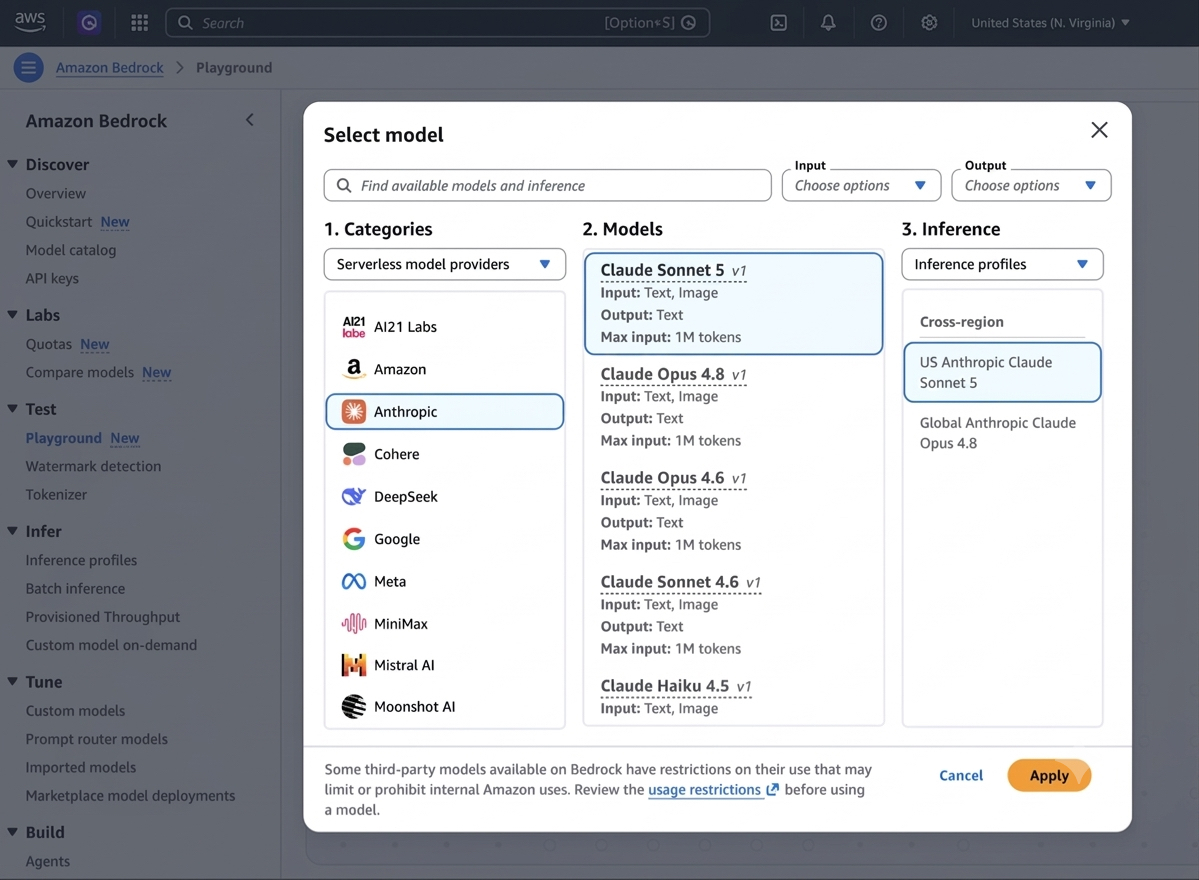
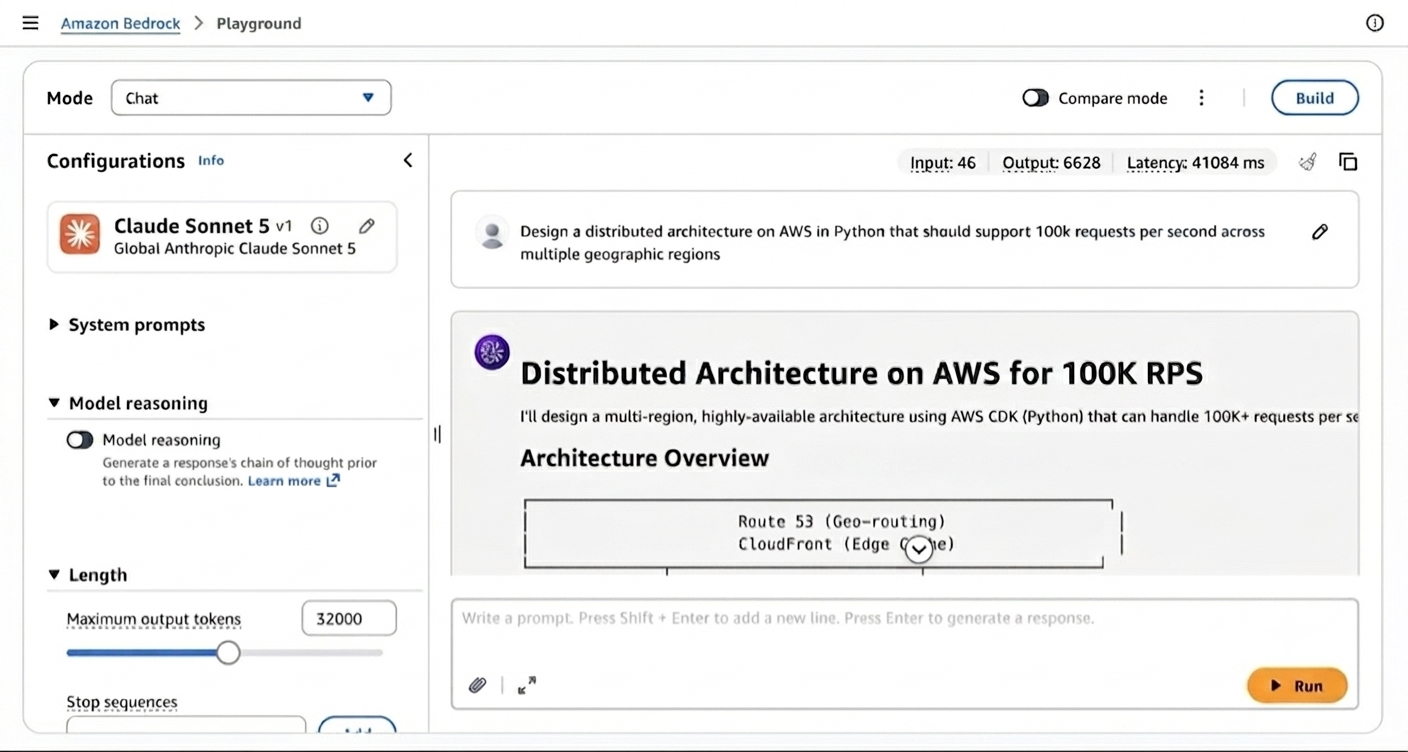
Amazon Bedrock console Playground with Claude Sonnet 5 selected
You can also access the model programmatically using the Anthropic Messages API to call the bedrock-runtime through Anthropic SDK or bedrock-mantle endpoints, or keep using the Invoke and Converse API on bedrock-runtime through the AWS Command Line Interface (AWS CLI) and AWS SDK.
Prerequisites
- Active AWS account with Amazon Bedrock access
- AWS CLI installed and configured
- Python 3.8+
- Boto3 installed:
pip install boto3 - Anthropic SDK installed:
pip install anthropic[bedrock] - IAM permissions:
bedrock:InvokeModel,bedrock:InvokeModelWithResponseStream, andbedrock:CreateInference
Here’s a quick example using the AWS SDK for Python (Boto3):
You can also use Claude Sonnet 5 with the Amazon Bedrock Converse API for a unified multi-model experience:
You can also use Claude Sonnet 5 with the Anthropic Messages API using the anthropic[bedrock] SDK package for a streamlined experience:
Availability
Claude Sonnet 5 is available today on Amazon Bedrock, with the full list of supported AWS Regions available in the Amazon Bedrock documentation. Claude Sonnet 5 is also available on the Claude Platform on AWS in North America, South America, Europe, and Asia Pacific.
Give Claude Sonnet 5 a try in the Amazon Bedrock console, in the Claude Platform on AWS, or explore the Getting Started notebooks on GitHub. For pricing information, see Amazon Bedrock pricing. You can also unlock Sonnet 5’s full potential by using Advanced Prompt Optimization on Amazon Bedrock. It takes your current prompts, benchmarks them against your evaluation criteria, and outputs production-ready rewrites.