AWS for M&E Blog

Webcast on-demand: Achieve broadcast-grade video latency for live streaming
Do your viewers complain about OTT video latency? Are you frustrated by comparisons to broadcast? New knowledge, technologies, and practices are making long-standing video latency problems for live streaming a thing of the past. In this webcast, experts explain ways to optimize your video workflows and achieve broadcast-grade latency using standard protocols and software in […]
AWS at SIGGRAPH 2018
By Colin Cupp, AWS Thinkbox Product Marketing Manager SIGGRAPH is the premier event for computer graphics artists and professionals, drawing more than 16,000 attendees from around the world. With a schedule of rotating destination cities, this year’s event will be held in Vancouver, BC August 12-16. In years past AWS subsidiaries have exhibited at SIGGRAPH […]

Webcast on-demand: Linear channel 101 for ‘Digital First’ media companies
From APN Partner Amagi: Check out this webcast to understand why Digital First media companies should launch linear channels, and how cloud playout can help. Speakers: Baskar Subramanian, co-founder, Amagi Mark Stephens, Global Partner Segment Leader M&E, AWS Key topics covered: Changing content consumption preferences and linear OTT market growth Various paths to capture […]

New from the Compute Blog: Building a GPU workstation for visual effects with AWS
The elasticity, scalability, and cost effectiveness of the cloud value proposition is attractive to media customers. One of the key design patterns in media and entertainment (M&E) workloads is using the cloud as a content lake and bringing the underlying processes closer without having to synchronize data. In this high-end graphics visualization business, a pixel-perfect, […]

Territory Studio / life at work: A visualization of the data in content creation
Guest post by Helena Corvin-Swahn, Territory Studio A motion graphics and vfx specialist, Territory’s team of artists and designers rely on an ever-evolving relationship with technology to realise their creative work. In 2016, AWS Thinkbox Deadline was implemented to efficiently manage the increase in rendering requirements as the studio scaled. With an opportunity to create […]

In the news: AWS chosen to provide the vast majority of cloud infrastructure for 21st Century Fox | Business Wire
21st Century Fox extended its strategic relationship with AWS, selecting the world’s leading cloud provider for the vast majority of its workloads. Read the full release: AWS Chosen to Provide the Vast Majority of Cloud Infrastructure for 21st Century Fox | Business Wire You can learn more from 21st Century Fox CTO Paul Cheesbrough as […]

Working with AWS Elemental MediaTailor logs and metrics
AWS Elemental MediaTailor is a content personalization and monetization service that allows customers to implement stitched server-side ad insertion for streaming video while maintaining high quality of service. It uses dynamic transcoding to reduce storage requirements and ensure that video seamlessly transitions between advertising and primary content during playback. AWS Elemental MediaTailor manipulates the HTTP Live […]
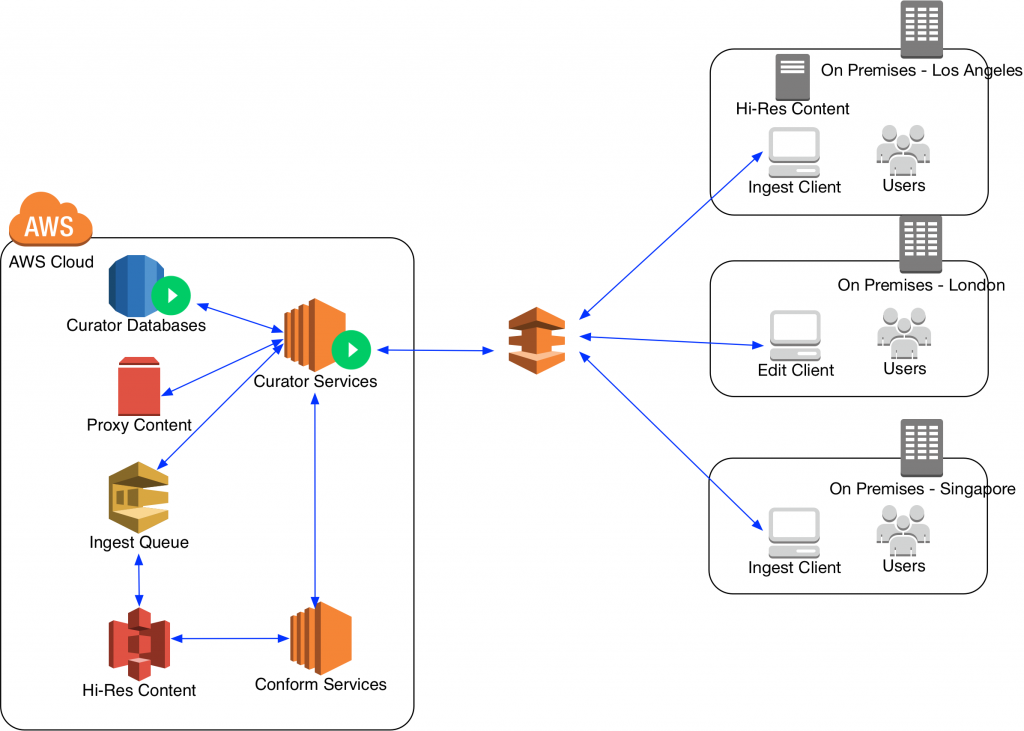
Hybrid cloud editing with IPV curator and AWS
Guest post by Mark Stephens (Partner Solutions Architect, AWS Partner Program), James Varndell (Product Manager, IPV), and Rebecca Lindley (Product Marketing Associate, IPV). There’s no doubt that modern video content production workflows can be incredibly complicated. From storing a growing library of media, to managing projects with editors in different locations, to the demand for turning content […]

AWS M&E Cloud Symposium in Los Angeles – agenda and registration
Presentations have now been published for download. Details and agenda below: Date: July 31 Time: 10:30am-5pm Location: Skirball Cultural Center (parking is limited. Recommend ride sharing) Registration now closed AGENDA Keynote: Enhancing the Viewer Experience with Machine Learning: GrayMeta and the Sky News “Royal Wedding: Who’s Who App” Josh Wiggins (Chief Commercial Officer, GrayMeta) With the […]

How to migrate workflows from Amazon Elastic Transcoder to AWS Elemental MediaConvert
March 2025: The contents of this post are outdated. Please refer to this post for updated info: Migrating workflows from Amazon Elastic Transcoder to AWS Elemental MediaConvert Introduction At re:Invent 2017, AWS Elemental released five new media processing and delivery services. One of these services, AWS Elemental MediaConvert, shares functionality with another file-based video transcoding service on […]