AWS Security Blog
Implementing data governance on AWS: Automation, tagging, and lifecycle strategy – Part 1
Generative AI and machine learning workloads create massive amounts of data. Organizations need data governance to manage this growth and stay compliant. While data governance isn’t a new concept, recent studies highlight a concerning gap: a Gartner study of 300 IT executives revealed that only 60% of organizations have implemented a data governance strategy, with 40% still in planning stages or uncertain where to begin. Furthermore, a 2024 MIT CDOIQ survey of 250 chief data officers (CDOs) found that only 45% identify data governance as a top priority.
Although most businesses recognize the importance of data governance strategies, regular evaluation is important to ensure these strategies evolve with changing business needs, industry requirements, and emerging technologies. In this post, we show you a practical, automation-first approach to implementing data governance on Amazon Web Services (AWS) through a strategic and architectural guide—whether you’re starting at the beginning or improving an existing framework.
In this two-part series, we explore how to build a data governance framework on AWS that’s both practical and scalable. Our approach aligns with what AWS has identified as the core benefits of data governance:
- Classify data consistently and automate controls to improve quality
- Give teams secure access to the data they need
- Monitor compliance automatically and catch issues early
In this post, we cover strategy, classification framework, and tagging governance—the foundation you need to get started. If you don’t already have a governance strategy, we provide a high-level overview of AWS tools and services to help you get started. If you have a data governance strategy, the information in this post can assist you in evaluating its effectiveness and understanding how data governance is evolving with new technologies.
In Part 2, we explore the technical architecture and implementation patterns with conceptual code examples, and throughout both parts, you’ll find links to production-ready AWS resources for detailed implementation.
Prerequisites
Before implementing data governance on AWS, you need the right AWS setup and buy-in from your teams.
Technical foundation
Start with a well-structured AWS Organizations setup for centralized management. Make sure AWS CloudTrail and AWS Config are enabled across accounts—you’ll need these for monitoring and auditing. Your AWS Identity and Access Management (IAM) framework should already define roles and permissions clearly.
Beyond these services, you’ll use several AWS tools for automation and enforcement. The AWS service quick reference table that follows lists everything used throughout this guide.
Organizational readiness
Successful implementation of data governance requires clear organizational alignment and preparation across multiple dimensions.
- Define roles and responsibilities. Data owners classify data and approve access requests. Your platform team handles AWS infrastructure and builds automation, while security teams set controls and monitor compliance. Application teams then implement these standards in their daily workflows.
- Document your compliance requirements. List the regulations you must follow—GDPR, PCI-DSS, SOX, HIPAA, or others. Create a data classification framework that aligns with your business risk. Document your tagging standards and naming conventions so everyone follows the same approach.
- Plan for change management. Get executive support from leaders who understand why governance matters. Start with pilot projects to demonstrate value before rolling out organization-wide. Provide role-based training and maintain up-to-date governance playbooks. Establish feedback mechanisms so teams can report issues and suggest improvements.
Key performance indicators (KPIs) to monitor
To measure the effectiveness of your data governance implementation, track the following essential metrics and their target objectives.
- Resource tagging compliance: Aim for 95%, measured through AWS Config rules with weekly monitoring, focusing on critical resources and sensitive data classifications.
- Mean time to respond to compliance issues: Target less than 24 hours for critical issues. Tracked using CloudWatch metrics with automated alerting for high-priority non-compliance events
- Reduction in manual governance tasks: Target reduction of 40% in the first year. Measured through automated workflow adoption and remediation success rates.
- Storage cost optimization based on data classification: Target 15–20% reduction through intelligent tiering and lifecycle policies, monitored monthly by classification level.
With these technical and organizational foundations in place, you’re ready to implement a sustainable data governance framework.
AWS services used in this guide – Quick reference
This implementation uses the following AWS services. Some are prerequisites, while others are introduced throughout the guide.
|
Category |
Services |
Description |
|
Foundation |
Multi-account management structure that enables centralized policy enforcement and governance across your entire AWS environment. |
|
|
|
Controls who can access what resources through roles, policies, and permissions—the foundation of your security model. |
|
|
Monitoring and auditing |
Records every API call made in your AWS accounts, creating a complete audit trail of who did what, when, and from where. |
|
|
|
Continuously monitors resource configurations and evaluates them against rules you define (such as requiring that all S3 buckets much be encrypted). When it finds resources that don’t meet your rules, it flags them as non-compliant so you can fix them manually or automatically. |
|
|
|
Aggregates metrics, logs, and events from across AWS for real-time monitoring, dashboards, and automated alerting on governance non-compliance. |
|
|
Automation and enforcement |
Acts as a central notification system that watches for specific events in your AWS environment (such as when an S3 bucket has been created) and automatically triggers actions in response (such as by running a Lambda function to check if it has the required tags). Think of it as an if this happens, then do that automation engine. |
|
|
|
Runs your governance code (tag validation, security controls, remediation) in response to events without managing servers. |
|
|
|
Automates operational tasks across your AWS resources. In governance, it’s primarily used to automatically fix non-compliant resources—for example, if AWS Config detects an unencrypted database, Systems Manager can run a pre-defined script to enable encryption without manual intervention. |
|
|
Data protection |
Uses machine learning to automatically discover, classify, and protect sensitive data like personal identifiable information (PII) across your S3 buckets. |
|
|
|
Manages encryption keys for protecting data at rest, essential for high-impact data classifications. |
|
|
Analytics & Insights |
Serverless query service that analyzes data in Amazon S3 using SQL—perfect for querying CloudTrail logs to understand access patterns. |
|
|
Standardization |
Creates catalogs of pre-approved, governance-compliant resources that teams can deploy through self-service. |
|
|
ML Governance |
Provides specialized tools for governing machine learning operations including model monitoring, documentation, and access control. |
Understanding the data governance challenge
Organizations face complex data management challenges, from maintaining consistent data classification to ensuring regulatory compliance across their environments. Your strategy should maintain security, ensure compliance, and enable business agility through automation. While this journey can be complex, breaking it down into manageable components makes it achievable.
The foundation: Data classification framework
Data classification is a foundational step in cybersecurity risk management and data governance strategies. Organizations should use data classification to determine appropriate safeguards for sensitive or critical data based on their protection requirements. Following the NIST (National Institute of Standards and Technology) framework, data can be categorized based on the potential impact to confidentiality, integrity, and availability of information systems:
- High impact: Severe or catastrophic adverse effect on organizational operations, assets, or individuals
- Moderate impact: Serious adverse effect on organizational operations, assets, or individuals
- Low impact: Limited adverse effect on organizational operations, assets, or individuals
Before implementing controls, establishing a clear data classification framework is essential. This framework serves as the backbone of your security controls, access policies, and automation strategies. The following is an example of how a company subject to the Payment Card Industry Data Security Standard (PCI-DSS) might classify data:
- Level 1 – Most sensitive data:
- Examples: Financial transaction records, customer PCI data, intellectual property
- Security controls: Encryption at rest and in transit, strict access controls, comprehensive audit logging
- Level 2 – Internal use data:
- Examples: Internal documentation, proprietary business information, development code
- Security controls: Standard encryption, role-based access control
- Level 3 – Public data:
- Examples: Marketing materials, public documentation, press releases
- Security controls: Integrity checks, version, control
To help with data classification and tagging, AWS created AWS Resource Groups, a service that you can use to organize AWS resources into groups using criteria that you define as tags. If you’re using multiple AWS accounts across your organization, AWS Organizations supports tag policies, which you can use to standardize the tags attached to the AWS resources in an organization’s account. The workflow for using tagging is shown in Figure 1. For more information, see Guidance for Tagging on AWS.
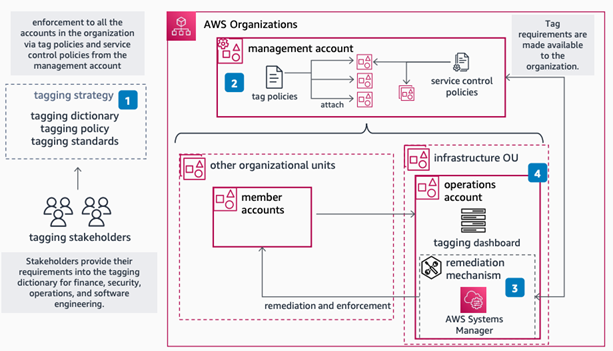
Figure 1: Workflow for tagging on AWS for a multi-account environment
Your tag governance strategy
A well-designed tagging strategy is fundamental to automated governance. Tags not only help organize resources but also enable automated security controls, cost allocation, and compliance monitoring.
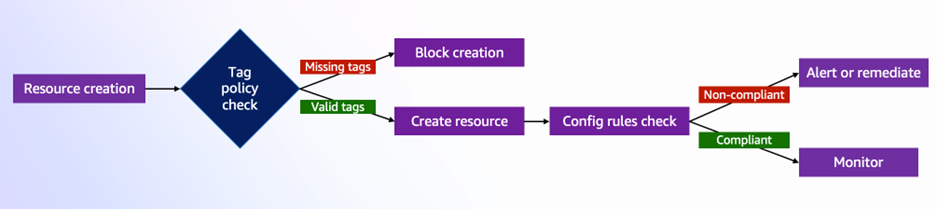
Figure 2: Tag governance workflow
As shown in Figure 2, tag policies use the following process:
- AWS validates tags when you create resources.
- Non-compliant resources trigger automatic remediation, while compliant resources deploy normally.
- Continuous monitoring catches variation from your policies.
The following tagging strategy enables automation:
While AWS Organizations tag policies provide a foundation for consistent tagging, comprehensive tag governance requires additional enforcement mechanisms, which we explore in detail in Part 2.
Conclusion
This first part of the two-part series established the foundational elements of implementing data governance on AWS, covering data classification frameworks, effective tagging strategies, and organizational alignment requirements. These fundamentals serve as building blocks for scalable and automated governance approaches. Part 2 focuses on technical implementation and architectural patterns, including monitoring foundations, preventive controls, and automated remediation. The discussion extends to tag-based security controls, compliance monitoring automation, and governance integration with disaster recovery strategies. Additional topics include data sovereignty controls and machine learning model governance with Amazon SageMaker, supported by AWS implementation examples.
If you have feedback about this post, submit comments in the Comments section below. If you have questions about this post, contact AWS Support.