AWS Storage Blog

Orchestrating multi-agent AI architectures with Amazon S3 Files
Organizations are moving beyond single-model AI toward multi-agent architectures. In these systems, agents offload intermediate results to files rather than carrying everything in the prompt, because a large prompt inflates cost and degrades quality. A model’s context window is finite, so files become working memory that persists after a session ends. In multi-agent systems, a […]

How WeatherBug reduced storage costs by 80% using Amazon S3 Storage Lens and Kiro CLI
WeatherBug is the third largest weather intelligence company in the US, delivering real-time forecasts, radar, lightning alerts, and interactive maps to over 10 million users. As their data footprint has grown across hundreds of Amazon Simple Storage Service (Amazon S3) buckets in a multi-account AWS environment, their storage costs rose steadily with no clear visibility […]

Securing backup data against modern threats with AWS Backup
Enterprises face an evolving spectrum of threats to their backup data. From ransomware attacks that encrypt production systems and target recovery points, to accidental deletions by well-meaning administrators, to full account compromises that put every resource at risk, organizations can no longer assume that traditional backup approaches will keep their data recoverable. When backup infrastructure […]

Hybrid ML inferencing on Amazon EKS with Amazon FSx for NetApp ONTAP and on-premises NetApp
Machine learning (ML) models used for inference on Kubernetes are often several gigabytes in size. When these models are embedded in container images, images become oversized and pod scheduling slows. More critically, inference pods are inherently stateful. Model weights, tokenizer files, compiled GPU kernels, and runtime caches must persist across pod restarts, node failures, and […]

Optimize your self-managed PostgreSQL data warehouse with Amazon FSx for OpenZFS
A data warehouse is the analytical backbone of a modern enterprise, consolidating data from disparate sources into a single, authoritative view that enables complex queries, trend analysis, and confident decision-making. In financial services, this means sharper regulatory reporting, faster fraud detection, and deeper customer understanding. The operational reality is demanding. Enterprises juggle multiple source databases […]
Access Amazon S3 backup data directly using S3 Access Points in AWS Backup
AWS Backup for Amazon S3 now lets you access your backup data through Amazon S3 Access Points. You create an access point for a recovery point, and AWS Backup provisions an S3 endpoint with an alias that works anywhere you would use a bucket name. You can then read backup data using standard S3 APIs, […]
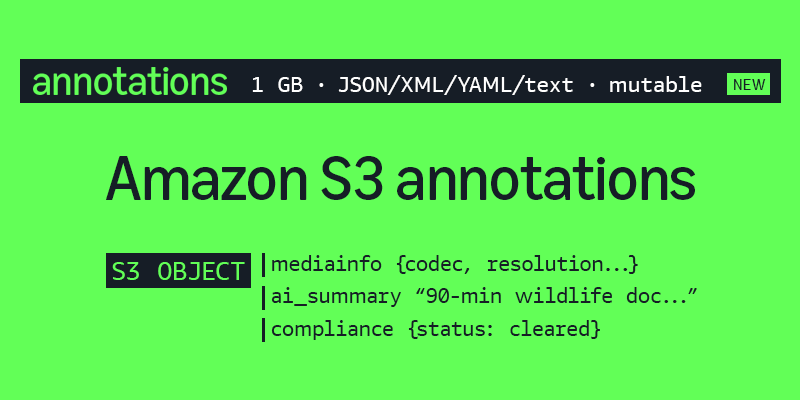
Track healthcare data lineage in real time with Amazon S3 annotations
Organizations that store sensitive data need to answer a simple question: where did this data come from, and what happened to it? In healthcare, this isn’t optional. Regulations like HIPAA, GDPR, and SOX require organizations to produce this information on demand. When an auditor asks, for example, “Show me every transformation that touched patient record […]
Analyze Amazon S3 annotations at scale with materialized views
Customers managing large volumes of objects in Amazon Simple Storage Service (Amazon S3) often need to attach rich business context like compliance classifications, processing lineage, AI-generated labels, and more. Until now, this context lived in external databases or sidecar files that were stored as separate objects, which created complexity to manage and keep it up […]

Accelerate Amazon S3 Replication with automated S3 Batch Operations parallelization
As data volumes grow, organizations must move large datasets between storage locations to meet compliance requirements, optimize performance, and help meet data sovereignty requirements. However, migrating petabytes of data presents significant challenges: lengthy transfer times, complex coordination of parallel operations, data integrity verification, and substantial engineering overhead. Automation reduces resource consumption and operational complexity during […]

Simplify compliance-driven Amazon S3 data movement with multi-criteria filtering
Organizations routinely need to move a subset of their stored data from one location to another, such as a compliance audit that requires all PDFs from a specific quarter, a company reorganization that splits one tenant’s records into an isolated bucket, or a regulatory mandate that demands financial documents older than 7 years be archived […]