AWS Storage Blog
Category: Amazon Bedrock

How Precisely transforms user experience with AI agents using Amazon S3 Vectors
At Precisely, the team is reimagining the user experience for its Data Integrity Suite by adding a conversational interface powered by AI agents to the traditional UI. With this enhancement, users can interact with the platform more naturally and intuitively (asking questions, making requests, and exploring data assets through dialogue) while still benefiting from the […]

Build AI-powered file classification with AWS Transfer Family
Organizations that receive files from external partners through SFTP face a persistent operational challenge: routing each file to the correct downstream system. Invoices, contracts, images, CSVs, and reports all arrive in a single landing zone, and each requires a different destination. The traditional approach—pattern-matching on file names with regular expressions—is inherently fragile. It relies on […]

Enable zero-copy access to AWS services on Amazon FSx for NetApp ONTAP with Amazon S3 Access Points
Semiconductor verification teams run thousands of simulation jobs every night using Electronic Design Automation (EDA) tools. A large verification environment can generate logs from 100,000 or more test executions per night. A single regression cycle produces simulation logs, compilation logs, and scheduler logs. For a regression with dozens of failures, manual triage typically takes 45–60 […]

Orchestrating multi-agent AI architectures with Amazon S3 Files
Organizations are moving beyond single-model AI toward multi-agent architectures. In these systems, agents offload intermediate results to files rather than carrying everything in the prompt, because a large prompt inflates cost and degrades quality. A model’s context window is finite, so files become working memory that persists after a session ends. In multi-agent systems, a […]
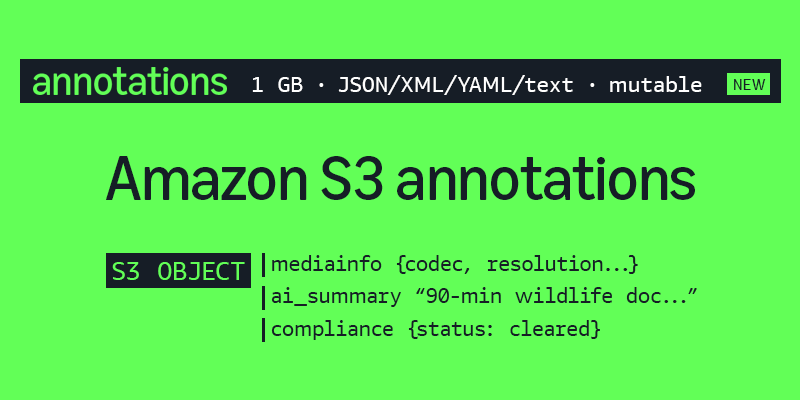
Analyze Amazon S3 annotations at scale with materialized views
Customers managing large volumes of objects in Amazon Simple Storage Service (Amazon S3) often need to attach rich business context like compliance classifications, processing lineage, AI-generated labels, and more. Until now, this context lived in external databases or sidecar files that were stored as separate objects, which created complexity to manage and keep it up […]
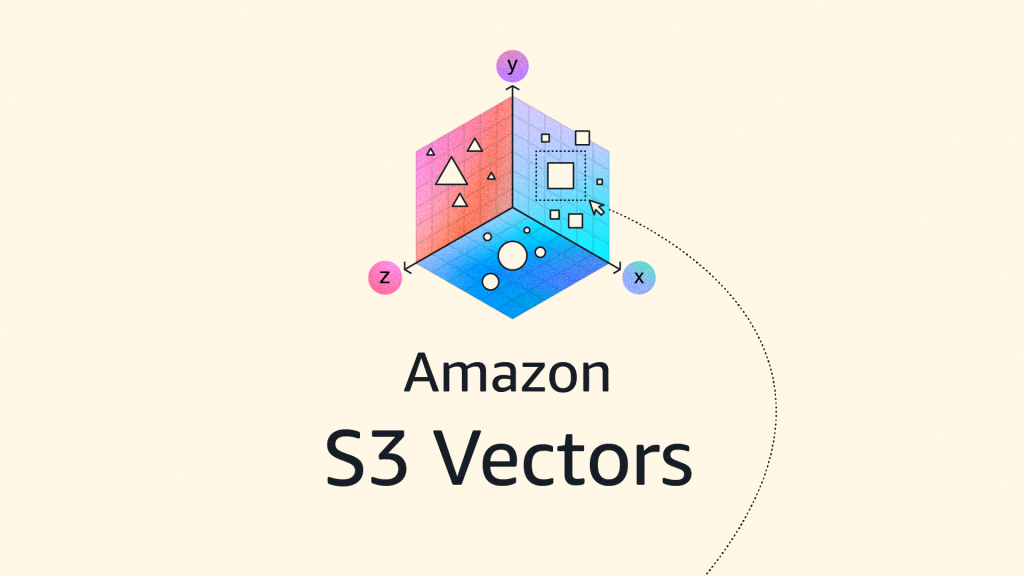
Building persistent memory for multi-agent AI systems with Amazon S3 Vectors
The most capable multi-agent AI systems share a common trait: they give agents the right context at the right time. When agents lack access to shared history, including what other agents discovered, what tasks are already complete, and what decisions were made in previous sessions, they might duplicate work, contradict each other, and burn through […]

Enabling natural language access to structured data using Amazon S3 Tables and Amazon Bedrock Knowledge Bases
Organizations generate massive volumes of structured data from customer transactions, operational metrics, product catalogs, and compliance records. This data contains insights that can help businesses make better and timely decisions. Financial advisors need to review client transaction histories, retail analysts track inventory trends, and healthcare administrators monitor patient outcomes. Yet accessing these insights creates a […]

Migrate to Amazon S3 account regional namespaces
Since its launch in 2006, Amazon S3 has used a global namespace where bucket names must be unique across all AWS accounts and AWS Regions. This design has served customers well at scale, but organizations managing multiple accounts and environments often encounter naming collisions. When a bucket is deleted, its name returns to the global […]
Optimize agent tool selection using Amazon S3 Vectors and Amazon Bedrock Knowledge Bases
State-of-the-art AI agents rely on external tools to perform actions on their behalf. A tool is a function with a clear description, defined inputs, and outputs that extend the capabilities of a large language model (LLM). As toolkits expand, selecting the right tool for each task requires effective mechanisms, among which semantic search enables agents […]

Optimizing recommendations and analytics using Amazon DynamoDB and Amazon S3
Today, consumers navigate thousands of products on e-commerce sites, hundreds of shows on streaming platforms, and countless options in digital marketplaces. This choice overload creates decision fatigue, yet consumers continue to demand more variety and make more purchases online. As a result, personalization has become essential—consumers reward brands that deliver relevant, tailored online experiences. However, […]