AWS Storage Blog
Category: Artificial Intelligence

Accelerate inference with KV cache tiering on AWS
When running large language model (LLM) inference at scale on AWS, the GPU might not be the only thing that limits you. The GPU generates tokens fast, but what then contributes to performance is everything around it: memory, storage, and the network path that connects them. That’s the difference between a demo and production. Training […]
How Precisely transforms user experience with AI agents using Amazon S3 Vectors
At Precisely, the team is reimagining the user experience for its Data Integrity Suite by adding a conversational interface powered by AI agents to the traditional UI. With this enhancement, users can interact with the platform more naturally and intuitively (asking questions, making requests, and exploring data assets through dialogue) while still benefiting from the […]

Build AI-powered file classification with AWS Transfer Family
Organizations that receive files from external partners through SFTP face a persistent operational challenge: routing each file to the correct downstream system. Invoices, contracts, images, CSVs, and reports all arrive in a single landing zone, and each requires a different destination. The traditional approach—pattern-matching on file names with regular expressions—is inherently fragile. It relies on […]

Enable zero-copy access to AWS services on Amazon FSx for NetApp ONTAP with Amazon S3 Access Points
Semiconductor verification teams run thousands of simulation jobs every night using Electronic Design Automation (EDA) tools. A large verification environment can generate logs from 100,000 or more test executions per night. A single regression cycle produces simulation logs, compilation logs, and scheduler logs. For a regression with dozens of failures, manual triage typically takes 45–60 […]
Migrate VMware Storage to Amazon FSx for NetApp ONTAP using AWS Transform
Enterprise storage underpins every critical workload in a VMware environment. It’s not just capacity, it’s the operational backbone that delivers automatic failover, instant snapshots, writable clones, inline deduplication, and multi-protocol access that production applications depend on every day. When the time comes to migrate these workloads to the cloud, teams expect those same capabilities on […]

Orchestrating multi-agent AI architectures with Amazon S3 Files
Organizations are moving beyond single-model AI toward multi-agent architectures. In these systems, agents offload intermediate results to files rather than carrying everything in the prompt, because a large prompt inflates cost and degrades quality. A model’s context window is finite, so files become working memory that persists after a session ends. In multi-agent systems, a […]

How WeatherBug reduced storage costs by 80% using Amazon S3 Storage Lens and Kiro CLI
WeatherBug is the third largest weather intelligence company in the US, delivering real-time forecasts, radar, lightning alerts, and interactive maps to over 10 million users. As their data footprint has grown across hundreds of Amazon Simple Storage Service (Amazon S3) buckets in a multi-account AWS environment, their storage costs rose steadily with no clear visibility […]
Hybrid ML inferencing on Amazon EKS with Amazon FSx for NetApp ONTAP and on-premises NetApp
Machine learning (ML) models used for inference on Kubernetes are often several gigabytes in size. When these models are embedded in container images, images become oversized and pod scheduling slows. More critically, inference pods are inherently stateful. Model weights, tokenizer files, compiled GPU kernels, and runtime caches must persist across pod restarts, node failures, and […]
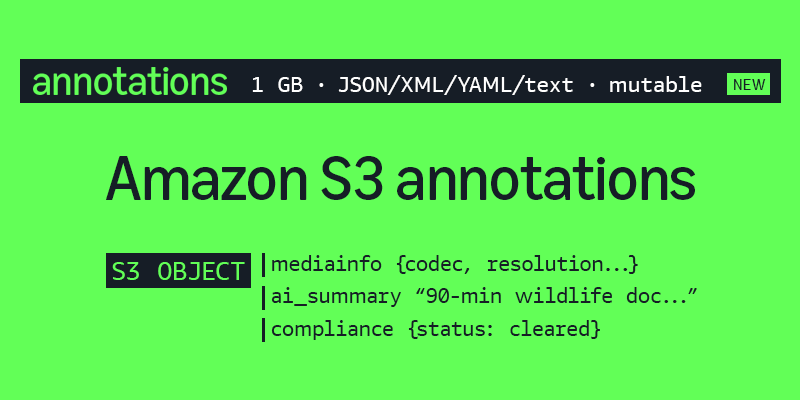
Analyze Amazon S3 annotations at scale with materialized views
Customers managing large volumes of objects in Amazon Simple Storage Service (Amazon S3) often need to attach rich business context like compliance classifications, processing lineage, AI-generated labels, and more. Until now, this context lived in external databases or sidecar files that were stored as separate objects, which created complexity to manage and keep it up […]
Building persistent memory for multi-agent AI systems with Amazon S3 Vectors
The most capable multi-agent AI systems share a common trait: they give agents the right context at the right time. When agents lack access to shared history, including what other agents discovered, what tasks are already complete, and what decisions were made in previous sessions, they might duplicate work, contradict each other, and burn through […]