What is a Distributed Architecture?
A distributed architecture is a computing system where its components exist on multiple computing resources, and often in different physical locations.
- What is a Distributed Architecture?
- What are the key components of a distributed architecture?
- What are the key benefits of a distributed architecture?
- What are some architectural patterns for distributed systems?
- What are some best practices for distributed computing?
- How can AWS help you build a cloud computing distributed architecture?
What is a Distributed Architecture?
A distributed architecture is a computing system where its components exist on multiple computing resources, and often in different physical locations. Distributed architectures can offer enhanced scalability, reliability, and cost-effectiveness, providing faster access to users. Cloud-based computing supports distributed architectures, although you can choose to co-locate components. Different architectural patterns and best practices help organizations to run, grow, and benefit from distributed architectures.
What are the key components of a distributed architecture?
A distributed architectural system comprises several independent components that work together, interconnected by a network. Here are the main components used in distributed systems and how they contribute.
Independent components that work together
The independent components in a system have different responsibilities depending on the specific purpose of the architecture. For example, there may be servers that process client requests, client machines that are part of the client-server architecture, databases, object storage, other services, or middleware that facilitates communication.
There is a range of different independent components, each of which has a specific task in the system. Because these are independent components, engineers can update, scale, or alter each component without impacting the entire system. Different components can run different operating systems through virtual machines or containers without conflicts. The components’ distributed nature also means that they can offer a higher degree of fault tolerance for functions such as storage and processing.
These components can run on physically distributed hardware or logically distributed computing, in the case of virtualization.
Inter-component communications
Communication systems facilitate the exchange of data between independent components, interconnecting them and allowing them to coordinate actions, despite being in different locations. One strategy that allows for communication is message passing, where components send messages to one another to notify about changes, request additional services, or exchange data.
Other central mechanisms for inter-component communication include Remote Procedure Calls (RPC), which allow a program to execute functions on other remote components, RESTful APIs, WebSockets, message queues, and TCP and UDP protocols for socket-based communication. A predefined distributed data structure helps in building your distributed system.
Traffic management strategies
Traffic management components refer to any infrastructural systems or strategies that optimize incoming user requests and balance workloads across the wider node system. For example, load balancers distribute incoming requests across different servers, ensuring no one node is overwhelmed by requests and that system performance remains stable.
Distributed systems rely on traffic management to help the multiple servers manage diverse workloads without performance issues. Content delivery networks (CDNs) and API gateways are two other strategies that help with traffic and data management.
Monitoring systems
Distributed computing systems can use monitoring hardware and software components to track the health and performance of the ecosystem. Monitoring and logging systems will examine a node’s communication patterns and relevant information about performance, which engineers can use to debug and troubleshoot if there is an issue.
These logging systems feed into analytics to identify potential bottlenecks or scalability issues. Some systems might employ load tests to locate areas for performance improvement. Monitoring helps with observation and alerting of the architectural aspects of the system, to ensure everything is running as expected, or alert on issues.
What are the key benefits of a distributed architecture?
Distributed systems are not inherently better than centralized systems. A distributed approach only begins to offer benefits over a central server system in specific circumstances. Here are some of the benefits organizations can experience in using distributed computing.
Scalability
A distributed system can scale horizontally by adding more components to access more computing, storage, and processing capacity. Each of these components brings more compute or storage resources to the system, allowing organizations to expand their total capacity without the need to do a full architectural redesign. Horizontal scaling is particularly effective for scaling your computing and processing capacity.
Horizontal scaling can scale as demand grows and is much easier to implement than vertical scaling, which would involve upgrading existing systems.
Faster user access
Another benefit of having a distributed system with components in many different places is that end users can experience lower latency and faster connectivity. Traffic management systems, such as CDNs, allow components to deliver content to end-device user interfaces from the closest possible node, reducing the total time it takes for content to load for a user.
Other strategies, such as load balancing, help to keep user access as quick and reliable as possible.
Reliability
In a distributed system, if one node fails, you can configure it so that the others use more of their resources to cover the difference. Due to this, distributed systems have a higher degree of fault tolerance, minimizing overall downtime and improving server availability. When designed for fault tolerance, there is no single point of failure in a distributed environment.
Components can also duplicate information from a primary node and disseminate it to all secondary components by peer-to-peer sharing, meaning that there are backups with important data or resources in case of unexpected outages. Data partitioning, or sharding, also helps distribute the same data across different components, helping to build more resilience into the system.
Cost optimization
Centralized systems involve maintaining an ever-increasing hub of hardware in one singular location. Managing a centralized set of servers can quickly become costly, while distributed systems may offer more accessible pay-as-you-go models or dynamic pricing to scale costs to actual usage.
Especially if opting for a cloud computing system, there are numerous ways of reducing costs while maximizing the benefits you receive from these isolated components.
What are some architectural patterns for distributed systems?
Distributed system patterns are approaches to architecture that better position a computing system or software application to be able to scale and handle higher workload demands. Here are some of the most common patterns in distributed systems.
Microservice architecture
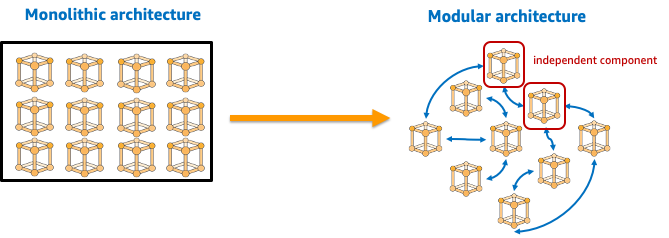
A monolithic structure runs its system through coupled processes, meaning a spike in demand for one area means that the entire system must scale to meet that demand. In microservice architecture, each part of the system is an independent component. These components communicate with one another using lightweight APIs.
When a specific part of the microservice architecture has a spike in demand, it can scale independently to meet that demand without impacting other components. This also means that organizations can develop, update, and scale specific functions independently of one another.
Event-driven architecture
An event-driven architecture uses single events (changes in state or updates) to trigger communication between isolated components. Two decoupled services can communicate with one another through these events. An event producer publishes an event, which is transferred to the event router, which pushes events to the consumer.
While this facilitates communication, the components of the event-driven system are isolated from one another. Like with microservices, this means that organizations can scale, update, and deploy components completely independently, providing agility and scalability to the system.
Serverless architecture
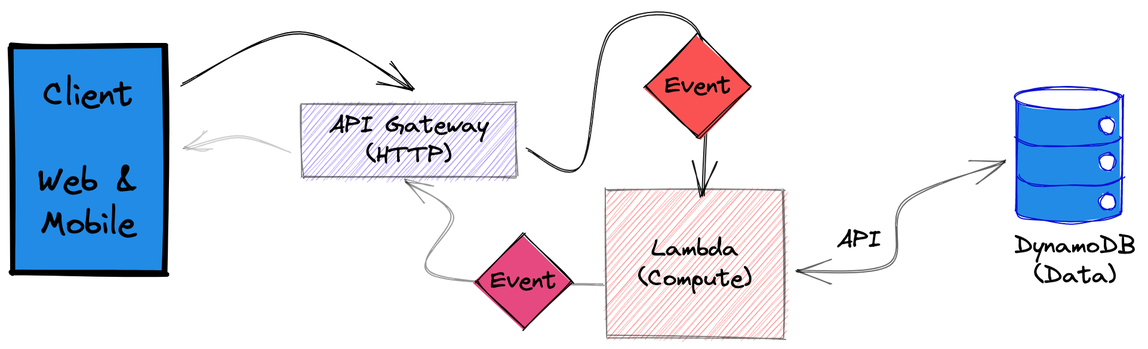
A serverless architecture is a method of creating and running applications without needing to manage the underlying infrastructure. In a serverless architecture, a third-party service provider handles server management, meaning you don’t have to scale, provision, or maintain your distributed databases or compute resources manually. A serverless architecture allows your organization to focus on business logic and development rather than system maintenance.
Serverless architecture is related to distributed systems because servers communicate through asynchronous communication protocols, integrating with distributed databases and other persistence layers to maintain consistency. This modular approach also allows organizations to align with service-oriented architecture (SOA), leading to flexible, scalable distributed systems that can evolve with your organization.
Service mesh
A service mesh is an infrastructure and software layer that streamlines communication between different microservices for data consistency. Especially in large-scale distributed computing systems, there can be thousands of individual microservices that need to communicate with one another. A service mesh handles all communication between these services, providing service-level observability and control to the system.
Because distributed systems consist of multiple services, a service mesh offers an effective way of defining policies centrally and deploying them across all networked computers in a cluster. A service mesh helps improve everything from traffic monitoring and load balancing to security and request mirroring in a wider distributed system.
What are some best practices for distributed computing?
Here are some best practices for building and managing effective distributed systems.
Use a zero-trust security architecture
Adopting a zero-trust security architecture that seeks to verify and authenticate every internal and external user and service request helps to reduce the possibility of unauthorized access. For distributed systems, this reduces the attack surface of your system, as with continuous validation of user accounts, applications, and data storage component requests.
Document dependencies
Distributed systems can quickly grow, increasing their attack surface and making it more difficult to effectively monitor this sprawling architecture. Organizations must document dependencies between individual services and data flows, creating a map of the active system.
A high degree of visibility into your distributed system will improve security management, as security specialists can identify areas needing improvement.
Conduct risk assessments on the architecture
Regularly conduct risk assessments to identify any potential weaknesses in your distributed systems. These assessments can help to identify any architectural weaknesses, such as unmonitored APIs or single-region dependencies that could create problems for your organization. You can also conduct stress tests and failure tests to observe how your distributed system responds.
If possible, take risk assessment beyond just architectural tests, to include compliance, privacy, and data residency considerations.
Use asynchronous communication where possible
When multiple disparate networks work together, I/O and network overheads can quickly increase. Turning to asynchronous communication across your distributed systems offers a mechanism to solve this heightened traffic, allowing services to communicate independently. An asynchronous approach improves responsiveness and removes the burden on your system. You can use message queues and publish-subscribe models to get started with this form of communication.
Build in redundancy for important services and availability
Building in redundancy to your systems helps to ensure availability across your distributed systems. Replicating information or systems from primary components and distributing them across secondary components in different regions provides continuity even in the event of regional node downtime.
Redundancy in your system provides high availability, helps ensure consistency across components, and contributes to a more flexible distributed systems architecture.
Use health checks for services
Monitoring your distributed system performance, variances in processing power capacity, and bottlenecks in data processing and resource sharing allows you to diagnose issues in your system. These checks help to identify any operational problems, allowing you to fix them or create solutions to minimize their impact.
Health checks on your services can also integrate into automatic healing processes, where certain reparative measures initiate if a node displays suboptimal performance. These strategies help to ensure your system always runs as it should.
How can AWS help you build a cloud computing distributed architecture?
Amazon Web Services’ range of cloud services is built for composable, distributed architectures. Our global Geographic Regions and Availability Zones allow you to build and scale your distributed infrastructure and applications. Some key services to help you build your distributed systems include:
- Amazon DynamoDB global tables is a multi-region, multi-active database for globally distributed database systems with up to 99.999% availability and offers high database resilience.
- Amazon Elastic Container Service is a fully managed container orchestration service that enables teams to build, manage, and run distributed, containerized workloads without the complexity of infrastructure management. Pair with Amazon Elastic Kubernetes Service to build, run, and scale distributed, production-ready applications anywhere.
- Amazon EventBridge allows you to easily build loosely coupled, event-driven architectures, with point-to-point integrations across distributed systems.
- AWS Step Functions is a visual workflow service that helps developers use AWS services to build distributed applications, automate processes, orchestrate microservices, and create data and machine learning (ML) pipelines.
- Amazon X-Ray is a monitoring service that allows you to compile data from your AWS resources to determine bottlenecks in your distributed systems and improve application performance.
Get started with creating distributed architectures on AWS by creating a free account today.
Browse all cloud computing concepts
Browse all cloud computing concepts content here:
Did you find what you were looking for today?
Let us know so we can improve the quality of the content on our pages